
Want to bet smarter on tennis? Discover expert tennis betting tips, odds insights, and proven strategies to boost your winning chances today.
Tennis Betting Tips: Expert Strategies for Bettors

Expert tennis betting tips center on analyzing surface performance, head-to-head records, recent form, and match-specific conditions before placing a wager. More disciplined bettors combine these factors with structured bankroll management rather than relying on rankings, favorites, or instinct alone.
Reading tennis odds means understanding how bookmakers express a player’s implied win probability through decimal, fractional, or moneyline formats. Betting markets such as match winner, set betting, handicaps, and total games then apply those prices to different possible match outcomes.
Common tennis betting strategies include value betting, in-play analysis, and disciplined staking approaches adapted to the sport’s scoring structure. These methods take tennis-specific variables into account, including surface conditions, service performance, momentum changes, fatigue, and match format.
Expert tennis predictions are generally more useful when they consider statistical evidence, player fitness, tournament conditions, and matchup characteristics rather than relying on rankings alone. Bettors can use these assessments as an additional reference point while still conducting their own analysis before wagering.
This guide from ClickZen explains practical tennis betting tips, how to interpret odds and markets, commonly used betting strategies, and the factors bettors can evaluate before making a decision.
What Are the Best Expert Tennis Betting Tips for Smarter Wagers?

Expert tennis betting tips are evidence-based guidelines that combine match research, price evaluation, and bankroll discipline to support more structured betting decisions. No individual factor guarantees a successful wager, so bettors generally gain more context by examining several variables together.
What Are the Different Types of Tennis Betting Tips Bettors Should Know?
Tennis betting tips can be divided into four practical categories: pre-match research, in-play analysis, bankroll management, and surface-specific analysis. Each category focuses on a different part of the betting process.
- Pre-match research covers recent form, head-to-head records, tournament draws, fitness updates, and matchup characteristics before a match begins.
- In-play analysis focuses on information that becomes visible during the match, such as serving performance, physical condition, tactical adjustments, and score progression.
- Bankroll management covers stake sizing, exposure limits, record keeping, and rules designed to prevent a single result from having an excessive impact on the bettor’s available funds.
- Surface-specific analysis considers how clay, grass, and hard courts can affect movement, ball speed, rally patterns, and the effectiveness of different playing styles.
These categories are complementary rather than interchangeable. Pre-match and surface analysis help bettors assess a matchup before the first point, while in-play analysis incorporates new information that becomes available after the match starts.
How Do You Apply Expert Tennis Betting Tips to Real Matches?
Applying tennis betting analysis to a real match usually involves checking recent form, reviewing the specific matchup, evaluating surface performance, and confirming player fitness before assessing the available odds.
- Check recent form to understand how each player has performed across recent matches and tournaments rather than relying only on season-long rankings.
- Review head-to-head records to identify previous matchup patterns while considering how old those matches are and whether they were played under comparable conditions.
- Assess surface performance by comparing each player’s results and playing style on clay, grass, or hard courts with the surface used in the upcoming event.
- Check fitness and availability through credible tournament information, official announcements, or reliable reporting, particularly when a player has recently withdrawn or shown signs of injury.
- Compare the resulting assessment with the bookmaker’s price before deciding whether the available odds justify a wager.
None of these variables should be treated as conclusive on its own. A favorable head-to-head record, for example, may be less relevant when the previous meetings took place years earlier or under significantly different surface and fitness conditions.
How Do You Read Tennis Odds and Betting Markets?

Reading tennis odds means understanding the probability implied by a bookmaker’s price and how that price applies to a particular betting market. Decimal, fractional, and moneyline odds express similar underlying information in different formats.
For decimal odds, the basic raw implied probability can be estimated by dividing 1 by the decimal price and multiplying the result by 100. For example, decimal odds of 2.00 correspond to a raw implied probability of 50%.
However, raw implied probabilities are not automatically the same as fair probabilities because bookmaker prices normally include a margin, often called the overround. When the implied probabilities for all possible outcomes are added together, the total can exceed 100%. Bettors comparing prices therefore need to distinguish between the bookmaker’s quoted probability and their own estimate of the underlying chance of an outcome occurring.
What Are the Main Types of Tennis Betting Markets?
Common tennis betting markets include match winner, set betting, total games, handicap betting, and outright tournament winner markets. Each market focuses on a different aspect of the result.
- Match winner markets ask bettors to select which player will win the match.
- Set betting markets can involve predicting a set-related outcome, including an exact match score such as 2-0 or 2-1 where that option is offered.
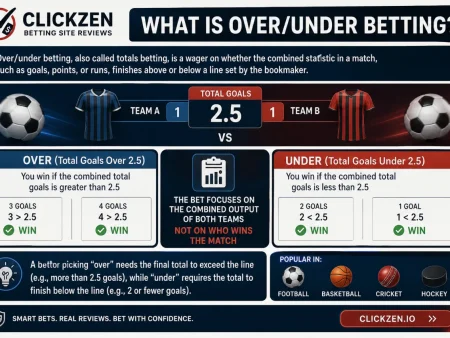
- Total games markets set a line for the combined number of games played, with bettors choosing whether the final total will finish over or under that number.
- Handicap betting applies a game or set advantage or disadvantage to one player before determining the betting result.
- Outright winner markets allow bettors to back a player to win an entire tournament rather than an individual match.
The information required for each market can differ. Match winner bets focus primarily on the final winner, while total games and handicap markets require additional consideration of the likely competitiveness and score distribution of the match.
Moneyline vs Handicap Betting: Which Tennis Market Suits Beginners?
Moneyline or match-winner betting is generally easier for beginners to understand because the wager is based primarily on which player wins the match. Handicap betting introduces an additional game or set adjustment that must also be covered.
- A match-winner bet is settled according to the winner under the sportsbook’s applicable tennis settlement rules.
- A handicap bet applies a predetermined advantage or disadvantage to the player’s game or set total.
- A strong favorite typically has shorter match-winner odds because the bookmaker assigns that player a higher implied probability of winning.
- Shorter odds normally produce a smaller potential return relative to the stake, but they should not be interpreted as a guarantee or as being free of risk.
- Handicap markets can offer a different price from the standard match-winner market because the bettor is wagering on a result after the handicap has been applied.
For new bettors, match-winner markets are often easier to evaluate because fewer settlement conditions need to be considered. Handicap betting becomes more relevant once a bettor is comfortable estimating winning margins and understanding game- and set-based lines.
What Are the Best Betting Strategies and Systems Specific to Tennis?

Common tennis betting approaches include value betting, market-specific analysis, in-play betting, surface-based research, and disciplined bankroll management. These approaches provide frameworks for analyzing wagers, but none can guarantee profitable results.
How Does Value Betting Work in Tennis?
Value betting involves comparing a bettor’s estimated probability of an outcome with the probability implied by the available odds. A potential value opportunity exists when the bettor believes an outcome has a higher chance of occurring than the price appears to represent.
A basic value-betting process can include the following steps:
- Convert the available odds into raw implied probabilities.
- Consider the bookmaker margin when comparing prices across the available outcomes.
- Develop an independent probability estimate using relevant information such as recent performance, surface results, matchup characteristics, fitness, and serving or returning statistics.
- Compare the independent estimate with the market price.
- Consider a wager only when the bettor believes the difference is meaningful enough to justify the uncertainty involved.
Value betting should not be confused with simply backing an underdog or opposing a favorite. A short-priced favorite can theoretically represent value, while a high-priced underdog can still be poorly priced if the bettor believes the player’s actual chance of winning is lower than the odds imply.
Probability estimates also contain uncertainty. Maintaining records across a substantial sample of bets can provide more useful information about an analytical approach than judging it from a small number of wins or losses.
Is In-Play (Live) Betting a Good Strategy for Tennis?
In-play betting can provide additional analytical opportunities because bettors can observe information that was unavailable before the match, but it also involves rapidly changing prices and shorter decision windows. It is therefore better viewed as a different betting environment rather than an inherently superior strategy.
During a live tennis match, bettors may monitor factors such as:
- First-serve percentage and the effectiveness of first and second serves.
- Return performance and the frequency with which a player is creating or saving break-point opportunities.
- Visible changes in movement, fitness, or physical discomfort.
- Tactical adjustments between sets or after service breaks.
- Changes in match conditions, including weather during outdoor matches.
- The relationship between new information from the court and the continuously updated live price.
A break of serve or a short run of consecutive games does not automatically create betting value. Live prices are continuously adjusted, and bettors still need to determine whether their assessment differs meaningfully from the current market price.
Because decisions may need to be made quickly, in-play betting can also increase the risk of impulsive wagers, chasing losses, or overreacting to short-term score changes. Setting limits before the match can help reduce those risks.
How Can You Evaluate Expert Tennis Predictions Before Betting?

Bettors can evaluate expert tennis predictions by examining the evidence behind the selection, checking the analyst’s transparency and track record, and comparing the reasoning with their own match research. A prediction is more informative when it explains why a particular price or market may be attractive rather than simply naming a player expected to win.
Useful questions include whether the analysis considers current form, court surface, matchup characteristics, fitness, scheduling, and the price available at the time the prediction was published.
What Factors Should Expert Predictions for Tennis Matches Consider?
A well-rounded tennis prediction can consider current form, surface suitability, head-to-head context, physical condition, scheduling, and relevant match conditions. The importance of each variable depends on the players and tournament involved.
- Current form provides context about recent performance but should be interpreted alongside the quality of opposition and tournament level.
- Surface suitability examines how a player’s movement, serve, return game, and rally tolerance translate to clay, grass, or hard courts.
- Head-to-head history can identify matchup patterns, although older meetings may become less useful when player form, coaching, or playing style has changed.
- Fatigue and scheduling can matter when a player has completed long matches, traveled between tournaments, or had limited recovery time.
- Fitness information can materially alter a matchup when a player has recently suffered an injury, retired from a previous match, or withdrawn from an event.
- Weather can influence outdoor matches through heat, humidity, wind, or other conditions, while indoor and closed-roof matches are less exposed to these variables.
Ranking remains useful as a broad indicator of competitive level, but it does not capture every variable relevant to one specific match. Predictions are therefore generally stronger when the reasoning extends beyond ranking alone.
What Are Some Advanced or Lesser-Known Tennis Betting Angles Experts Use?
More detailed tennis analysis can include tiebreak performance, doubles-specific variables, and sportsbook rules governing retirements and withdrawals. These areas can add context to a betting decision, although they should not be treated as standalone indicators of value.
How Do Tiebreak Statistics Influence Tennis Betting Decisions?
A player’s tiebreak record can provide additional context for matches expected to contain close sets, particularly when combined with serving and returning statistics. Historical tiebreak win rate alone, however, does not prove that a player has a repeatable betting edge.
Tiebreak results can be influenced by factors including serve quality, return performance, opponent strength, surface, sample size, and normal statistical variation. Bettors should therefore avoid treating a high historical tiebreak percentage as a guarantee that the same player will dominate future tiebreaks.
Tiebreak rules can also vary by competition and match format. In many standard sets, a tiebreak is played when the score reaches 6-6, while some competitions use different procedures for deciding sets or alternative scoring formats. Checking the tournament rules is particularly important when betting on exact set scores, total games, or related markets.
Are Doubles Betting Tips Different From Singles Betting Tips?
Yes. Doubles betting requires greater attention to partnership-specific variables because the performance of a team cannot always be inferred from the individual singles rankings of its two players.
- Partnership history can indicate how frequently the pair has competed together and whether its results have been consistent.
- Serving combinations matter because one particularly strong or vulnerable server can affect the team’s ability to hold throughout the match.
- Return quality is important because effective doubles teams often need to apply pressure quickly against opposing service games.
- Net positioning, communication, and coordinated movement play a larger tactical role than they do in many singles matches.
- Recent doubles-specific form can be more informative than relying entirely on each player’s singles results.
- Tournament scoring rules should be checked because some doubles competitions use no-ad scoring, a match tiebreak, or other alternative formats.
For this reason, bettors should avoid assuming that two highly ranked singles players automatically form the stronger doubles team. Established partnerships can possess tactical familiarity that is not visible from individual rankings alone.
How Do Retirement and Withdrawal Rules Affect Tennis Bets?
Retirements and withdrawals can affect tennis wagers differently depending on the sportsbook, market, and point at which the match ends. Bettors should check the operator’s tennis settlement rules rather than assuming every sportsbook handles an incomplete match in the same way.
Depending on the operator and market, a wager may be voided, settled based on a completed portion of the match, or handled under a specific retirement policy. Some bookmakers may also offer special retirement-related guarantees or promotions, but these should not be treated as a universal tennis betting market.
- Check whether a match must be completed for a match-winner wager to have action.
- Review how the sportsbook handles markets that have already been mathematically determined before a retirement.
- Confirm whether different rules apply to set betting, game handicaps, totals, or player-specific markets.
- Read the operator’s current tennis rules before wagering because settlement policies can differ between sportsbooks.
This is particularly important when comparing odds across operators. A slightly better price may not always represent a better overall betting proposition if the sportsbooks apply materially different settlement rules when a player retires.
Conclusion
Smarter tennis betting starts with structured analysis rather than dependence on a single statistic or prediction. Recent form, surface performance, matchup characteristics, fitness, and market price each provide part of the overall picture.
Understanding implied probability and bookmaker margin also helps bettors separate a prediction about who is most likely to win from the separate question of whether the available odds represent an attractive price. The favorite is not automatically a good bet, just as an underdog is not automatically good value.
More advanced analysis can incorporate live match information, tiebreak data, doubles-specific factors, and sportsbook settlement rules, but each should be interpreted in context. No betting strategy removes uncertainty or guarantees profit. A disciplined approach to research, price comparison, staking, and bankroll management remains central to responsible tennis betting.
Marcus Zeno is the CEO and Lead Betting Analyst at ClickZen. With over eight years of experience in the iGaming industry, he specializes in evaluating global sportsbooks, mobile betting apps, and bonus terms. Marcus is dedicated to cutting through promotional noise to provide bettors with transparent, fact-based insights.


Top Rated Casinos

FanDuel is a regulated North American betting and gaming brand offering Sportsbook, Casino, Fantasy, Racing and prediction markets, with product availability determined by state or provincial regulations.

DraftKings is a regulated North American sportsbook and gaming operator offering sports betting, live wagering, casino games, daily fantasy sports, Pick6 and horse racing in eligible jurisdictions.

Fanatics Sportsbook is a regulated U.S. betting platform available in 23 states plus Washington, D.C., offering major sports markets, live betting, same game parlays and a distinctive FanCash rewards ecosystem.


ClickZen is an independent betting information and review website providing clear, practical insights into sportsbooks, online casinos, betting apps, bonuses, and related services for a global audience.
This website is intended for users aged 18 and over. Gambling can be addictive, so please gamble responsibly. The content on this website is for informational purposes only.
About ClickZen