
New to over/under betting? Discover how totals markets work, how odds and payouts are set, and how they compare to other bet types.
Over/Under Betting Explained: Totals Guide for Beginners

Over/under betting is a market where bettors predict whether a specific statistic in a match will finish above or below a line set by the bookmaker. The statistic is usually the combined total from both teams or players, such as goals in football, points in basketball, or games in tennis.
Unlike moneyline betting, over/under bets do not require bettors to predict which side will win. Instead, the outcome depends entirely on whether the final total exceeds or falls below the selected line.
For example, if a football match has an over/under line of 2.5 goals and ends 2–1, the match produces three total goals. Over 2.5 wins, while Under 2.5 loses.
This ClickZen guide explains how over/under betting works, the different types of totals available, how bookmakers set lines and odds, how payouts are calculated, and the main risks bettors should understand.
What Is Over/Under Betting?
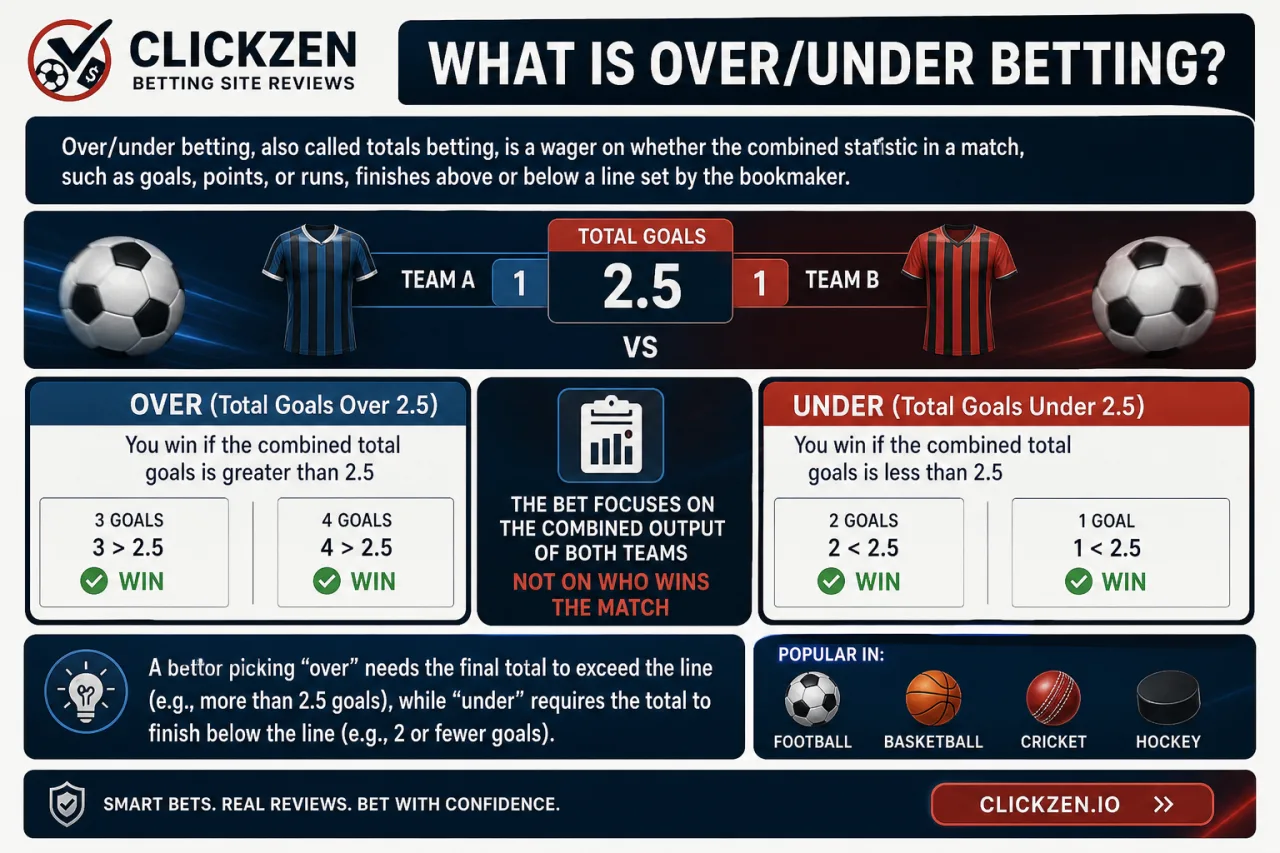
Over/under betting, also known as totals betting, is a wager on whether the combined value of a specified statistic finishes above or below a line set by the bookmaker.
The bet focuses on the combined output of both teams or players rather than the winner of the event. A bettor choosing “Over” needs the final total to exceed the posted line, while an “Under” selection wins when the total finishes below it.
For example, consider a football match with a total-goals line of 2.5:
- A 2–1 result produces 3 goals, so Over 2.5 wins
- A 1–1 result produces 2 goals, so Under 2.5 wins
- The team that wins the match does not affect how the total is settled
The terms “totals betting” and “over/under betting” generally describe the same type of market. The terminology may vary between sportsbooks, but the underlying principle remains the same.
Because the bet does not depend on the outright winner, bettors often use totals when their analysis focuses more on scoring patterns, game tempo, defensive performance, or match conditions.
How Does the Over/Under Market Work Across Different Sports?
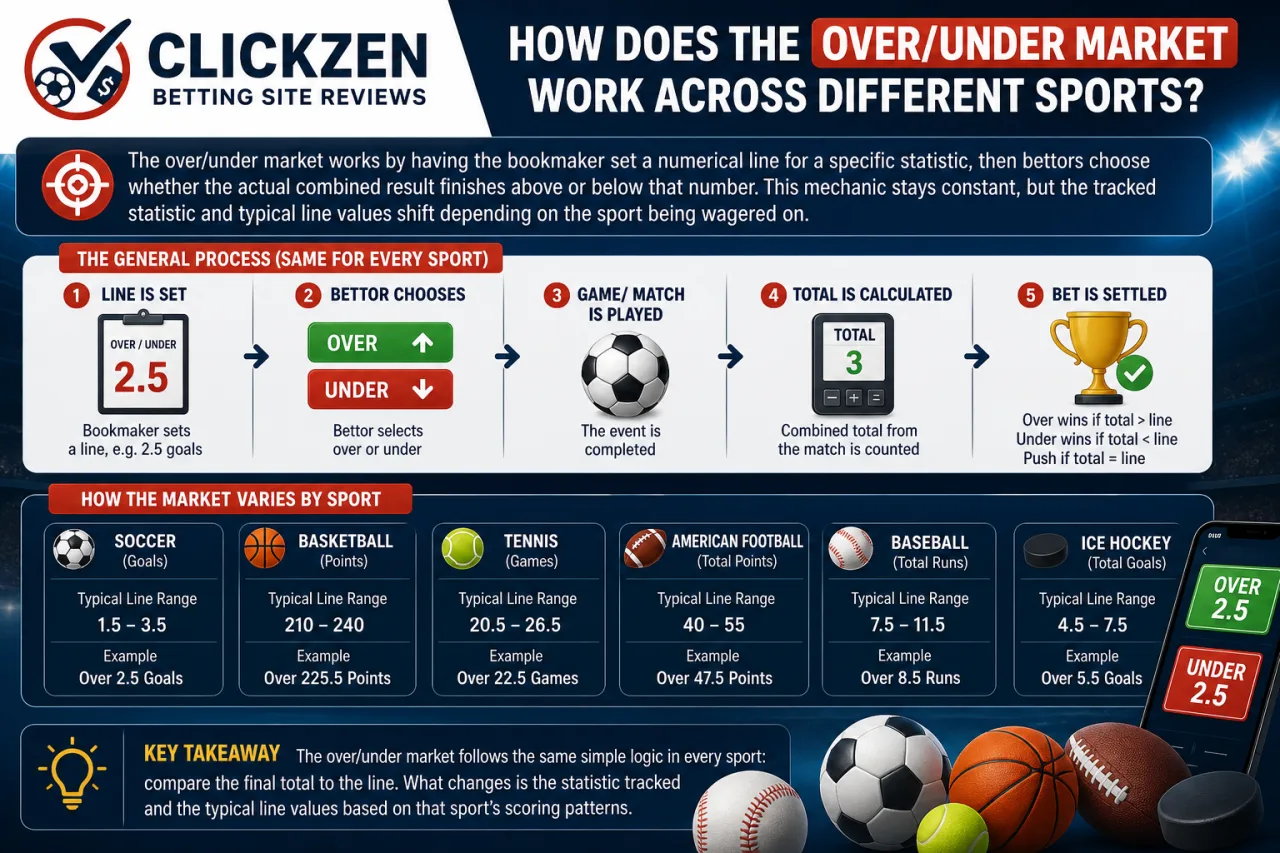
The over/under market works by assigning a numerical line to a particular statistic and allowing bettors to choose whether the final result will finish above or below that number.
The basic process is similar across sports:
- The bookmaker posts a total
- The bettor chooses Over or Under
- The relevant statistic is recorded during the event
- The bet is settled according to the final total
In football, the most common total is the number of goals scored by both teams. Basketball totals usually refer to combined points, while tennis totals can be based on the number of games or sets played.
For example:
- Football: Over/Under 2.5 goals
- Basketball: Over/Under 215.5 points
- Tennis: Over/Under 22.5 games
Some markets use whole-number totals rather than half-number totals. When the final result lands exactly on a whole-number line, the bet may be settled as a push, meaning the original stake is returned.
What Are the Common Types of Over/Under Lines?
Over/under markets commonly use half-number, whole-number, and quarter-number lines. The main difference is how each format handles a final total that lands on or close to the posted number.
Half lines such as 2.5 or 3.5 eliminate the possibility of a push. Because a match cannot finish with half a goal, point, or other whole-unit statistic, the bet must settle as either a win or a loss.
For example, with a football total of 2.5 goals:
- 3 or more goals = Over wins
- 0, 1, or 2 goals = Under wins
Whole-number lines such as 3.0 goals can produce a push. If exactly three goals are scored, neither side wins and the original stake is normally returned.
Quarter lines such as 2.25 and 2.75 divide the stake between two neighbouring totals. For example, a 2.25-goal bet is split between 2.0 and 2.5. This creates the possibility of partial wins, partial losses, or partial refunds depending on the final result.
What Statistics Can Over/Under Markets Be Based On?
Over/under markets can be based on many different match and player statistics, including goals, points, corners, cards, games, sets, and individual player performance.
Common totals include:
- Total goals: combined goals scored by both teams in football
- Total points: combined points scored by both teams in basketball
- Total corners: combined corner kicks in a football match
- Total cards: number of cards shown during a match
- Total games or sets: number of games or sets played in tennis
- Player totals: statistical output from an individual player, such as shots, rebounds, or aces
Every market follows the same basic principle: the bookmaker sets a line and the bettor predicts whether the final statistic will finish above or below it.
How Are Over/Under Lines and Odds Set?
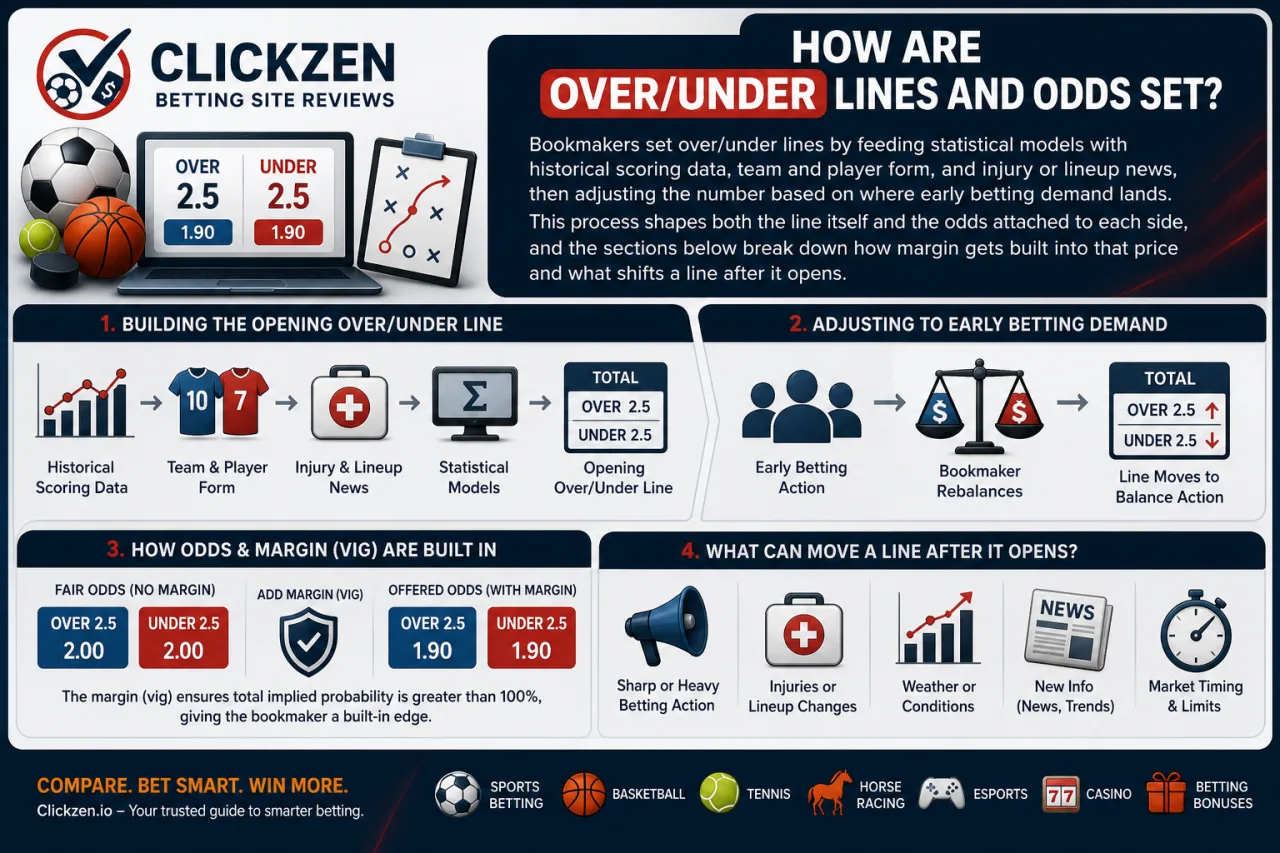
Bookmakers set over/under lines using statistical data, historical performance, team and player form, expected scoring conditions, and other information that may affect the event.
The bookmaker aims to create a line that reflects the expected total while attaching odds to both the Over and Under selections.
Relevant factors can include:
- Recent scoring performance
- Defensive records
- Team or player form
- Injuries and suspensions
- Expected lineups
- Match tempo
- Weather conditions
- Historical matchup data
- Betting activity
A bookmaker margin is normally incorporated into the prices offered on both sides of the market. This means the combined implied probability of the Over and Under can exceed 100%.
How Is the Over/Under Line Adjusted Before an Event?
An over/under line can move before an event when bookmakers react to new information or changes in betting activity.
Possible reasons include:
- An injury to an important attacking or defensive player
- A confirmed lineup that differs from expectations
- Weather conditions that could affect scoring
- New information about the event
- Significant betting activity on one side of the market
A bookmaker can adjust either the total itself or the odds attached to each selection.
For example, a football total might move from 2.5 goals to 3.0 goals if market expectations for scoring increase. Alternatively, the bookmaker may keep the 2.5 line while changing the odds available on Over and Under.
Line movement can show that the market has reacted to new information or betting activity, but it does not reveal with certainty who placed the bets or which outcome will occur.
How Is an Over/Under Bet Payout Calculated?
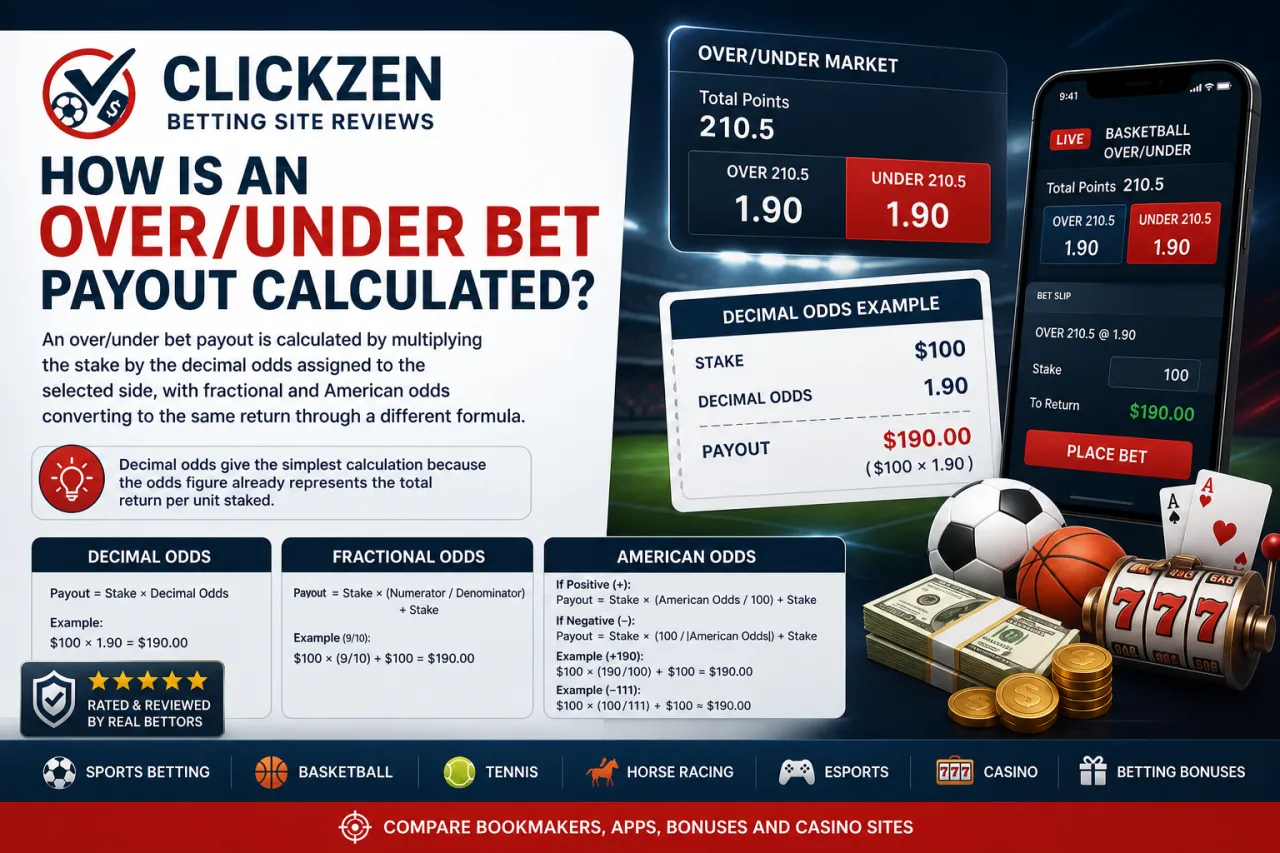
An over/under payout depends on the amount staked and the odds attached to the selected total.
With decimal odds, the calculation is:
Total Return = Stake × Decimal Odds
For example, if a bettor stakes $100 on Over 2.5 goals at decimal odds of 1.90:
$100 × 1.90 = $190 total return
The $190 consists of:
- $100 original stake
- $90 profit
Fractional odds express the potential profit relative to the stake. The profit is calculated first and the original stake is then added to determine the total return.
American odds use positive or negative numbers. Positive odds show how much profit can be made from a 100-unit stake, while negative odds show how much needs to be staked to make 100 units of profit.
Odds can also be converted into implied probability, which represents the probability associated with the price.
For decimal odds:
Implied Probability = 1 ÷ Decimal Odds × 100
Decimal odds of 2.00 therefore represent an implied probability of 50%.
Because bookmakers include a margin in their prices, the implied probabilities of the Over and Under sides usually add up to more than 100%.
How Does Over/Under Betting Compare to Handicap Betting?
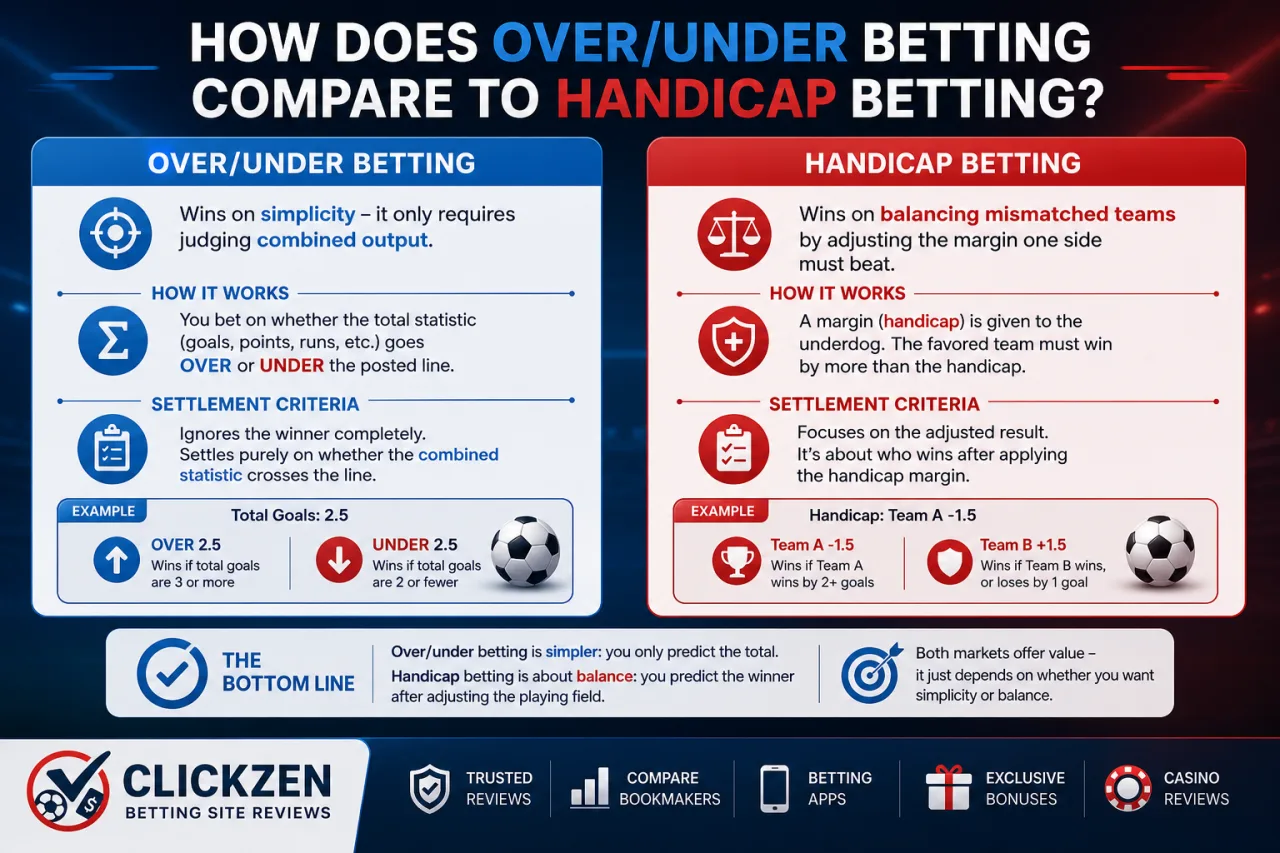
Over/under betting focuses on the combined total of a statistic, while handicap betting adjusts the result by giving one team or player a virtual advantage or disadvantage.
The two markets therefore settle according to different criteria.
With over/under betting, the winning team is irrelevant. The bet is settled only by comparing the final total with the bookmaker’s line.
With handicap betting, one side receives a positive or negative handicap before the adjusted result is evaluated.
For example:
- Over/Under 2.5 goals asks whether the match produces at least three goals
- Team A -1.5 asks whether Team A wins by at least two goals
Totals are generally more relevant when the analysis focuses on scoring conditions, tempo, or defensive performance.
Handicap markets instead focus on the expected difference in strength or winning margin between the two sides.
Both markets contain bookmaker pricing and remain subject to uncertainty.
How Does Over/Under Betting Compare to Moneyline Betting?
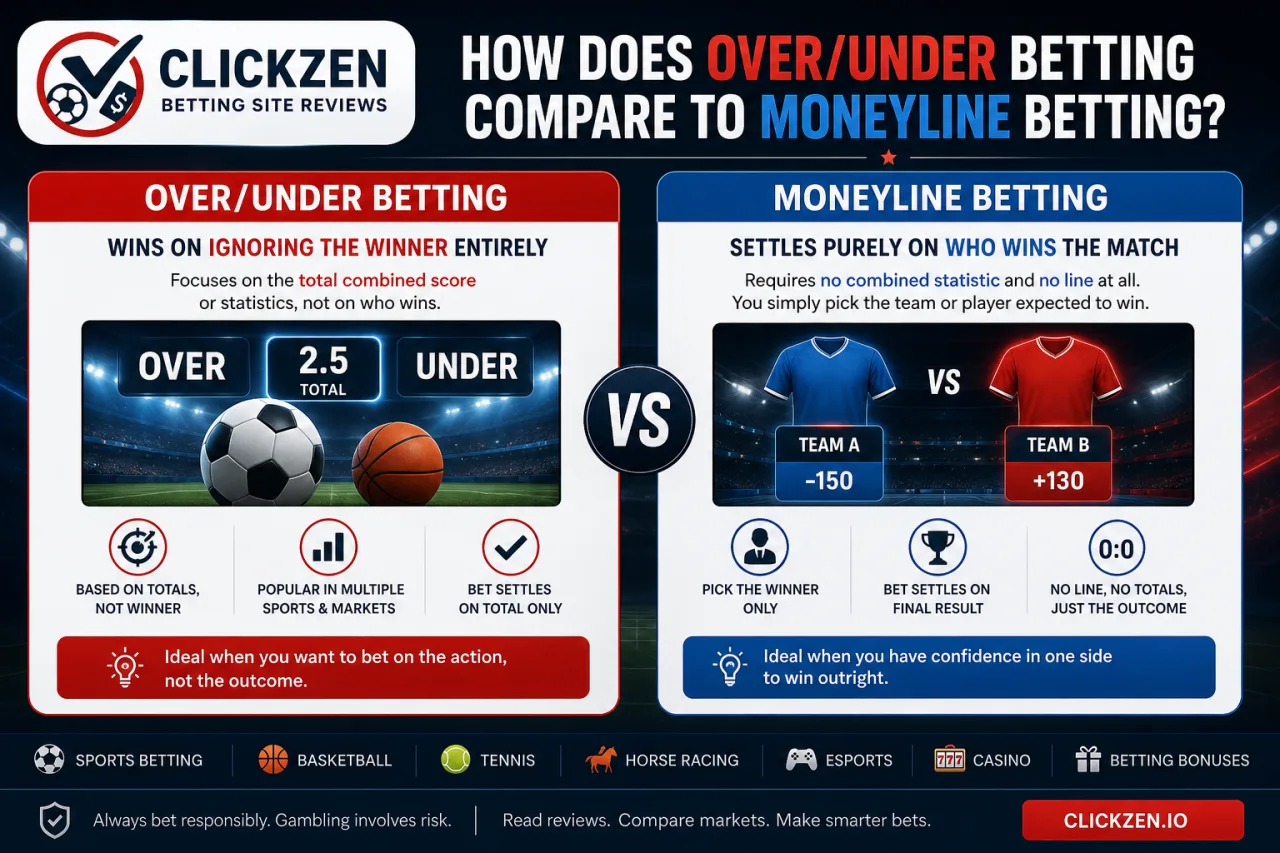
Over/under betting focuses on the total produced in an event, whereas moneyline betting requires bettors to predict the outright winner.
A moneyline wager does not use a totals line. The bettor simply selects the team or player expected to win.
For example, suppose a football match ends 3–1:
- A moneyline bet depends on which team scored the three goals
- Over 2.5 wins because four total goals were scored
- Under 2.5 loses regardless of which team won
The two markets can also appear together in parlays or accumulators. Each selection is still settled according to its individual rules.
Moneyline markets are based on the expected winner, while over/under markets are more closely connected with scoring levels and other statistical totals.
Both markets include a bookmaker margin, and combining multiple selections into one wager does not remove that margin.
What Are the Risks and Common Mistakes in Over/Under Betting?
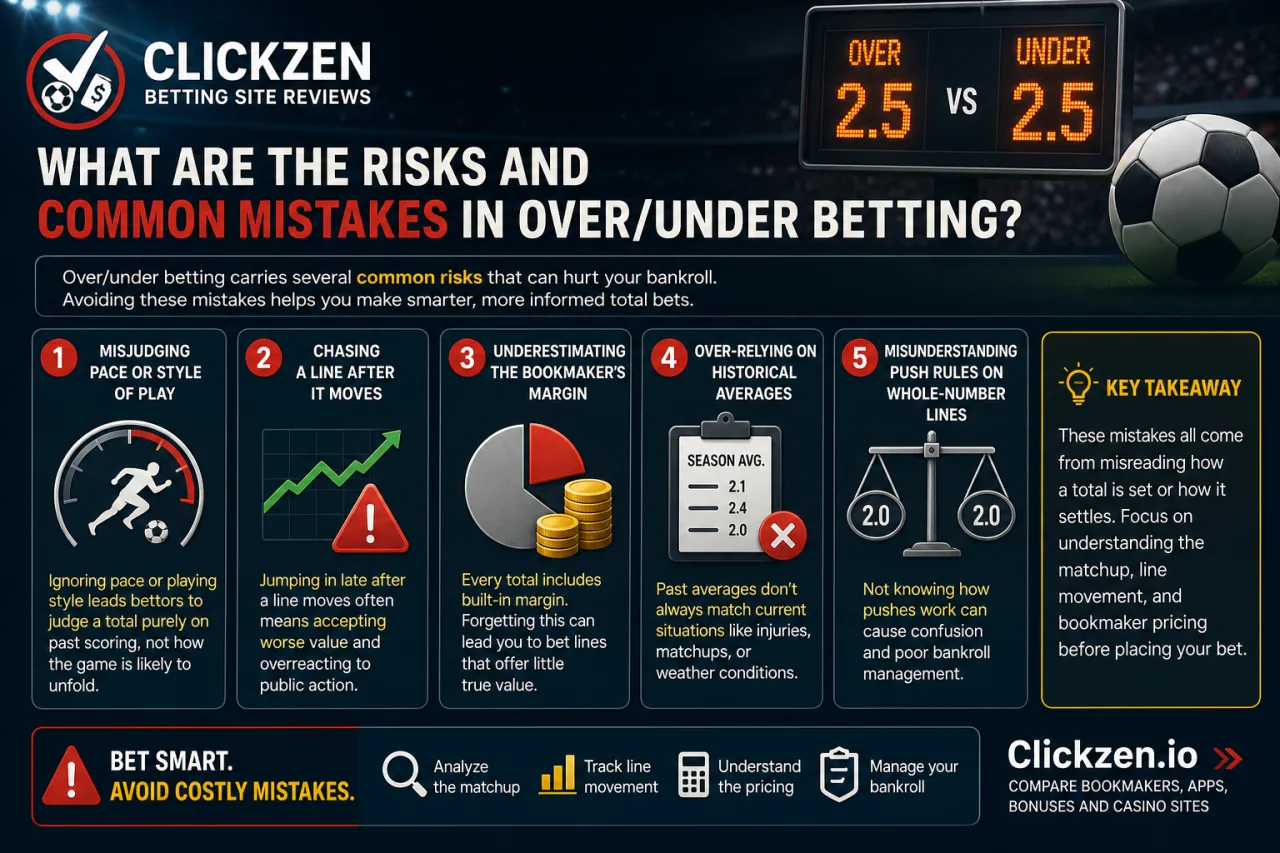
Common mistakes in over/under betting include relying too heavily on historical averages, ignoring current conditions, misunderstanding line movements, and failing to account for bookmaker margin.
One frequent mistake is evaluating a total using only past scoring averages. Historical results can provide context, but they do not automatically reflect the conditions surrounding a specific match.
Factors such as injuries, team selection, tactics, weather, and match importance can affect scoring patterns.
Another mistake is chasing a line after it has already moved. For example, a bettor who originally considered Over 2.5 but waits until the market moves to Over 3.0 is accepting a different settlement threshold.
Bookmaker margin is another important consideration. Over and Under should not automatically be treated as a perfectly fair 50/50 market simply because there are two possible selections.
Bettors should also understand how whole-number lines are settled. A bet on Over 3.0, for example, does not necessarily win when exactly three goals are scored. Depending on the market rules, the result can be a push and the stake returned.
No statistical model, betting system, or analysis method can eliminate the uncertainty associated with sporting events or guarantee profitable results.
What Are Some Less Common Variations of Over/Under Betting?
Sportsbooks can offer several variations of standard totals markets, including alternative totals, team totals, player totals, period totals, and live over/under markets.
The underlying principle remains the same, but the statistic, time period, or betting line changes.
A team total, for example, applies only to one team’s scoring output rather than the combined total from both sides.
Period totals restrict the market to a specific section of the event, such as the first half of a football match or a period in hockey.
Player totals focus on individual statistics rather than the overall match.
How Does Live (In-Play) Over/Under Betting Differ From Pre-Match Totals?
Live, or in-play, over/under betting uses totals and odds that are recalculated while the event is taking place.
Pre-match totals are offered before the event begins and can change as new information or betting activity affects the market.
Once an event is underway, live totals respond to what is happening in real time.
Factors influencing live totals can include:
- Current score
- Time remaining
- Match tempo
- Game flow
- Player or team performance
- Significant events during the match
For example, a football match might start with a pre-match total of 2.5 goals. If the first half remains 0–0, the available live total may move lower because less playing time remains for goals to be scored.
If several goals are scored early, the live line may instead move higher.
Live odds can change quickly as the event develops, and the bookmaker margin remains incorporated into the prices.
How Do Alternative Totals Lines Work?
Alternative totals allow bettors to choose additional lines above or below the sportsbook’s main total, with the odds adjusted according to the selected threshold.
Suppose the main football total is 2.5 goals. A sportsbook might also offer:
- Over/Under 1.5
- Over/Under 2.0
- Over/Under 3.0
- Over/Under 3.5
Changing the line changes both the settlement threshold and the price.
Generally:
- A line that is easier for a selection to cover comes with shorter odds
- A line that is harder to cover comes with longer odds
For example, Over 1.5 goals is easier to satisfy than Over 3.5 goals, so the two selections would normally be priced differently.
Alternative totals provide more line choices, but they do not remove the bookmaker’s built-in margin or the uncertainty of the event.
Conclusion
Over/under betting is based on a straightforward question: will the selected statistic finish above or below the bookmaker’s line?
The same principle applies across sports, whether the market tracks football goals, basketball points, tennis games, corners, cards, or individual player statistics.
Understanding the difference between half, whole, and quarter lines is important because each can settle differently. Bettors should also understand how odds affect payouts, why totals can move before and during an event, and how over/under markets differ from moneyline and handicap betting.
Historical statistics, team news, match conditions, and line movements can provide useful context, but none can guarantee the final outcome. Bookmaker margin and sporting uncertainty remain part of every over/under market.
Zorvan Hale is a Betting & Casino Analyst at ClickZen with over eight years of experience. He provides objective reviews of global betting platforms, focusing on withdrawal terms, KYC processes, and real user experience to help you make informed and safer betting decisions.


Top Rated Casinos

FanDuel is a regulated North American betting and gaming brand offering Sportsbook, Casino, Fantasy, Racing and prediction markets, with product availability determined by state or provincial regulations.

DraftKings is a regulated North American sportsbook and gaming operator offering sports betting, live wagering, casino games, daily fantasy sports, Pick6 and horse racing in eligible jurisdictions.

Fanatics Sportsbook is a regulated U.S. betting platform available in 23 states plus Washington, D.C., offering major sports markets, live betting, same game parlays and a distinctive FanCash rewards ecosystem.


ClickZen is an independent betting information and review website providing clear, practical insights into sportsbooks, online casinos, betting apps, bonuses, and related services for a global audience.
This website is intended for users aged 18 and over. Gambling can be addictive, so please gamble responsibly. The content on this website is for informational purposes only.
About ClickZen