
Discover practical horse racing betting tips to read odds, pick winners, and bet smarter—perfect for beginners and seasoned punters alike.
Horse Racing Betting Tips for Beginners: Expert Strategies

Improving horse racing betting decisions depends on combining form analysis, disciplined bankroll management, and value-based odds assessment rather than relying on luck. Expert strategies focus on identifying discrepancies between a horse’s estimated chances and the odds offered, allowing bettors to make more informed decisions over time.
Horse racing bets fall into several categories, including win, place, show, and exotic bets such as exactas, trifectas, and superfectas, although terminology and settlement rules can vary by country, racetrack, and betting operator. Understanding how each available bet type works determines both the potential payout and the level of risk involved.
Reading horse racing odds means interpreting the relationship between stake and potential payout, while form guides reveal a horse’s recent race history, jockey performance, and track conditions. Combining both sources of information helps narrow down realistic contenders before placing a wager.
Beginners benefit most from starting with simple win or place bets, setting a fixed budget, and avoiding complex exotic wagers until basic odds-reading skills are developed. ClickZen provides comparisons of betting platforms to help newcomers understand available options before choosing where to place a bet. Readers should always check the gambling laws in their country and gamble responsibly, as this content is intended only for individuals who meet the legal gambling age in their jurisdiction.
The following sections break down these strategies in detail, starting with the core techniques that experienced bettors use to make more structured horse racing betting decisions.
What Are the Best Expert Strategies to Improve Your Horse Racing Betting Success?

Four core pillars can support a structured horse racing betting strategy: bankroll management, value betting, specialization, and betting discipline. Building decisions around these elements shifts betting away from guesswork and toward a repeatable, informed process. Bankroll management controls how much of a betting fund is staked per race, protecting against significant losses during losing streaks. Value betting focuses on comparing the odds offered against a bettor’s independently estimated probability of a horse winning, rather than simply backing favorites. Specialization narrows focus to specific tracks, race types, or distances where a bettor can study patterns more thoroughly. Betting discipline ties these elements together by enforcing consistent rules and limiting impulsive wagers driven by emotion. The following sections outline each of these strategies in more detail.
How Should Beginners Manage Their Betting Bankroll?
Beginners manage their betting bankroll by setting a fixed budget separate from daily finances, then staking a small, consistent unit size per race rather than varying wager amounts based on confidence or emotion. This approach to bankroll management reduces the risk of the betting fund being depleted quickly during a losing streak.
A staking plan defines exactly how much of the total bankroll goes into each bet, often expressed as a percentage rather than a flat cash figure. Unit betting builds on this by assigning one “unit” (a small, fixed portion of the bankroll) to standard bets, with any variation in stake size following a predetermined staking strategy rather than an emotional reaction to previous results.
Beginners avoid chasing losses by refusing to raise stakes after a losing race in an attempt to recover money quickly, since this pattern can erode the bankroll rapidly. Practical steps include:
- Setting a total bankroll amount used exclusively for horse racing betting.
- Defining a unit size, commonly a small percentage of the total bankroll per bet.
- Recording every wager to track performance across a full session or race meeting, not just individual races.
- Stopping betting for the day once a predetermined loss limit is reached.
Following a staking plan keeps individual losses manageable while preserving funds for future races where better value opportunities may appear.
What Is Value Betting and Why Does It Matter?
Value betting means placing a wager when the odds offered by a bookmaker or betting market imply a lower probability of winning than the bettor’s independently estimated probability of the horse winning the race. This concept matters because it shifts the focus away from simply picking winners toward assessing whether the available price adequately reflects the perceived chance of success.
Spotting value requires converting odds into an implied probability, then comparing that figure against an independent estimate of the horse’s winning chance built from form study, pace analysis, track conditions, and other relevant factors. A horse priced at odds implying a lower chance than the bettor’s own estimated probability may represent a value bet, even if that horse is not favored to win.
Value betting matters for three main reasons:
- Reduces reliance on guesswork by grounding decisions in estimated probability rather than popularity or gut feeling.
- Helps bettors avoid wagers where the potential payout appears insufficient relative to the estimated risk.
- Builds a repeatable analytical process that connects directly to bankroll management and staking discipline.
Identifying value does not guarantee profit on an individual race or over any fixed period, but consistently assessing price against estimated probability is central to a value-based betting approach.
Is It Better to Specialize in Certain Races or Bet Broadly?
Specializing in specific tracks, distances, or race types can support more consistent analysis than betting broadly across every card, since focused study may reveal patterns that broad coverage misses. This specialization strategy connects directly to the value betting approach already discussed, since spotting potentially mispriced odds depends on understanding a race type well enough to estimate a horse’s chances.
Specialization carries clear advantages. Concentrating on one track familiarizes a bettor with its specific characteristics, such as whether certain running styles or post positions have performed differently under particular conditions. Focusing on a distance category or race type (sprints, route races, or handicaps) can also build deeper pattern recognition than spreading attention thin.
Betting broadly carries its own tradeoffs. Wider coverage increases the number of races available for analysis, but it also reduces the depth of research applied to any single race. Broad betting may suit bettors who prioritize a larger number of opportunities, though it typically requires more research to build reliable judgment across varied conditions.
For beginners still developing form-reading skills, narrowing focus to a small set of tracks or race types can reinforce the bankroll management and staking discipline covered earlier by limiting decisions to races that are better understood.
What Are the Different Types of Horse Racing Bets and How Do You Place Them?
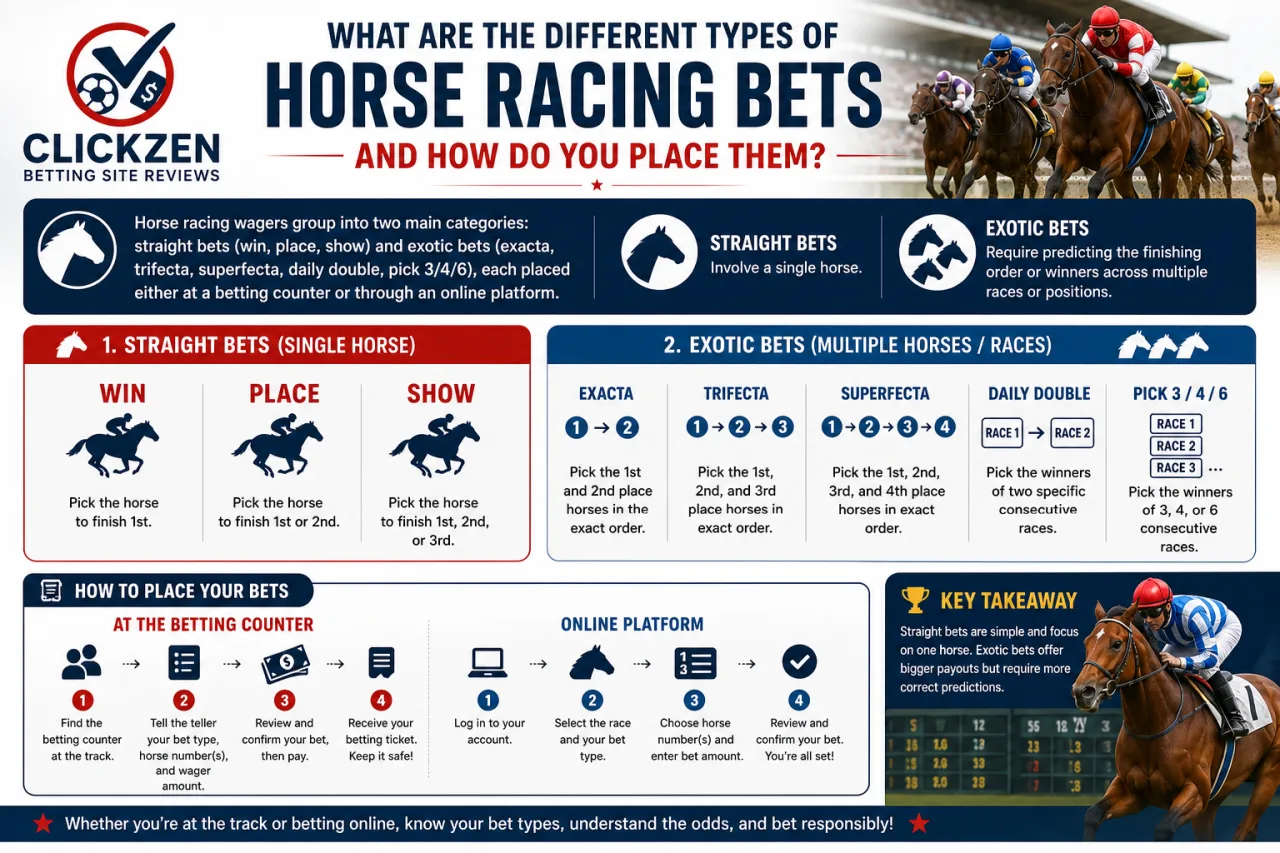
Horse racing wagers commonly include straight bets such as win, place, and show, as well as exotic or combination bets such as exactas, trifectas, superfectas, daily doubles, and Pick 3/4/6 wagers. However, available bet types, terminology, and settlement rules vary by jurisdiction, racetrack, and betting operator. Win, Place, Show, Exacta, Trifecta, and Superfecta terminology is particularly common in North American pari-mutuel racing. Straight bets typically involve a single horse, while exotic bets require predicting multiple finishing positions or winners across multiple races.
What Is the Difference Between Win, Place, and Show Bets?
For the same horse, Win bets generally offer greater payout potential because the horse must finish first, while Place and Show bets cover a wider range of finishing positions and therefore typically provide a greater chance of producing a return but often at a lower payout. Exact definitions and settlement rules can vary between betting markets.
In a typical North American pari-mutuel system, a Win bet only pays if the selected horse finishes first. A Place bet pays when the selected horse finishes first or second, while a Show bet pays when the horse finishes first, second, or third.
Unlike fixed payout assumptions, pari-mutuel returns depend on how money is distributed within the relevant wagering pool, along with applicable deductions. Final payouts therefore cannot be determined solely from whether a wager is Win, Place, or Show.
The basic tradeoff across the three bet types is:
- Win bets require the horse to finish first and generally provide greater payout potential for the same selection.
- Place bets cover a wider range of successful outcomes by including first- and second-place finishes under commonly used North American rules.
- Show bets cover first-, second-, and third-place finishes under commonly used North American rules, generally providing the broadest margin for a successful result of the three.
Choosing among these options depends on a bettor’s assessment of the horse, available odds, and preferred balance between potential return and probability of collecting a payout.
What Are Exotic Bets Like Exacta, Trifecta, and Superfecta?
Exotic bets are wagers that require predicting multiple horses or multiple race outcomes at once, grouping bets like exacta, trifecta, and superfecta under a higher-complexity category with potentially larger payouts. These wagers move beyond the single-horse focus of win, place, and show bets, shifting the challenge toward predicting exact combinations rather than one outcome.
An exacta typically requires picking the first- and second-place finishers in exact order, while a trifecta extends this to the first three finishers in exact order, and a superfecta requires predicting the first four finishers in exact order. Each added position increases the number of possible combinations, making the wager more difficult to hit.
This structure creates a clear risk/reward tradeoff:
- Exactas require correctly predicting the first two finishing positions and can offer larger payouts than many straight bets.
- Trifectas increase the difficulty by adding a third required finishing position.
- Superfectas require four finishing positions in exact order and can produce substantial payouts when difficult combinations occur.
Placing an exotic bet at a betting counter or online platform generally involves selecting the race, choosing the bet type, and specifying horse numbers in the required finishing order. Some operators also allow a bettor to “box” combinations, covering multiple possible finishing orders at a higher total stake.
How Do You Place a Horse Racing Bet Step by Step?
Placing a horse racing bet generally follows four practical steps: choosing the race and horse, selecting an available bet type, entering the required wager details, and confirming the wager before submitting payment. Exact procedures vary by racetrack and betting platform.
At a physical betting window or kiosk, the sequence may include:
- Selecting the race number and track name from the program or screen.
- Choosing the bet type offered by the track or operator.
- Entering or stating the horse number or required combination.
- Stating or entering the wager amount.
- Reviewing the printed or displayed ticket for accuracy before finalizing the transaction.
Online platforms follow similar logic through a digital interface: selecting the race, choosing the bet type, selecting the horse or horses, confirming the stake, and submitting the wager electronically. Double-checking the bet slip or confirmation screen helps prevent errors in selection, bet type, or stake amount before wagering closes.
How Do You Read Horse Racing Odds and Form Guides to Pick a Winning Horse?
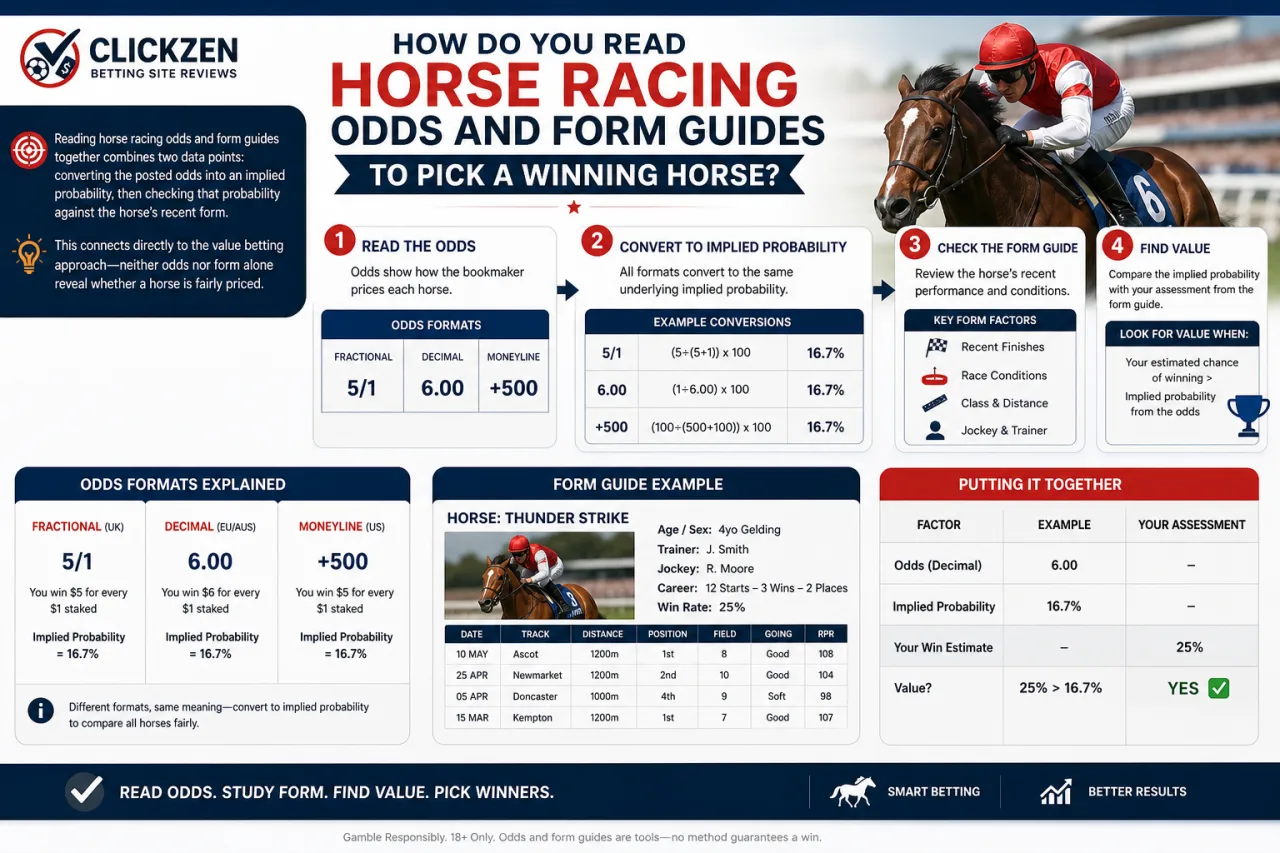
Reading horse racing odds and form guides together combines two important pieces of information: converting the available odds into an implied probability, then comparing that figure against an independent assessment of the horse’s chances based on recent form and race conditions. This process connects directly to the value betting approach already outlined, since neither odds nor form alone determines whether a horse offers an attractive price. Odds may appear in fractional, decimal, or other formats depending on the betting market, while form guides provide information such as recent finishes, jockey and trainer statistics, and track or distance suitability.
What Do Horse Racing Odds Numbers Actually Mean?
Horse racing odds express the relationship between a stake and its potential return, with common formats including fractional odds such as 5/1 and decimal odds such as 6.0. Other formats may also be used depending on the country or betting platform.
Fractional odds show profit relative to stake, so 5/1 represents five units of potential profit for every one unit staked, plus the original stake if the wager wins. Decimal odds display the total return per unit staked, including the stake itself, making 6.0 equivalent to 5/1 before considering any market-specific rules or deductions.
Decimal odds can be converted into a basic implied probability by dividing 1 by the decimal odds and multiplying by 100. For example, decimal odds of 6.0 correspond to an implied probability of approximately 16.7%. This figure represents the probability implied by the price, not a guaranteed or objectively true probability of the horse winning.
In pari-mutuel markets, displayed odds may continue changing as additional wagers enter the pool before betting closes, meaning the final price can differ from the odds visible earlier.
What Key Information Should You Look for in a Form Guide?
A form guide commonly includes several important elements, such as past performance, jockey and trainer statistics, track conditions, weight carried, and recent form lines. These factors can contribute to an independent assessment of how well a horse may be suited to the current race.
Past performance lists results from previous races, helping bettors evaluate consistency, distance suitability, and competitiveness. Jockey and trainer statistics provide additional context about the people responsible for riding and preparing the horse.
Track conditions describe surface type and condition, since individual horses may perform differently depending on whether the surface is firm, soft, wet, synthetic, or otherwise affected by weather. Weight carried can also influence performance, particularly in handicap races. Recent form lines summarize previous starts and provide a quick reference for identifying changes in performance.
These factors should be considered together rather than treated as guarantees of future performance.
How Do You Combine Odds and Form Data to Make a Betting Decision?
Combining odds and form data involves three main steps: converting the available odds into implied probability, independently estimating the horse’s winning probability using relevant racing information, and then comparing those two percentages. This keeps both sides of the comparison in the same unit and creates a clearer framework for identifying potential value.
The practical method runs as follows:
- Convert the available decimal, fractional, or other applicable odds into an implied probability.
- Assess past performance, pace, jockey and trainer statistics, track conditions, weight, distance suitability, and other relevant factors.
- Use that analysis to estimate the horse’s probability of winning rather than assigning a form score that cannot be directly compared with a percentage.
- Compare the estimated probability with the probability implied by the available odds.
- Consider a wager only when the estimated probability is meaningfully higher than the implied probability and the bet fits the predetermined bankroll strategy.
- Skip the race when the available price does not appear to provide a sufficient edge.
For example, decimal odds of 5.00 imply a basic winning probability of 20%. If a bettor’s independent analysis estimates the horse’s chance of winning at 25%, the available price may represent value according to that assessment. If the estimated chance is around 20% or lower, the wager may offer little or no perceived value.
These estimates remain uncertain, so identifying a perceived value edge does not guarantee that a wager will win.
What Tips Should Complete Beginners Follow When Starting Horse Racing Betting?

Complete beginners can follow four starter principles when approaching horse racing betting: starting small, choosing simple bets first, learning core terminology, and avoiding common mistakes that can drain a bankroll early. These tips connect directly to the bankroll management, bet types, and odds-reading skills already outlined, translating that broader strategy into a practical starting checklist.
What Common Mistakes Do Beginner Horse Racing Bettors Make?
Beginner horse racing bettors commonly make mistakes such as backing favorites blindly, ignoring track conditions, over-betting on exotics, and chasing losses after a bad race. These errors connect directly to the bankroll management, value betting, and odds-reading skills already outlined, since each mistake bypasses part of a disciplined analytical process.
Backing favorites blindly skips the value betting check entirely, treating shorter odds as a guarantee rather than comparing the implied probability against an independent assessment. Ignoring track conditions overlooks a potentially important form factor. Over-betting on exotics can expose too much of the bankroll to wagers that require several outcomes to occur correctly.
Chasing losses breaks staking discipline by increasing bet size after losing wagers in an attempt to recover money quickly. Additional frequent errors include:
- Skipping the form guide entirely and betting on name recognition alone.
- Betting every race on a card instead of focusing on races that have been adequately researched.
- Ignoring relevant jockey and trainer statistics when evaluating a race.
Avoiding these patterns helps keep early betting decisions aligned with a value-based, bankroll-conscious approach.
Which Bet Types Are Easiest for Beginners to Start With?
Straight bets, particularly Win or Place wagers where those options are available, are generally easier for beginners to understand before progressing to more complex exotic bets. This grouping ties directly into the bet type comparison already outlined, since Win and Place bets require following the outcome of a single horse rather than predicting an exact multi-horse finishing combination.
Win bets keep the selection straightforward: choose one horse to finish first. In markets using the typical North American definition, Place bets provide a wider successful outcome because the selected horse can finish first or second.
Exotic bets such as exactas, trifectas, and superfectas increase complexity because they require multiple horses to finish in specified positions. Moving into these bet types may be more appropriate once a bettor understands odds, form analysis, staking, and the rules of the specific betting market being used.
What Lesser-Known Factors Can Give You an Edge in Horse Racing Betting?
Experienced bettors may incorporate advanced handicapping factors such as pace scenarios, trip handicapping, workout patterns, and equipment changes in addition to basic form and odds analysis. These factors extend the value betting and form guide approach outlined earlier by adding information that may not be immediately obvious from finishing positions alone.
How Does Pace Handicapping Reveal Hidden Betting Value?
Pace handicapping examines how each horse’s preferred running style and early speed may interact with rivals, helping bettors identify race scenarios that basic finishing positions or morning-line odds may not fully capture. This analysis extends the form guide and odds-conversion process already outlined.
A pace scenario can develop when multiple horses prefer to compete for the early lead. If several front-runners contest a fast early pace, they may use more energy in the opening stages, potentially creating an opportunity for horses that normally race behind the leaders. Conversely, a race with only one natural front-runner may allow that horse to establish a more comfortable early position.
Reading pace works through a few consistent checks:
- Identifying how many horses in the field typically race near the front early.
- Noting whether the field lacks multiple natural front-runners, potentially allowing one horse to control the early pace.
- Comparing a horse’s finishing position with where it raced during the early and middle stages of previous races rather than evaluating only the final result.
If a bettor believes the expected pace scenario benefits a particular horse more than the available odds suggest, that difference can become part of a broader value assessment.
Can Tracking Trainer and Jockey Betting Patterns Improve Your Picks?
Tracking trainer and jockey performance patterns can provide useful context when evaluating a horse, but changes in betting activity or odds should not automatically be interpreted as evidence of insider information. Trainer-jockey combinations, stable patterns, and market movements are better treated as additional analytical signals rather than guarantees.
Useful checks can include:
- Tracking a trainer’s historical results when paired with a specific jockey and comparing them with broader performance figures.
- Monitoring meaningful changes in a horse’s market price while also checking whether new public information, race conditions, or other factors may explain the movement.
- Reviewing how a trainer’s horses have historically performed following changes such as class moves, layoffs, equipment adjustments, or changes in race conditions.
A shortening price indicates increased market support relative to the earlier price, but the odds movement alone does not reveal why bettors are backing the horse or whether the current price still represents value.
Bettors who record trainer, jockey, pace, and race-condition trends across multiple meetings can use that information as an additional input when estimating probability, while avoiding assumptions about the source or reliability of market activity.
Conclusion
Making better horse racing betting decisions comes down to a repeatable analytical process rather than any single trick. Fixed bankroll rules help control losses, while comparing implied probability with an independently estimated chance of winning provides a framework for identifying potential value. Specializing in familiar tracks or race types can also improve the consistency of research. Beginners can start with simpler bet types where available before gradually incorporating more advanced factors such as pace scenarios and trainer or jockey patterns. None of these methods guarantees winning results, so every wager should remain within a predetermined budget and comply with applicable gambling laws.
Marcus Zeno is the CEO and Lead Betting Analyst at ClickZen. With over eight years of experience in the iGaming industry, he specializes in evaluating global sportsbooks, mobile betting apps, and bonus terms. Marcus is dedicated to cutting through promotional noise to provide bettors with transparent, fact-based insights.


Top Rated Casinos

FanDuel is a regulated North American betting and gaming brand offering Sportsbook, Casino, Fantasy, Racing and prediction markets, with product availability determined by state or provincial regulations.

DraftKings is a regulated North American sportsbook and gaming operator offering sports betting, live wagering, casino games, daily fantasy sports, Pick6 and horse racing in eligible jurisdictions.

Fanatics Sportsbook is a regulated U.S. betting platform available in 23 states plus Washington, D.C., offering major sports markets, live betting, same game parlays and a distinctive FanCash rewards ecosystem.


ClickZen is an independent betting information and review website providing clear, practical insights into sportsbooks, online casinos, betting apps, bonuses, and related services for a global audience.
This website is intended for users aged 18 and over. Gambling can be addictive, so please gamble responsibly. The content on this website is for informational purposes only.
About ClickZen