
New to double chance betting? Discover how it works, real odds examples, pros and cons, and when this bet type suits your strategy.
Double Chance Betting Explained: A Complete Guide

Double chance betting is a wager that covers two of the three possible outcomes in a match: home win or draw, away win or draw, or home win or away win. This market is most common in sports where a draw is possible, especially football, and it generally carries less risk than selecting one exact result.
Double chance odds reflect the combined probability of two covered outcomes, adjusted for the bookmaker’s margin and market pricing. Because the bet has a higher probability of winning than a single 1X2 selection, the payout is usually lower.
Double chance also differs from markets such as 1X2 and draw no bet in how the draw is treated. Draw no bet typically refunds the stake if the match finishes level, while a 1X or X2 double chance selection treats the draw as a winning outcome.
ClickZen explains how double chance betting works, how odds and payouts are calculated, and how this market compares with other common bet types.
What Is Double Chance Betting?
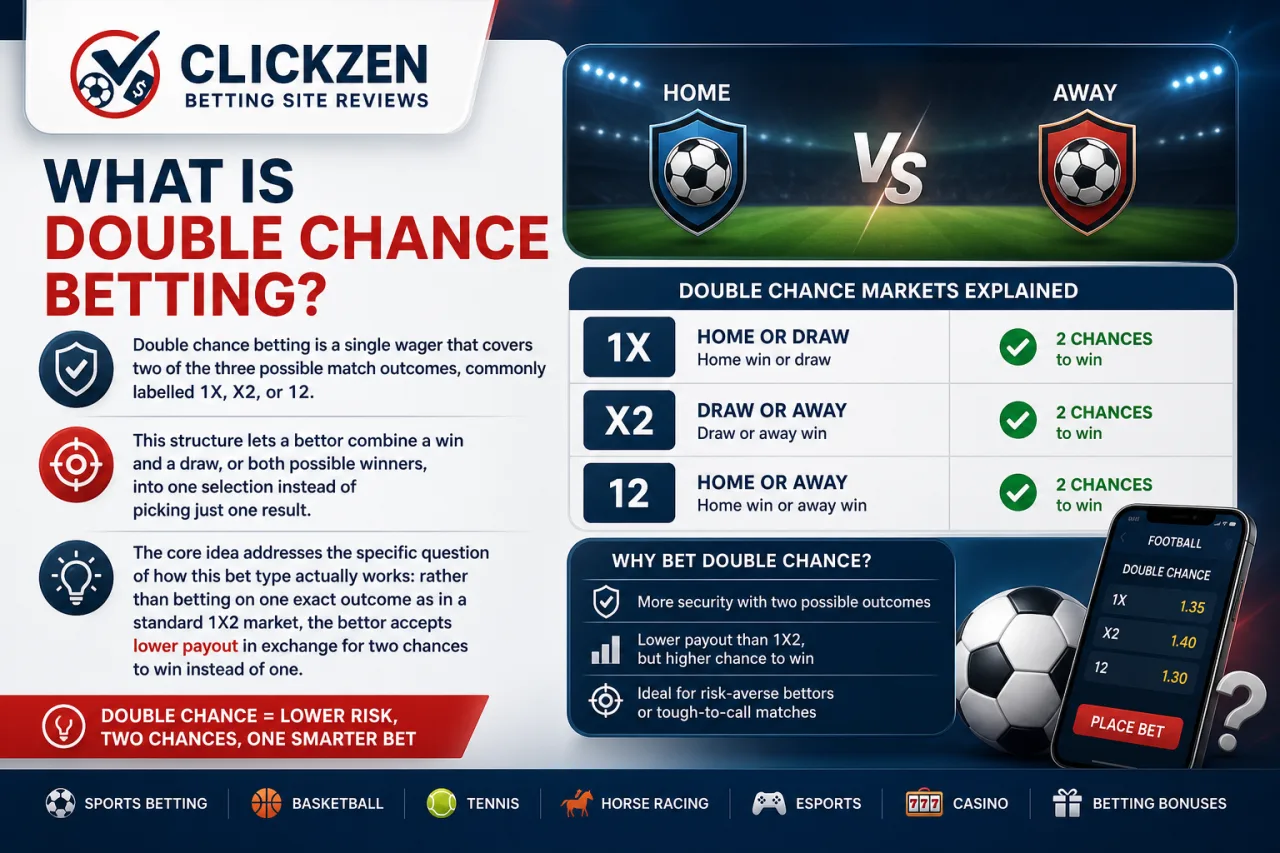
Double chance betting is a single wager that covers two of the three possible match outcomes, commonly labelled 1X, X2, or 12. It allows bettors to combine two results into one selection instead of choosing only one outcome from a standard three-way market.
Compared with a traditional 1X2 bet, double chance provides broader coverage but usually comes with shorter odds. The bettor accepts a smaller potential return in exchange for having two possible winning outcomes instead of one.
Double chance is mainly offered in sports and markets where a draw can form part of the result. Football is the most common example.
The three standard double chance combinations are:
- 1X: Home win or draw.
- X2: Draw or away win.
- 12: Home win or away win, excluding the draw.
What Are the Three Double Chance Options (1X, X2, 12)?
There are three double chance combinations: 1X, X2, and 12. Each one covers two of the three possible match results and excludes only one outcome.
- 1X wins if the home team wins or the match ends in a draw. It loses only if the away team wins.
- X2 wins if the away team wins or the match ends in a draw. It loses only if the home team wins.
- 12 wins if either team wins outright. It loses if the match ends in a draw.
For example, in a match between Team A at home and Team B away, a 1X bet wins if Team A wins or the match finishes level. A 12 bet wins if either Team A or Team B wins, but loses if the match is drawn.
Which Sports Commonly Offer Double Chance Betting?
Football is the sport most commonly associated with double chance betting, although similar markets may also appear in other sports where a draw or tied regulation-time result is possible.
- Football offers the widest range of double chance markets because draws are a regular match outcome.
- Some ice hockey and rugby markets may offer similar options when regulation time can finish level.
- Certain cricket formats may include markets covering multiple possible match outcomes.
- Tennis generally does not use traditional double chance betting because matches normally produce one winner and one loser.
- Basketball usually does not use the traditional football-style double chance market because standard match-winner bets are commonly settled after overtime, leaving two eventual match outcomes.
For this reason, bettors will encounter double chance most frequently when researching football betting markets.
How Does Double Chance Betting Work?
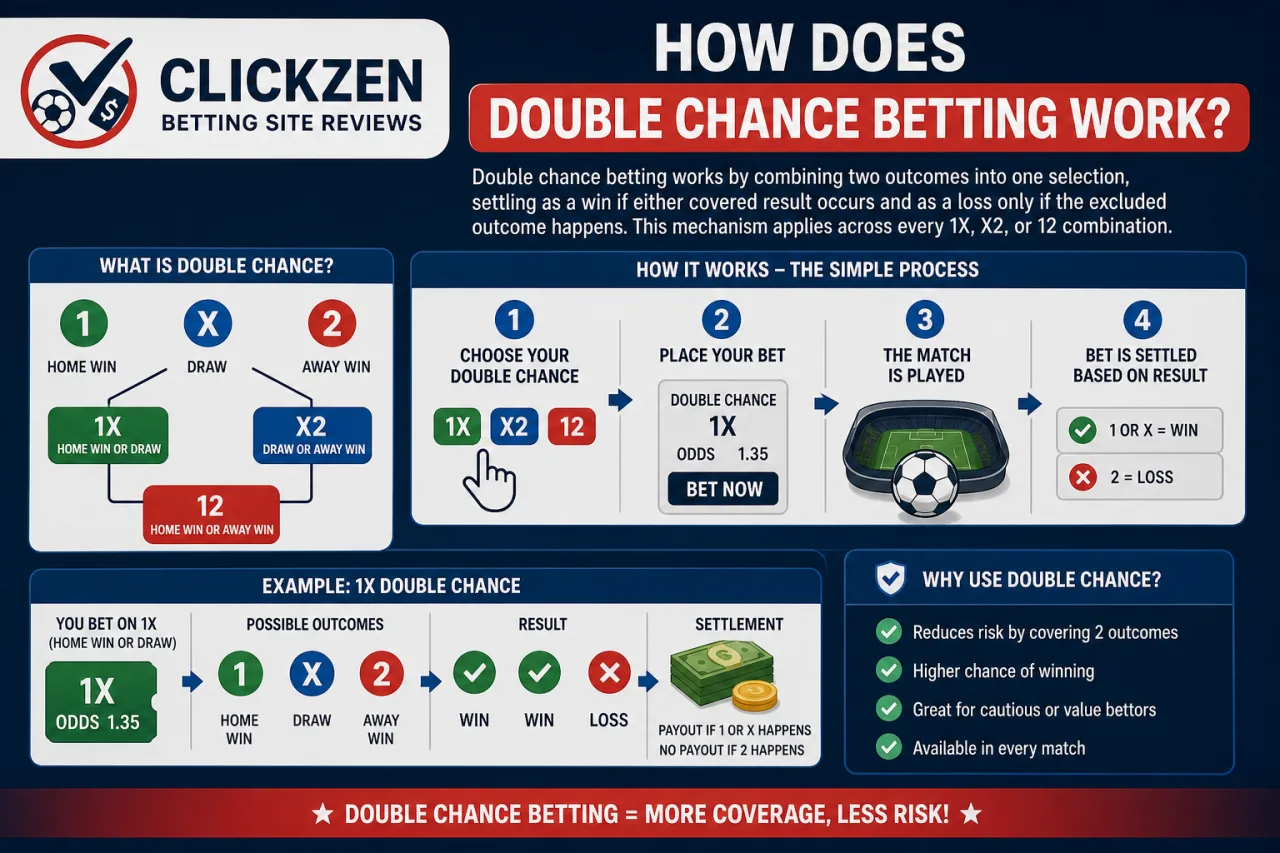
Double chance betting works by combining two possible results into one selection. The bet wins if either covered outcome occurs and loses only if the excluded result happens.
To place the bet, a bettor chooses one of the three double chance options — 1X, X2, or 12 — and places a stake at the displayed odds.
For example, an X2 selection covers a draw and an away win. If the match ends level or the away team wins, the bet is successful. If the home team wins, the bet loses.
Settlement is normally based on the result at the end of the period specified by the market, which in football is commonly 90 minutes plus stoppage time. Extra time and penalties are generally excluded unless the sportsbook’s market rules state otherwise.
How Are Double Chance Bets Settled at Full Time?
In football, double chance bets are typically settled according to the result after 90 minutes plus stoppage time. Extra time and penalty shootouts usually do not count unless the sportsbook specifically states that they are included.
This distinction is particularly important in knockout competitions.
- A 1X bet wins if the home team is ahead or the score is level after 90 minutes, even if the away team later wins in extra time.
- A 12 bet loses if the score is tied after 90 minutes, even if one team later advances on penalties.
- An X2 bet wins if the away team leads or the score is level at the end of normal time.
Because settlement rules can vary by sportsbook, competition, and market, bettors should always check the specific terms shown on the bet slip.
How Are Double Chance Odds and Payouts Calculated?
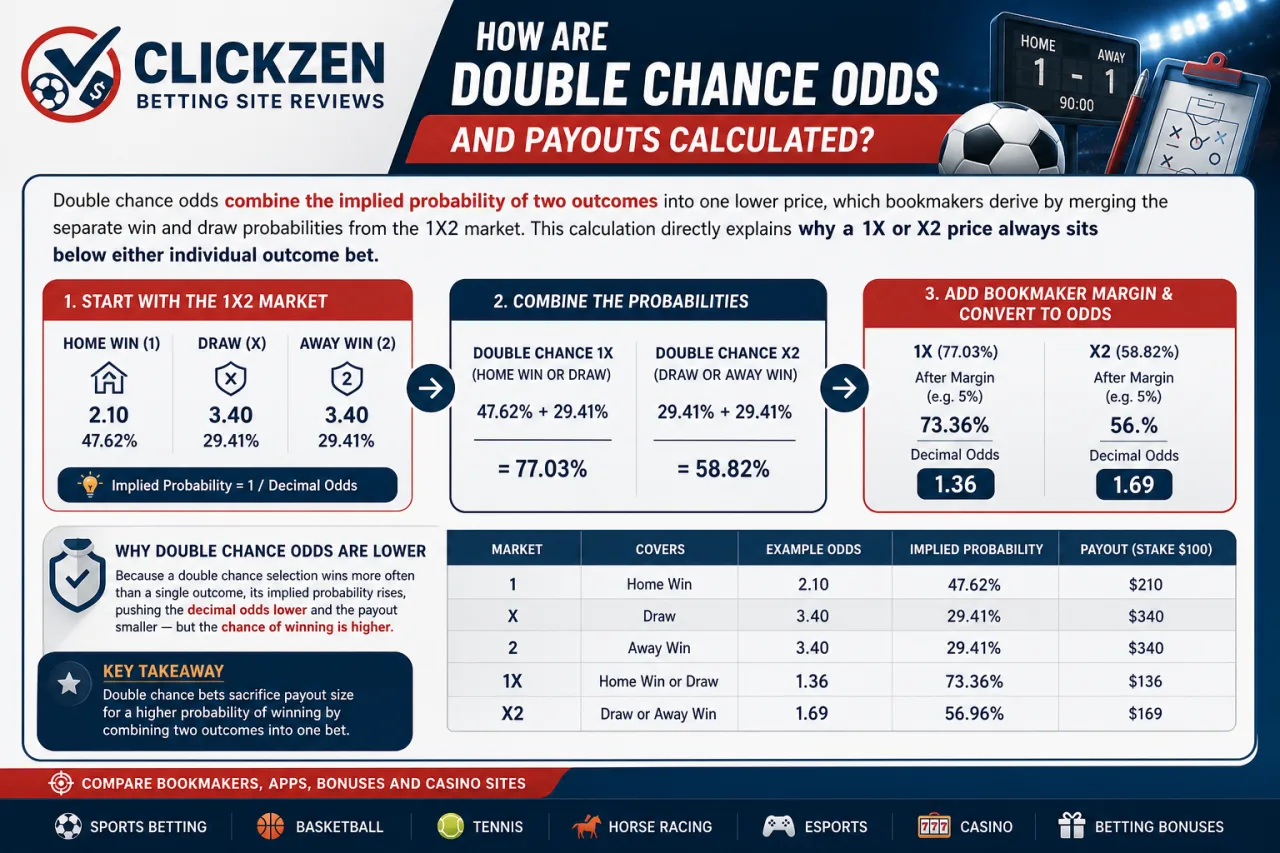
Double chance odds reflect the combined probability of two 1X2 outcomes, adjusted for the bookmaker’s margin and overall market pricing. Since two results are covered instead of one, the implied probability is higher and the odds are usually shorter than the corresponding single-outcome selections.
Bookmakers do not simply add two decimal odds together. Instead, the price reflects the estimated probability of either covered outcome occurring, together with the sportsbook’s built-in margin and any market adjustments.
A simple payout example illustrates how returns are calculated:
- Stake: $50.
- Double chance odds: 1.30.
- Total return: $50 × 1.30 = $65.
- Profit: $15.
The lower potential profit reflects the broader outcome coverage offered by the bet.
How Do You Calculate Implied Probability for Double Chance Bets?
To calculate the implied probability of decimal odds, divide 1 by the odds and multiply the result by 100.
For example, if a 1X double chance selection is priced at 1.30:
(1 ÷ 1.30) × 100 ≈ 76.9%
If a single home-win selection is priced at 2.10:
(1 ÷ 2.10) × 100 ≈ 47.6%
The double chance selection shows a higher implied probability because it covers two possible results instead of one. However, bookmaker margin means the quoted implied probability should not automatically be treated as the true probability of the outcome occurring.
Double Chance vs Other Bet Types: What’s the Difference?
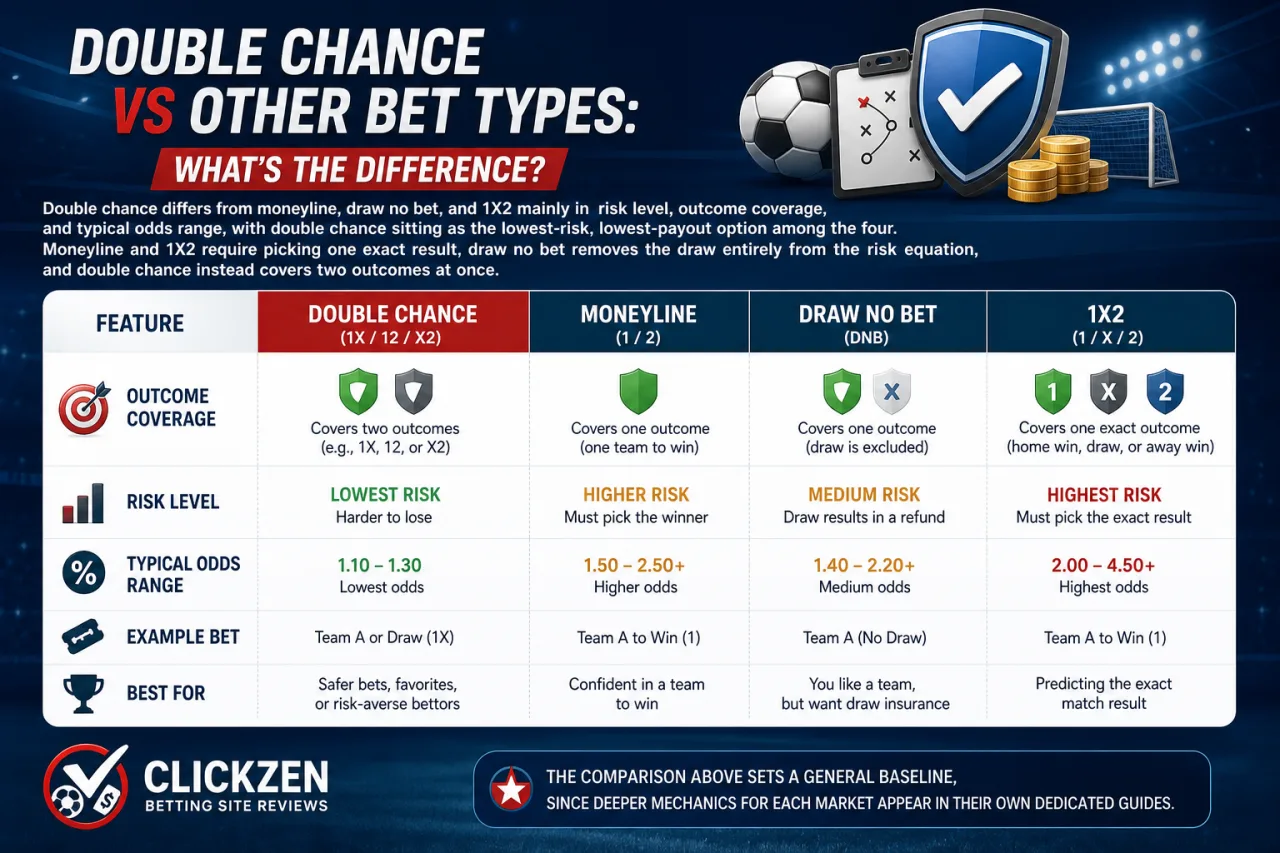
Double chance differs from 1X2, moneyline, and draw no bet mainly in outcome coverage, draw treatment, risk, and potential return. Double chance covers two results, while a standard 1X2 selection covers only one.
| Bet Type | Outcomes Covered | Draw Treatment | Typical Risk |
|---|---|---|---|
| Double Chance | Two of three results: 1X, X2, or 12 | Can be included as a winning outcome | Lower |
| 1X2 | One exact result: home, draw, or away | Separate selectable outcome | Higher |
| Moneyline | Usually one side to win | Depends on sport and sportsbook rules | Varies |
| Draw No Bet | One team to win | Stake typically refunded on a draw | Moderate |
In general, broader outcome coverage means a higher probability of winning but shorter odds. Markets that require one exact result usually offer greater potential returns because they involve more outcome risk.
Double Chance vs Moneyline: Which Covers More Outcomes?
Double chance covers two possible results, while a moneyline generally backs one side to win. The exact meaning and settlement of a moneyline bet can vary depending on the sport and sportsbook.
- Double chance covers two outcomes in a three-way market.
- A standard moneyline selection usually requires the chosen side to win.
- Double chance normally carries shorter odds because it provides broader coverage.
- Moneyline markets may offer higher returns because only one side is being backed.
In two-outcome sports such as tennis, traditional double chance has little practical role because there is no standard draw result to combine with a win selection.
Double Chance vs Draw No Bet: How Do They Differ?
Draw no bet usually refunds the stake when a match ends level, while 1X and X2 double chance bets treat the draw as a winning result.
- Draw no bet returns the original stake if the selected match finishes in a draw.
- 1X wins on either a home victory or a draw.
- X2 wins on either an away victory or a draw.
- Draw no bet still requires the selected team to win for the bettor to make a profit.
For example, if a bettor backs the home team using draw no bet and the match finishes level, the stake is normally returned. With a 1X selection, that same draw is a winning result.
Double Chance vs 1X2: How Are They Related?
Double chance is built from the same three possible outcomes used in the 1X2 market. Instead of selecting one result, it groups two results into a single wager.
- 1X2 lists home win, draw, and away win as separate selections.
- 1X covers home win and draw.
- X2 covers draw and away win.
- 12 covers home win and away win.
Both markets are generally settled using the same underlying match result, although bettors should still check individual sportsbook rules before placing a wager.
What Are the Pros and Cons of Double Chance Betting?
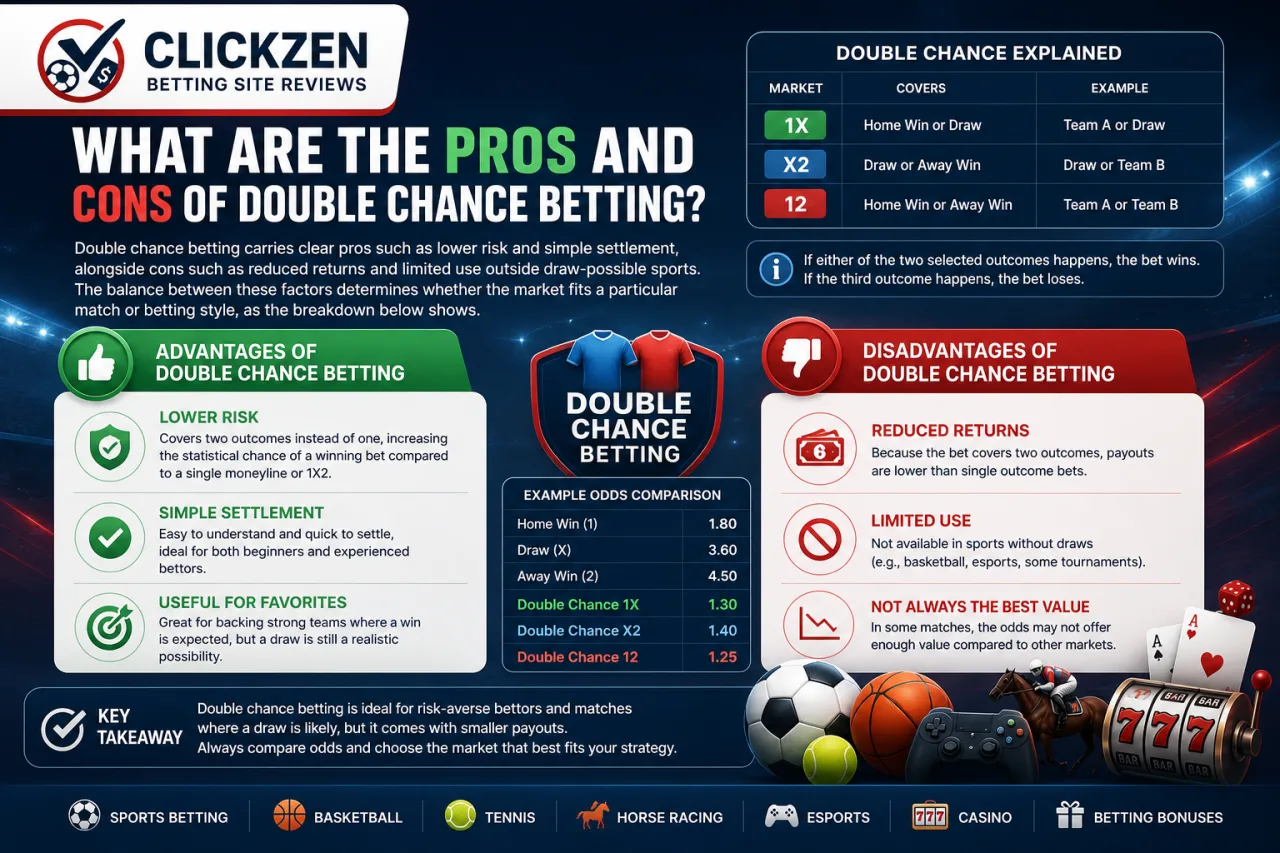
Double chance offers broader result coverage and lower outcome risk, but the trade-off is shorter odds and smaller potential returns.
Advantages of Double Chance Betting
The main advantage of double chance is that it covers two possible outcomes instead of one. This can be useful when a bettor expects one team not to lose but is uncertain whether the match will end in a win or draw.
- Covers two of the three possible match results.
- Reduces outcome risk compared with a single 1X2 selection.
- Can be useful in closely matched fixtures where a draw remains realistic.
- Provides a simple alternative to choosing one exact match winner.
Disadvantages of Double Chance Betting
The main disadvantage is that double chance usually offers shorter odds because the bettor receives broader coverage.
- Potential profit is usually lower than with a single-result selection.
- The market is less relevant in sports without a standard draw outcome.
- Odds can become extremely short when one side is heavily favoured, leaving limited potential return relative to the stake.
- Broader coverage does not guarantee value if the quoted price is too low.
When Is Double Chance Betting a Suitable Choice?
Double chance may suit fixtures where two outcomes appear meaningfully more plausible than the third. It is commonly considered when a bettor wants protection against a draw or believes one team is unlikely to lose outright.
Possible examples include:
- Closely matched teams where a draw remains realistic.
- An underdog with a strong recent record that may be capable of drawing or winning.
- A favourite playing away from home where a draw is considered more plausible than an outright defeat.
- Matches where recent performances suggest one team is difficult to beat but not certain to win.
These scenarios do not guarantee that double chance represents good value. Bettors still need to compare the probability they assign to the covered outcomes with the odds being offered.
What Are Some Lesser-Known Facts About Double Chance Betting?
Double chance markets can also appear in accumulators and knockout competitions, but sportsbook rules may differ depending on the event and bet combination. Market availability, same-game combination rules, and settlement terms should therefore be checked before placing a bet.
Can Double Chance Bets Be Combined in Accumulators?
Yes, double chance selections can commonly be included in accumulators when the sportsbook allows the combination. Each leg contributes its decimal odds to the overall accumulator price.
For example, a bettor might combine a 1X selection from one football match with an X2 selection from another. Because double chance odds are normally shorter than single-outcome prices, using several double chance legs may produce a lower total accumulator price than using individual 1X2 selections.
Rules can vary between sportsbooks, particularly when bettors try to combine several related markets from the same match. The bet slip normally indicates whether a particular combination is permitted.
Do Extra Time or Penalties Affect Double Chance Results in Cup Matches?
In most standard football double chance markets, extra time and penalties do not affect settlement because the bet is based on the 90-minute result.
- A 1X bet wins if the home team wins or draws after normal time.
- An X2 bet wins if the away team wins or draws after normal time.
- A 12 bet loses if the match is level after 90 minutes, even if one team later wins in extra time or on penalties.
However, sportsbook rules can differ for specific markets or competitions. Bettors should therefore confirm whether the listed double chance market refers to regulation time, qualification, or another settlement condition before placing the wager.
Conclusion
Double chance betting covers two of the three possible outcomes in a match, giving bettors broader protection than a standard 1X2 selection. The trade-off is shorter odds and lower potential returns. The market is most useful when a draw is realistic or when one team appears unlikely to lose, but the quoted price should still be assessed carefully before placing a bet. Understanding the differences between 1X, X2, 12, draw no bet, moneyline, and 1X2 helps bettors choose the market that best matches their view of the fixture.
Marcus Zeno is the CEO and Lead Betting Analyst at ClickZen. With over eight years of experience in the iGaming industry, he specializes in evaluating global sportsbooks, mobile betting apps, and bonus terms. Marcus is dedicated to cutting through promotional noise to provide bettors with transparent, fact-based insights.


Top Rated Casinos

FanDuel is a regulated North American betting and gaming brand offering Sportsbook, Casino, Fantasy, Racing and prediction markets, with product availability determined by state or provincial regulations.

DraftKings is a regulated North American sportsbook and gaming operator offering sports betting, live wagering, casino games, daily fantasy sports, Pick6 and horse racing in eligible jurisdictions.

Fanatics Sportsbook is a regulated U.S. betting platform available in 23 states plus Washington, D.C., offering major sports markets, live betting, same game parlays and a distinctive FanCash rewards ecosystem.


ClickZen is an independent betting information and review website providing clear, practical insights into sportsbooks, online casinos, betting apps, bonuses, and related services for a global audience.
This website is intended for users aged 18 and over. Gambling can be addictive, so please gamble responsibly. The content on this website is for informational purposes only.
About ClickZen