
Confused by Asian Handicap odds? Learn how the lines work, key terms, and simple examples to bet smarter and read the market with confidence.
Asian Handicap Explained: How It Works for Beginners

Asian Handicap is a form of sports betting where one team receives a virtual goal advantage or disadvantage before the match starts, aiming to level the perceived gap between two teams. This system removes the possibility of a draw in many betting lines, forcing bettors to focus purely on which team performs better relative to the handicap.
Asian Handicap works by applying the selected handicap to one team’s score for settlement, then comparing the adjusted result with the opponent’s score. A bettor should not subtract goals from one team and add the same handicap to the other at the same time. The final settlement can be a full win, half win, push, half loss, or full loss depending on the line selected and the actual match result.
Reading Asian Handicap lines requires distinguishing zero, whole-goal, half-goal, and quarter-goal handicaps. Lines such as 0, -1, and +2 are zero or whole-goal lines; -0.5 and -1.5 are half-goal lines; and -0.25, -0.75, -1.25, or -1.75 are quarter-goal lines that split the stake across two adjacent handicaps. Calculating returns requires applying the settlement rules for the relevant line before using the listed odds.
Asian Handicap differs from standard 1X2 betting because it uses fractional and split lines to eliminate or reduce the draw outcome, while 1X2 betting keeps three separate results: win, draw, or lose. This structural difference changes both risk exposure and how odds are priced across bookmakers.
A disciplined Asian Handicap approach can include analysing team form, home/away performance, injuries, market prices, and line movement before placing a bet rather than relying on instinct alone. Changes in handicap lines may reflect new information, betting activity, liquidity, or bookmaker adjustments, but line movement by itself does not prove that a wager offers value or that informed bettors are backing one side.
The sections below break down what Asian Handicap betting is, how it works step by step, and how to calculate and read handicap lines and odds, giving readers on ClickZen a structured foundation before applying any strategy in real betting scenarios. This guide is intended for readers of legal gambling age; always check local gambling laws and bet responsibly.
What Is Asian Handicap Betting?
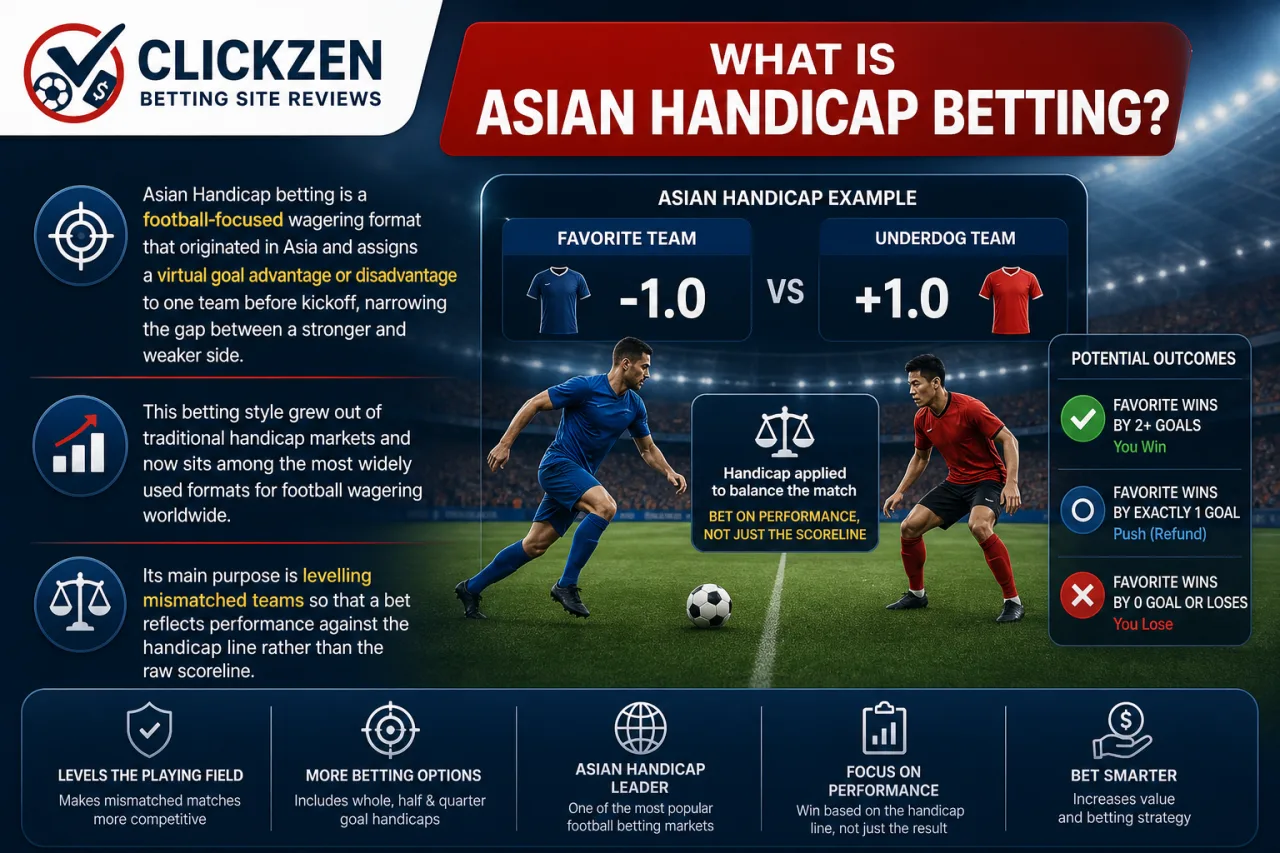
Asian Handicap betting is a football-focused wagering format that originated in Asia and assigns a virtual goal advantage or disadvantage to one team before kickoff, narrowing the gap between a stronger and weaker side.
This betting style grew out of traditional handicap markets and now sits among the most widely used formats for football wagering worldwide. Its main purpose is levelling mismatched teams so that a bet reflects performance against the handicap line rather than the raw scoreline alone, and in many of its lines it removes the draw as a possible outcome entirely. The sections that follow expand on how this handicap mechanism functions in practice and how the resulting lines get read and calculated.
Why Was Asian Handicap Created?
Asian Handicap was created to balance the odds between a stronger and weaker team, giving bettors a more even proposition than a straight win-draw-lose bet. By shifting a goal advantage onto the underdog and a deficit onto the favourite, the format corrects for lopsided matchups where one side dominates on paper.
This structure also changes how draws are treated. Half-goal lines such as -0.5 or +0.5 cannot produce an adjusted draw, while whole-goal lines such as -1 or +1 can produce a level settlement score; in that case, the wager is a push and the stake is refunded rather than settled as a draw selection.
Compared with 1X2 betting, Asian Handicap changes the settlement framework rather than simply adding another outcome. The bettor evaluates whether the selected team covers its handicap, with some lines allowing a push or split settlement instead of a separately priced draw outcome.
The exact geographic and historical origins of Asian Handicap betting, including precisely when and where it first emerged in Asia, remain unclear and are widely debated among betting historians.
What Are the Basic Terms Used in Asian Handicap?
The basic terms in Asian Handicap cover favorite (-), underdog (+), handicap line, half win, half loss, push, and whole, half, or quarter goal lines, each defining how a stake settles. These labels form the vocabulary bettors use to read a line and interpret a final result.
The favorite carries a minus sign and gives up goals, while the underdog carries a plus sign and receives goals before the match starts. The handicap line itself is the specific number applied, such as -0.5 or +1, and it dictates the adjusted scoreline used for settlement.
A half win occurs on a quarter-goal line when half of the stake wins and the other half pushes; the winning half is paid at the listed odds and the pushed half is refunded. A half loss occurs when half of the stake loses and the other half pushes. A push, available on whole-goal lines, refunds the full stake when the adjusted settlement score ends level.
Quarter goal lines split a stake across two adjacent whole or half lines, producing combined outcomes rather than a single settlement. Whole and half goal lines settle as a single result each, without splitting the stake between two values.
How Does Asian Handicap Work?
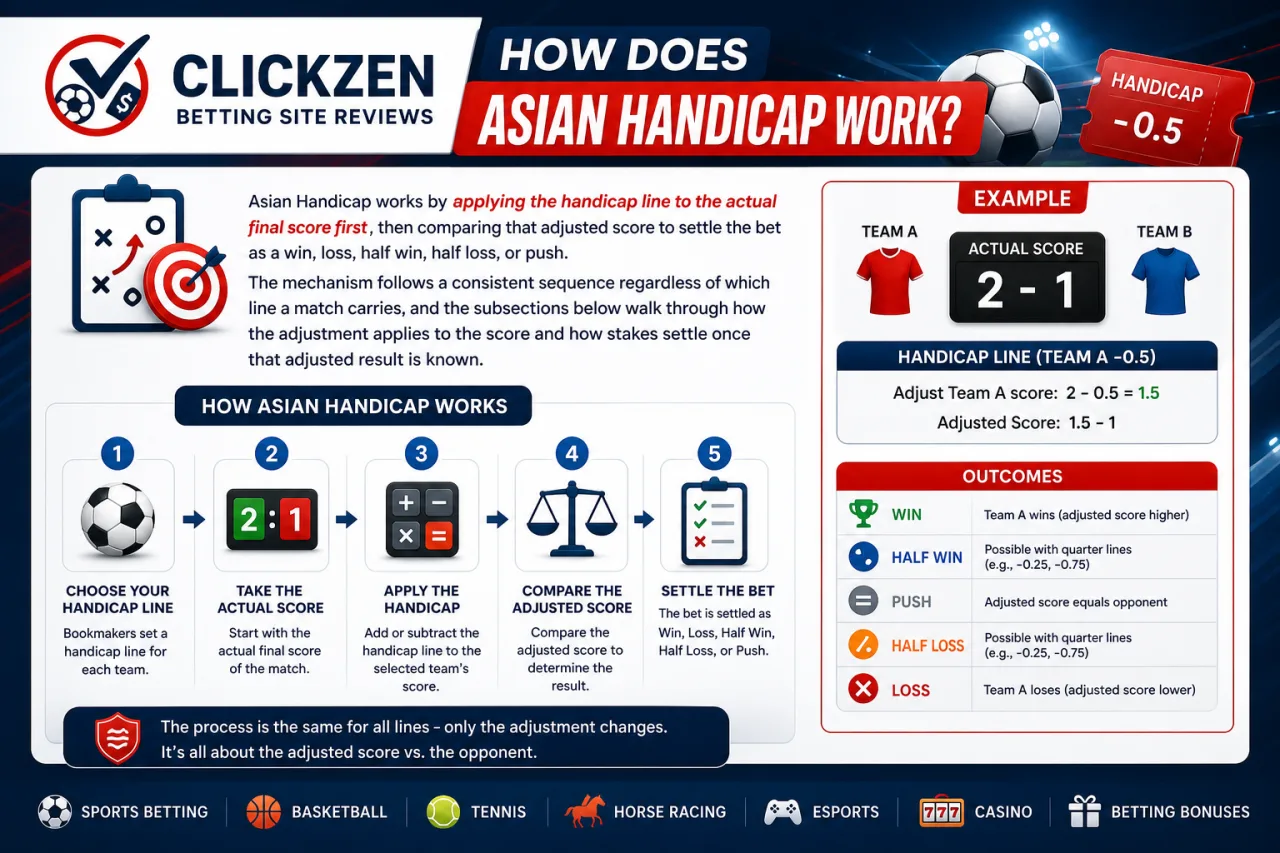
Asian Handicap works by applying the handicap line to the actual final score first, then comparing that adjusted score to settle the bet as a win, loss, half win, half loss, or push. The mechanism follows a consistent sequence regardless of which line a match carries, and the subsections below walk through how the adjustment applies to the score and how stakes settle once that adjusted result is known.
How Is the Final Score Adjusted With the Handicap?
The final score is adjusted by applying the handicap only to the team or selection being evaluated, then comparing that adjusted score with the opponent’s actual score. The same handicap should not be applied to both teams at once, because doing so would double-count the adjustment.
For example, suppose the favorite is -1 and wins the match 2-1. Applying -1 to the favorite changes the settlement score from 2-1 to 1-1. Because the adjusted score is level, a bet on the favorite -1 is a push and the stake is refunded. Looking at the equivalent opposite side, an underdog +1 bet in the same 2-1 result also reaches a level settlement score and pushes; the handicap is applied to the selected side, not simultaneously to both teams.
With a -0.5 line, if the favorite wins 1-0, applying -0.5 leaves an adjusted score of 0.5-0, so the favorite -0.5 bet settles as a full win. If the match finishes 0-0, the same -0.5 selection settles as a loss.
This adjust-then-compare sequence applies consistently across whole, half, and quarter goal lines, though quarter lines split the stake across two adjacent calculations before the final settlement.
What Are the Possible Outcomes in Asian Handicap Betting?
Asian Handicap betting produces five possible outcomes: full win, half win, push, half loss, and full loss, with the exact result depending on which line type applies to the bet. This range of outcomes stems directly from how the handicap adjusts the final score before settlement.
- A full win pays the entire stake at the listed odds when the adjusted score clearly favors the bet, occurring on whole, half, or quarter lines alike.
- A half win pays out on only half the stake when a quarter line splits the result between a winning half-line and a push, leaving the remaining portion refunded rather than lost.
- A push refunds the full stake when a whole goal line produces a level adjusted score, an outcome exclusive to whole-number lines such as -1 or +1.
- A half loss forfeits only half the stake when a quarter line splits the result between a losing half-line and a push.
- A full loss forfeits the entire stake when the adjusted score clearly goes against the bet.
Quarter lines are the only line type capable of producing the half win and half loss outcomes, since they combine two adjacent half-point calculations into one bet.
How to Calculate and Read Asian Handicap Lines and Odds?
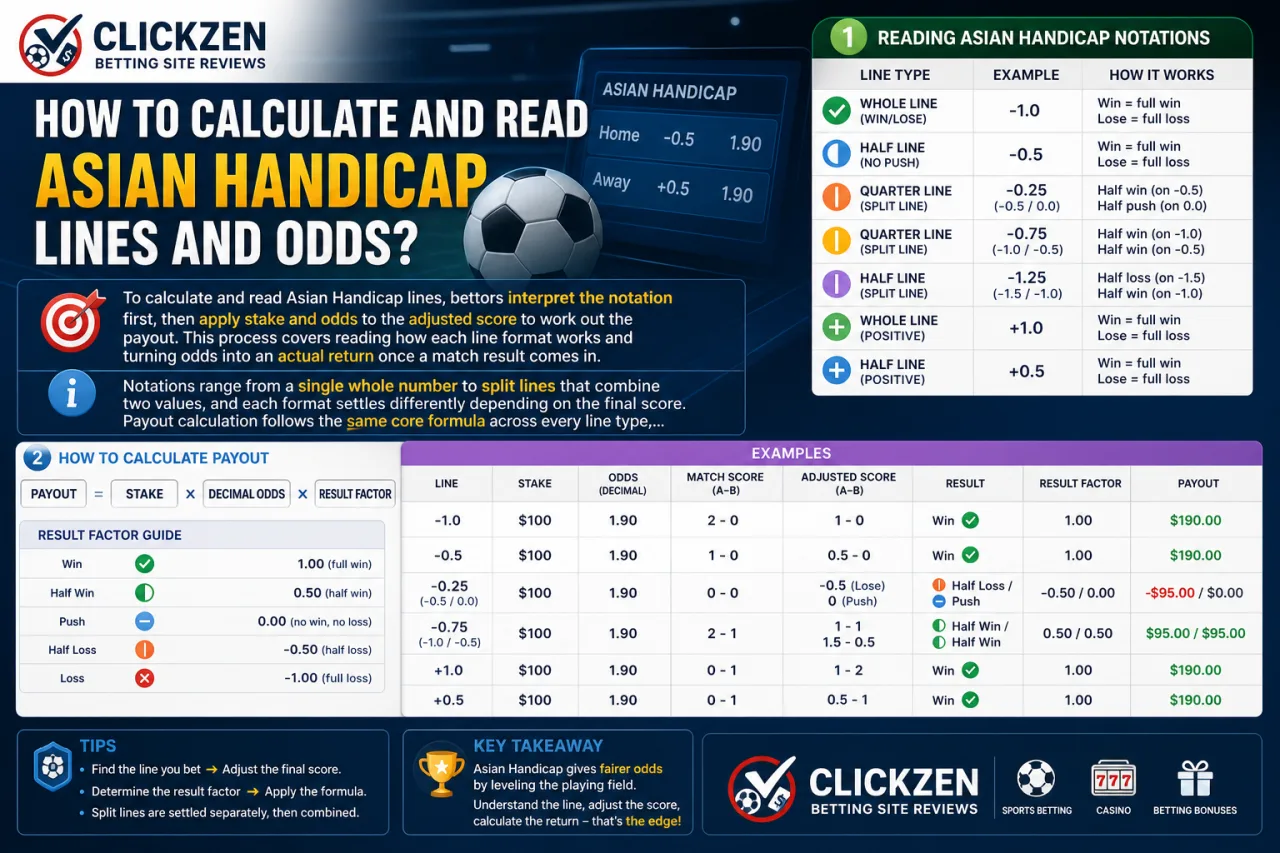
To calculate and read Asian Handicap lines, bettors interpret the notation first, then apply stake and odds to the adjusted score to work out the payout. This process covers reading how each line format works and turning odds into an actual return once a match result comes in.
Notations range from a single whole number to split lines that combine two values, and each format settles differently depending on the final score. Payout calculation follows the same core formula across every line type, multiplying stake by odds, though split lines divide that stake across two separate calculations before adding the results together. The subsections below walk through both the notation system and the payout math in detail.
What Do Different Handicap Numbers Mean (e.g., -0.5, -1, -1.5)?
Different handicap numbers indicate different settlement structures: whole-goal lines such as -1 can push, half-goal lines such as -0.5 or -1.5 cannot push, and quarter-goal lines such as -0.25, -0.75, or -1.25 split the stake across two adjacent handicaps. Correctly identifying the line type is essential because each type settles differently.
A whole line such as -1 or +1 applies a full-goal adjustment and allows a push when the adjusted result ends level, refunding the stake. A half line such as -0.5, +0.5, -1.5, or +1.5 applies a half-goal adjustment, making a level settlement score impossible; the wager therefore settles as either a full win or a full loss.
A quarter line splits the stake evenly between two adjacent whole- and half-goal lines. For example, -0.75 is split between -0.5 and -1.0, while -1.25 is split between -1.0 and -1.5. Some bookmakers display -1.25 as a split line such as -1 & -1.5; -1.5 by itself is still a half-goal line, not a quarter-goal handicap.
The higher the absolute value of the handicap, whether -1.5 or -2, the larger the goal gap the favorite must overcome for the bet to settle as a win, reflecting a wider perceived skill difference between the two teams.
How to Calculate Winnings From Asian Handicap Odds?
To calculate winnings from Asian Handicap odds, multiply the stake by the decimal odds for a full win, then split the stake across two adjacent line calculations whenever a quarter line applies. This formula stays consistent across whole, half, and quarter lines, though the settlement portion changes depending on how the adjusted score compares to the line.
A straightforward example clarifies the base formula. A stake of $100 at odds of 1.90 on a full win returns $190 in total, made up of the original $100 stake plus $90 profit.
Quarter lines change this calculation by dividing the stake into two equal halves. On a -0.75 line, for instance, half the stake follows the -0.5 result and the other half follows the -1 result.
If one half settles as a win and the other as a push, the winning half pays out at full odds while the pushed half simply returns as stake, producing a half win overall. If one half settles as a loss and the other as a push, the losing half forfeits its portion while the pushed half returns as stake, producing a half loss overall. This split mechanism means quarter-line payouts rarely equal the full stake-times-odds figure that a whole or half line produces.
Asian Handicap vs 1X2 Betting: What Is the Difference?
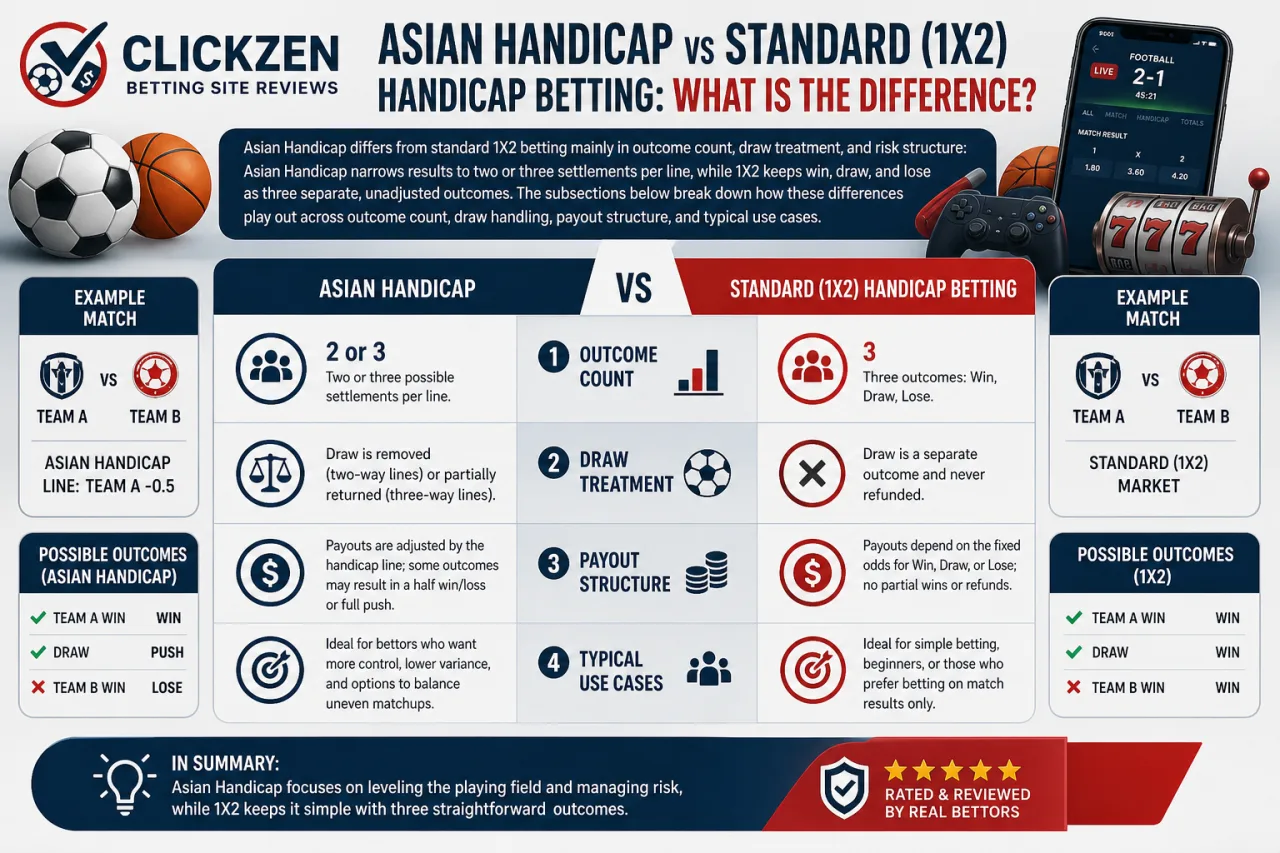
Asian Handicap differs from standard 1X2 betting mainly in outcome count, draw treatment, and risk structure: Asian Handicap narrows results to two or three settlements per line, while 1X2 keeps win, draw, and lose as three separate, unadjusted outcomes. The subsections below break down how these differences play out across outcome count, draw handling, payout structure, and typical use cases.
Does Asian Handicap Eliminate the Draw Outcome?
Asian Handicap removes the draw as a separately priced betting selection, but the settlement can still include a push on whole-goal lines or a partial push within a quarter-goal line. Half-goal lines cannot finish level after the handicap is applied, while quarter-goal lines split the stake and may combine a push on one half with a win or loss on the other.
Several factors explain why draw handling works this way on Asian Handicap:
- Half lines such as -0.5 or +0.5 shift the score by a fraction of a goal, making a level adjusted result mathematically impossible.
- Whole lines such as -1 or +1 still allow a level adjusted score, but that outcome settles as a push refunding the stake rather than paying out as a genuine draw win.
- Quarter lines split the stake across two adjacent calculations, so any potential level result on one half gets absorbed into a push while the other half settles as a win or loss.
Standard 1X2 betting keeps the draw as one of three separately priced, unadjusted outcomes alongside a home win and an away win, without using the Asian Handicap push or split-stake settlement structure.
Which Offers Better Value: Asian Handicap or 1X2?
Neither Asian Handicap nor 1X2 is inherently better value in every match. Value depends on the odds offered, the bookmaker’s margin, and whether a bettor’s estimated probability is more accurate than the market price. The two markets mainly provide different ways to express a view on the same fixture.
Asian Handicap can be useful when a bettor wants to account for the expected goal difference between two teams or choose a line with push or split-stake protection. However, accepting a different handicap also changes the price and the conditions required for the bet to win.
1X2 is simpler because each wager targets one of three match outcomes: home win, draw, or away win. It may be preferable when the bettor’s view is specifically about the final match result rather than the winning margin.
The more meaningful comparison is therefore the implied probability and price available in each market, not an assumption that one format automatically offers superior value.
How to Use Asian Handicap Strategy to Bet Successfully?

A structured Asian Handicap approach can combine team form analysis, home/away context, team news, price comparison, line movement tracking, bankroll management, and line selection matched to the bettor’s risk tolerance. No strategy can guarantee a profit, so these factors are best used as a consistent decision framework rather than as a formula for certain success.
What Factors Should You Analyze Before Placing an Asian Handicap Bet?
Bettors analyze six core factors before placing an Asian Handicap bet: team form, head-to-head record, injuries, home/away performance, motivation, and market line movement. This grouping expands on the strategic layer introduced earlier, breaking down each analytical factor a bettor weighs when evaluating a handicap line before kickoff.
- Team form measures recent match results and scoring patterns, indicating whether a side is trending upward or declining ahead of the fixture.
- Head-to-head record tracks previous meetings between the two sides, revealing tactical or psychological patterns that repeat across fixtures.
- Injuries assess which key players are unavailable, since missing a starting attacker or defender shifts a team’s realistic capacity to cover its handicap.
- Home/away performance separates a team’s results at its own venue from results on the road, since travel and crowd support often produce uneven output.
- Motivation weighs what a match means for each side, such as a title race, relegation battle, or a dead rubber with nothing left to play for.
- Market line movement follows how the handicap and price change from opening to kickoff. These changes can reflect team news, betting activity, liquidity, risk management, or bookmaker adjustments, so movement should be treated as market information rather than proof of informed money.
Each factor feeds into the same evaluation process, cross-referencing current conditions against the handicap line offered before committing a stake.
How to Manage Risk When Betting Asian Handicap?
To manage risk when betting Asian Handicap, bettors can combine disciplined bankroll management, deliberate stake sizing, careful price and line selection, and control over emotional decision-making. Risk depends on the stake, odds, estimated probability, and settlement conditions of the chosen line; a half-goal line is not automatically safer than a quarter-goal line.
Bankroll management involves limiting the amount risked on each wager relative to the total bankroll, which helps reduce the impact of any single losing result. The appropriate staking method depends on the bettor’s own risk tolerance and should not be increased simply to recover previous losses.
Half-goal lines provide simpler win-or-loss settlement, while quarter-goal lines split the stake and can produce half wins or half losses. That split can either soften or reduce a result around a key margin, depending on the side and line selected, so the choice should be evaluated together with the available odds rather than ranked as inherently safer or riskier.
Avoiding emotional betting keeps stake sizing and line selection tied to the pre-match analysis of team form, injuries, and line movement, rather than reacting to a recent result or chasing a previous loss with a larger wager.
- Set a fixed staking unit and apply it consistently across every Asian Handicap bet.
- Compare the settlement conditions and odds of whole, half, and quarter lines instead of assuming one line type is always safer.
- Base each wager on pre-match research rather than reacting to in-play emotion or recent losses.
What Are Some Lesser-Known Variations of Asian Handicap Used by Bookmakers?
Bookmakers may offer Asian Handicap markets beyond standard pre-match full-time goal handicaps, including live/in-play lines and handicaps applied to specific periods or statistics. The exact markets and settlement rules vary by bookmaker. The subsections below cover live Asian Handicap and applications such as corners, first-half results, and esports.
What Is Live Asian Handicap Betting?
Live Asian Handicap betting is an in-play variant where the handicap line adjusts continuously during a match to reflect the current score, time remaining, and momentum, rather than staying fixed as it does pre-match. This variant applies the same adjust-then-compare mechanism already covered, but recalculates it in real time as the match unfolds.
Unlike a pre-match line taken before kickoff, an in-play handicap and its odds can change as the match develops. Goals, red cards, time remaining, team performance, betting activity, and the bookmaker’s live pricing model can all affect the line. As a result, a wager placed during the match may have a different handicap and price from one placed before kickoff, and bettors should check the bookmaker’s specific in-play settlement rules before betting.
This dynamic pricing makes live Asian Handicap dependent on reading momentum shifts as they happen, rather than relying solely on pre-match form analysis.
Is Asian Handicap Used Beyond Football Full-Match Results?
Yes, Asian Handicap applies beyond full-match football results, extending into corner markets, first-half-only lines, and esports betting. This cross-market adoption follows the same adjust-then-compare mechanism already outlined for full-match goals, just applied to a narrower statistic or timeframe.
Asian Handicap corners work identically to goal-based lines, except the handicap adjusts a team’s corner count instead of its goal tally, settling as a win, loss, push, or split result depending on the final corner difference. First-half-only handicaps apply the same adjustment but restrict the settlement to the score at half-time, ignoring anything that happens in the second half.
Handicap betting is also used in esports, where the adjustment may apply to maps, games, or rounds rather than goals. The exact line format and settlement rules can vary by title, competition, and bookmaker, so bettors should not assume that every esports handicap uses the same whole-, half-, and quarter-goal structure as football.
Conclusion
Asian Handicap uses a virtual goal adjustment to determine settlement, with whole-, half-, and quarter-goal lines producing different combinations of wins, losses, pushes, and split outcomes. Understanding how each line is applied, especially that the handicap is applied to the selected side rather than counted twice, is essential for calculating a bet correctly. Compared with 1X2 betting, Asian Handicap provides a more granular way to price expected winning margins, but no market or strategy guarantees better value or a profit. Bettors should compare odds carefully, understand the bookmaker’s settlement rules, manage stakes responsibly, and comply with local gambling laws.
Zorvan Hale is a Betting & Casino Analyst at ClickZen with over eight years of experience. He provides objective reviews of global betting platforms, focusing on withdrawal terms, KYC processes, and real user experience to help you make informed and safer betting decisions.


New Casinos

Zula Casino is a U.S.-focused social and sweepstakes gaming platform offering casino-style games through Gold Coins and Sweeps Coins. Eligible users can earn Sweeps Coins through no-purchase methods and promotions, with prize redemptions starting from 50 SC.

William Hill is a long-established sportsbook and casino brand founded in 1934. Its UK and international operations are owned by evoke plc and regulated through recognised authorities including the UK Gambling Commission. The platform offers sports betting, Bet Builder, selected Cash Out, casino games, mobile betting and multiple payment options, although features and promotions vary by jurisdiction.

Winamax is a regulated European betting and poker operator with licensed operations in France, Spain, and Germany. It combines pre-match and live sports betting with a dedicated poker ecosystem featuring cash games, tournaments, Sit & Go, and Expresso, while product availability varies by jurisdiction.

Vave is a crypto-focused sportsbook and casino offering sports, esports, slots and live dealer games, but its unclear current licensing status remains a significant trust concern.

W88 is a multi-product betting brand offering sportsbook, live betting, slots, and live casino games. Its operator, licence, promotions, and payment methods vary by regional domain.

Videoslots is a Malta-based online casino and sportsbook with a large game library, multiplayer casino features and licences across several regulated markets.




Top Rated Casinos

FanDuel is a regulated North American betting and gaming brand offering Sportsbook, Casino, Fantasy, Racing and prediction markets, with product availability determined by state or provincial regulations.

DraftKings is a regulated North American sportsbook and gaming operator offering sports betting, live wagering, casino games, daily fantasy sports, Pick6 and horse racing in eligible jurisdictions.

Fanatics Sportsbook is a regulated U.S. betting platform available in 23 states plus Washington, D.C., offering major sports markets, live betting, same game parlays and a distinctive FanCash rewards ecosystem.


ClickZen is an independent betting information and review website providing clear, practical insights into sportsbooks, online casinos, betting apps, bonuses, and related services for a global audience.
This website is intended for users aged 18 and over. Gambling can be addictive, so please gamble responsibly. The content on this website is for informational purposes only.
About ClickZen