
New to sports betting? Discover what 1X2 betting means, how odds work, and tips to place smarter bets today.
1X2 Betting Explained: How It Works for Beginners

1X2 betting is a wager on a match result with three possible outcomes: Home win, Draw, or Away win. This format is the standard way to bet on football and other sports where a draw is a realistic result, and it forms the basis for most match result markets offered by bookmakers.
1X2 betting works by requiring a bettor to pick one of the three outcomes before kickoff, with odds assigned to each outcome based on the bookmaker’s assessment of how likely it is to happen. A bet settles as a win only if the selected outcome matches the final score at the end of regulation time, ignoring extra time or penalties.
1X2 odds and payouts are generally calculated by multiplying the stake by the decimal odds assigned to the chosen outcome, though the exact calculation method depends on whether odds are shown in decimal, fractional, or moneyline format. Lower odds reflect a higher implied probability of that result occurring, while higher odds indicate a less likely outcome with a bigger potential return.
1X2 betting differs from Double Chance and Asian Handicap in that it offers only three strict outcomes (home win, draw, away win), while Double Chance allows combining two of those outcomes into a single bet and Asian Handicap applies a goal-based adjustment to level the two teams’ chances. Double Chance covers two outcomes in one bet, while Asian Handicap removes the draw option by applying a goal advantage or disadvantage.
1X2 bets are placed through licensed online bookmakers that list this market for most football and team sport fixtures, and choosing a reliable platform matters as much as understanding the odds. ClickZen reviews and compares such betting sites to help readers evaluate their options, though it does not accept bets itself. The section below, What Is 1X2 Betting?, breaks down the core concept in more detail before moving into strategy and odds calculation. This content is intended for readers of legal gambling age, and checking local gambling laws before placing any bet is essential. 18+.
What Is 1X2 Betting?
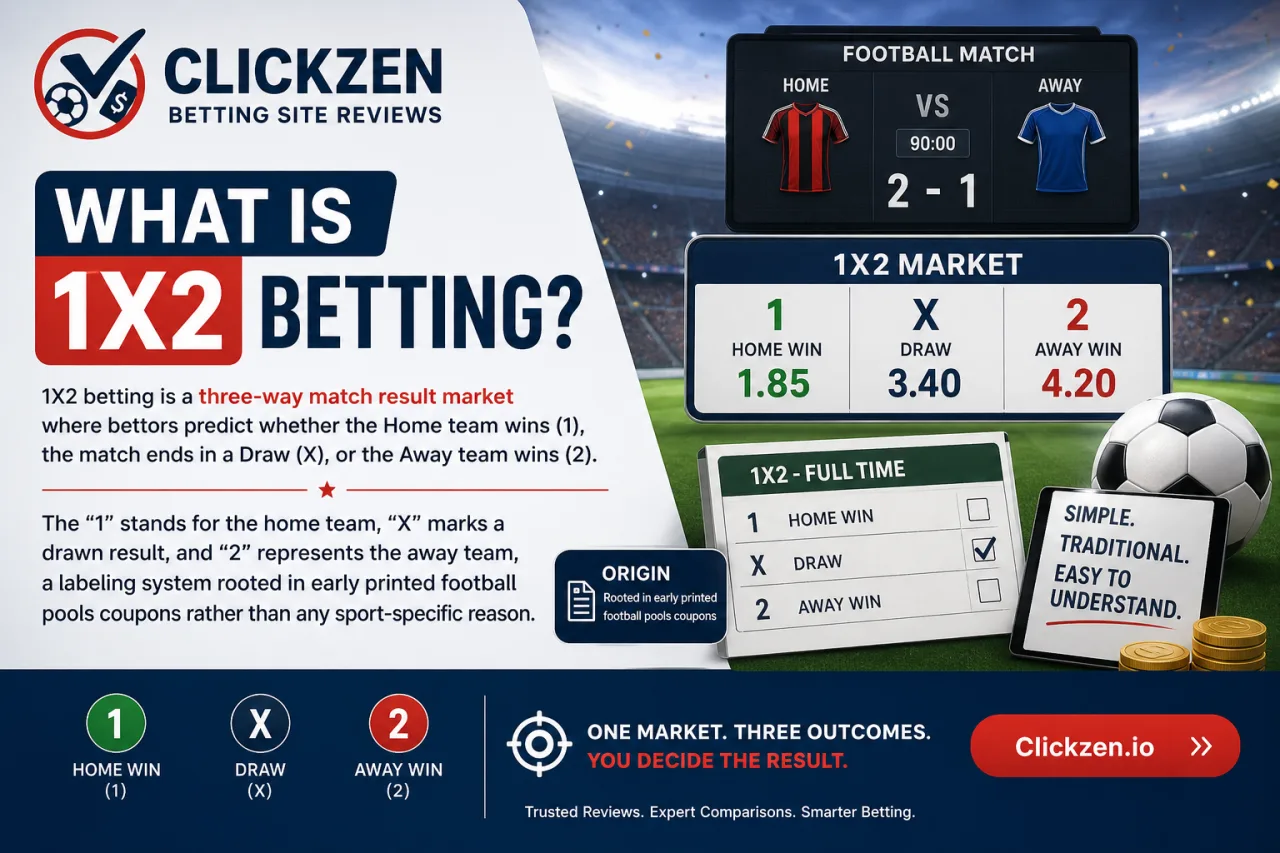
1X2 betting is a three-way match result market where bettors predict whether the Home team wins (1), the match ends in a Draw (X), or the Away team wins (2). This naming convention gives each outcome a single-digit or letter code that lines up with how odds are traditionally displayed on betting coupons and boards.
The “1” stands for the home team, “X” marks a drawn result, and “2” represents the away team, a labeling system rooted in early printed football pools coupons rather than any sport-specific rule. This shorthand became attached to football betting because draws happen often enough in the sport to warrant a dedicated symbol for that outcome, unlike sports where ties rarely happen.
1X2 betting counts among the most fundamental markets in sports betting because it maps directly onto the natural result of a match without requiring goal lines, handicaps, or combined outcomes. It applies primarily to football and soccer, where three distinct results are common, though bookmakers extend similar three-way formats to other sports with comparable draw possibilities. Understanding this basic structure sets up the odds and payout mechanics already outlined for the 1X2 market.
How Does 1X2 Betting Work?
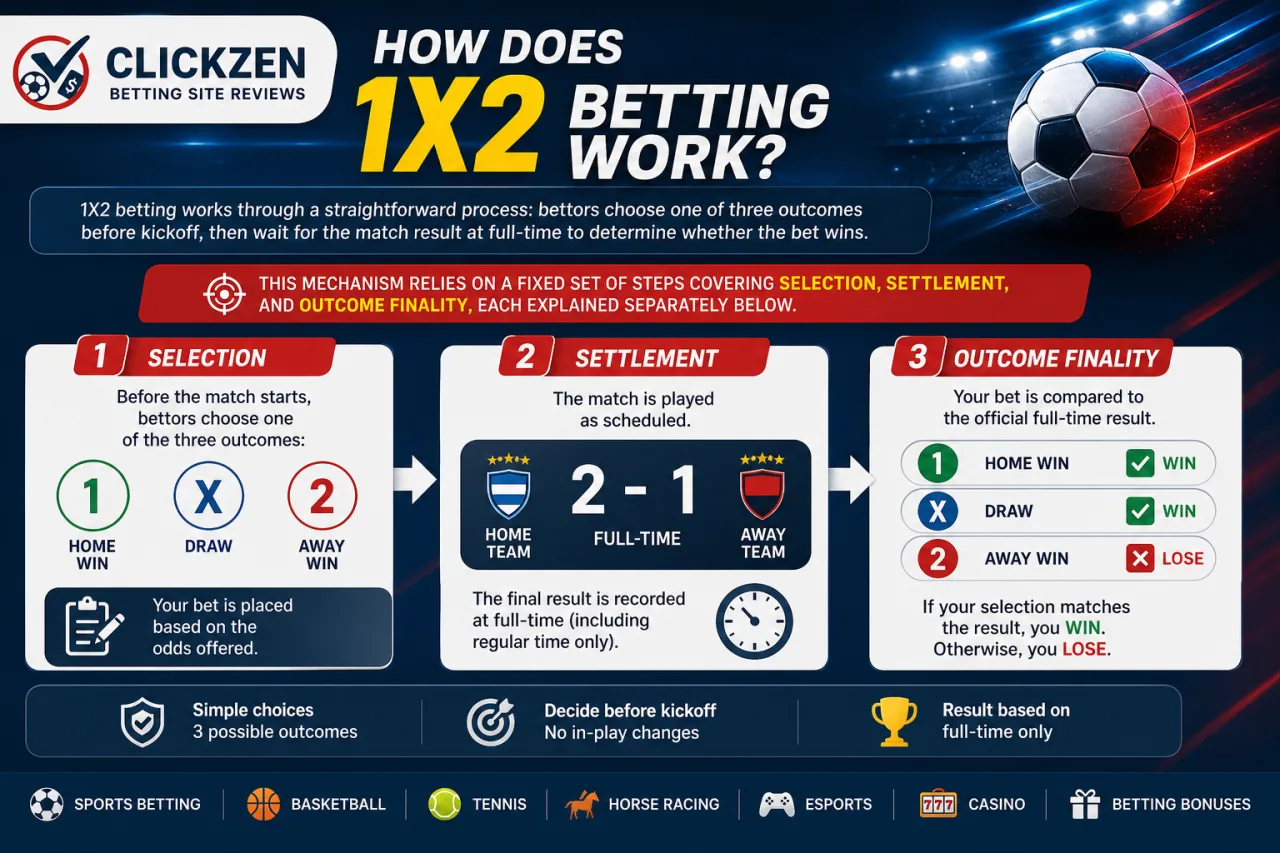
1X2 betting works through a straightforward process: bettors choose one of three outcomes before kickoff, then wait for the match result at full-time to determine whether the bet wins. This mechanism relies on a fixed set of steps covering selection, settlement, and outcome finality, each explained separately below.
What Do the Numbers 1, X, and 2 Represent?
In 1X2 betting, “1” represents a Home team win, “X” represents a Draw, and “2” represents an Away team win, with each symbol printed directly on the betting slip next to its corresponding odds. This labeling convention ties back to the same coding structure covered above for the 1X2 market.
Bookmakers apply this three-symbol system universally across football coupons and odds boards for practical reasons rather than arbitrary preference.
- Numbering the home team as “1” and the away team as “2” mirrors the fixture listing order, where the home side traditionally appears first.
- Using “X” for a draw avoids confusion with a third numeral, keeping the visual format compact on printed coupons and digital interfaces alike.
- Standardizing these three symbols across bookmakers lets bettors compare odds between different platforms without relearning a new notation system each time.
This consistency across operators makes the 1X2 format instantly recognizable regardless of which licensed bookmaker lists the market.
What Are the Different Types of 1X2 Bets Beginners Should Know?
1X2 betting includes three main variations based on match timeframe: Full-Time 1X2, Half-Time 1X2, and Second-Half 1X2. Each variant applies the same Home/Draw/Away structure but settles the bet against a different portion of the match rather than the entire game.
Full-Time 1X2 stands as the default version of this market and settles strictly on the score at the end of regulation time, matching the standard mechanics already described for 1X2 betting.
Half-Time 1X2 shifts the settlement point earlier, grading the bet solely on the score recorded at the interval break rather than the final result.
Second-Half 1X2 narrows the window even further by measuring only what happens from the restart to full-time, treating the second half as its own standalone contest for betting purposes.
These timeframe-based variants let bettors target specific segments of a match instead of committing to a single outcome across the full 90 minutes. A team leading at half-time carries no guarantee for the Full-Time market, and a Second-Half 1X2 bet resets that scoreline to zero regardless of what happened earlier in the game. Recognizing which variant a betting slip refers to prevents confusion when odds for the same fixture appear under multiple 1X2 listings.
How Do You Calculate 1X2 Odds and Payouts?
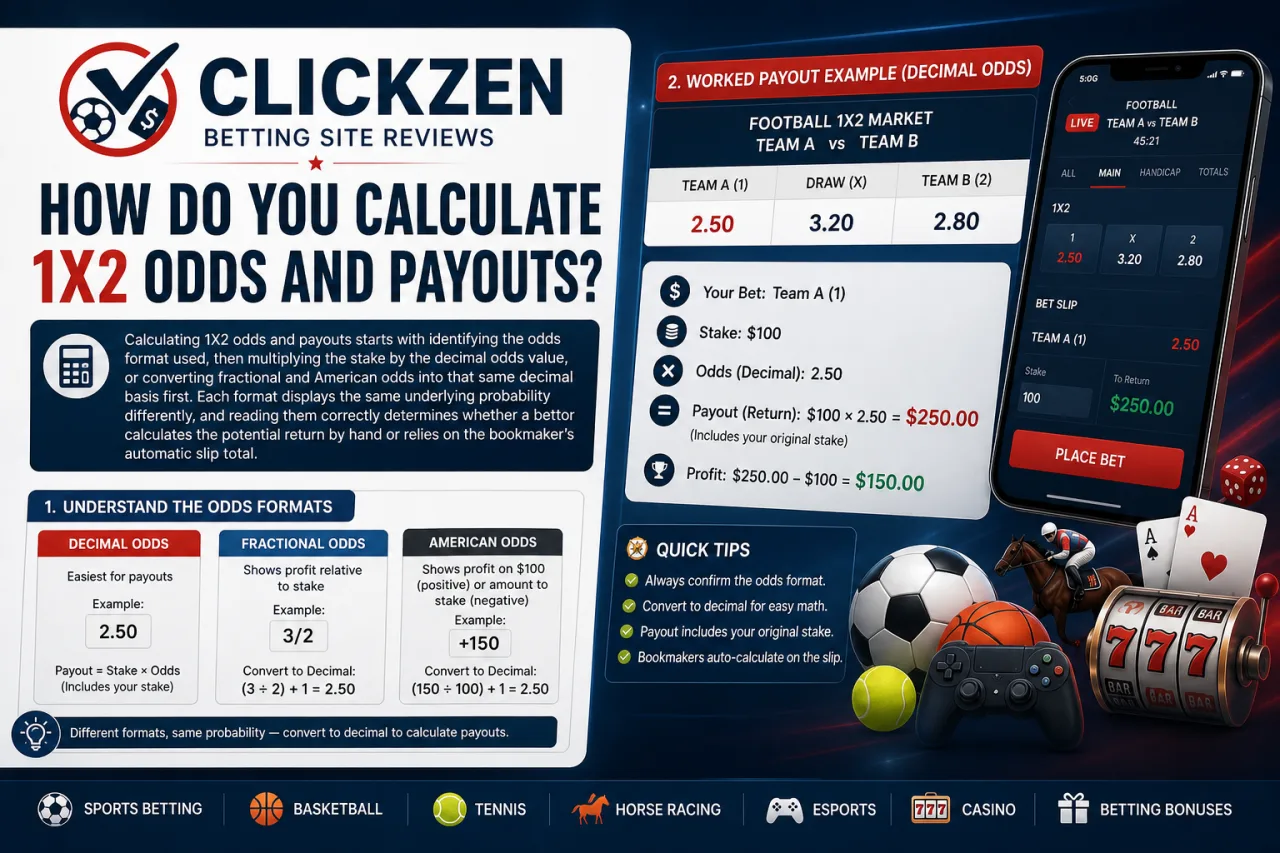
Calculating 1X2 odds and payouts starts with identifying the odds format used, then multiplying the stake by the decimal odds value, or converting fractional and American odds into that same decimal basis first. Each format displays the same underlying probability differently, and reading them correctly determines whether a bettor calculates the potential return by hand or relies on the bookmaker’s automatic slip total. The breakdown below covers how to read each format, a worked payout example, and how implied probability ties back to the odds themselves.
What Factors Influence 1X2 Odds Movement?
1X2 odds movement responds to four main factors: team form, home advantage, injuries or suspensions, and betting market demand, each pushing the bookmaker’s assessment of an outcome’s likelihood up or down before kickoff. These factors work independently or together, and bookmakers recalculate odds continuously as new information arrives rather than fixing a price once and leaving it unchanged.
Team form shifts odds when a side strings together wins or losses in recent matches, signaling a change in actual performance level compared to the previous assessment. Home advantage factors into the initial odds because the home team tends to convert scheduling and crowd familiarity into better results than the same fixture played away.
Injuries and suspensions move odds when a key player becomes unavailable, since losing a starting goalkeeper or top scorer changes the squad’s expected output for that match. Betting market demand affects odds directly through the bookmaker’s own liability management, as heavy staking on one outcome prompts a shortening of that outcome’s odds and a lengthening of the others.
Together, these four factors explain why 1X2 odds for the same fixture rarely stay static between the moment a match gets listed and the moment it kicks off.
How Does 1X2 Betting Compare to Other Match Result Markets?
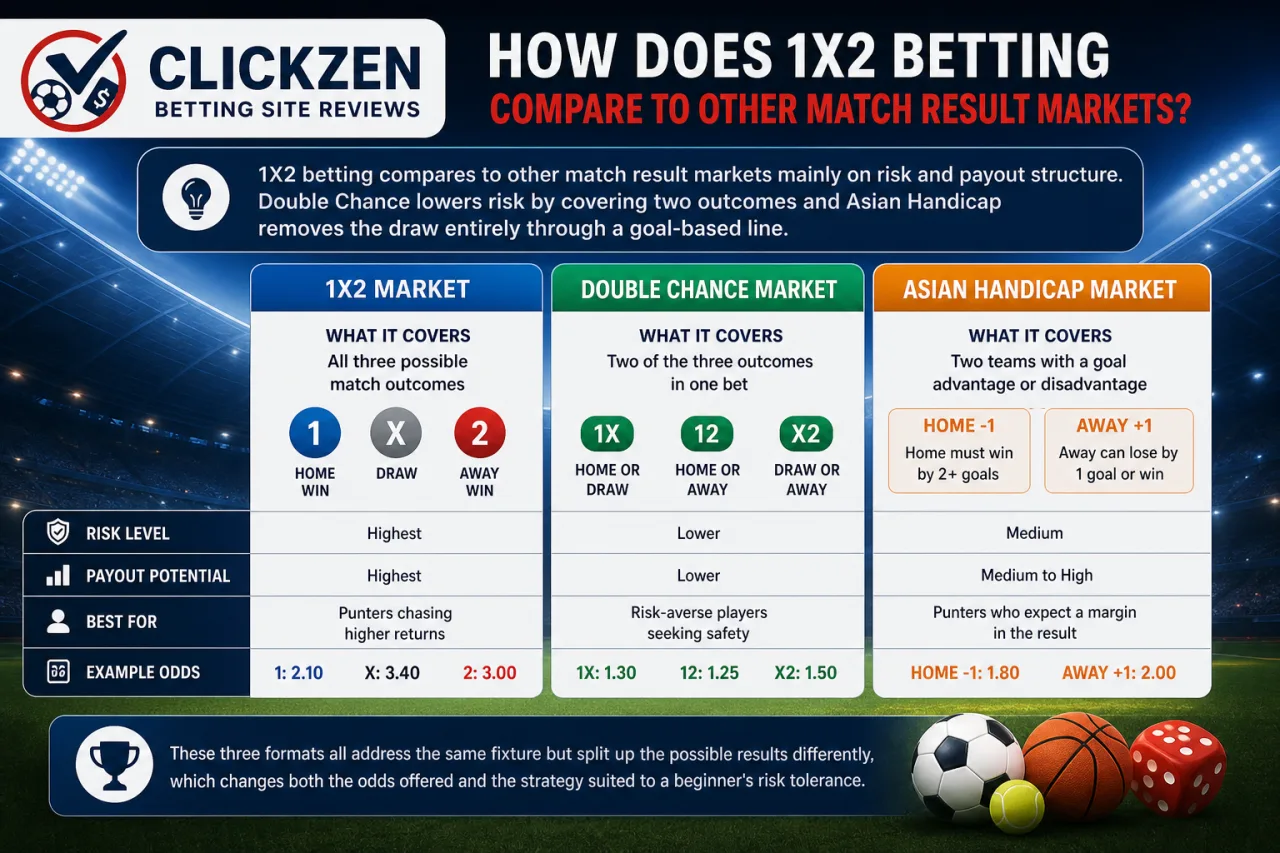
1X2 betting compares to other match result markets mainly on risk and payout structure, with Double Chance lowering risk by covering two outcomes and Asian Handicap removing the draw entirely through a goal-based line. These three formats all address the same fixture but split up the possible results differently, which changes both the odds offered and the strategy suited to a beginner’s risk tolerance.
Each market handles the draw and risk level in a distinct way:
- 1X2: keeps all three outcomes separate, offering higher potential payout for a single correct pick.
- Double Chance: combines two of the three 1X2 outcomes into one selection, such as Home-or-Draw, raising the probability of winning but lowering the odds compared to a single 1X2 result.
- Asian Handicap: eliminates the draw option by applying a goal advantage or disadvantage to one team, turning the bet into a two-way market instead of three-way.
A beginner more comfortable with straightforward, high-payout selections tends toward 1X2, while a beginner prioritizing a safer, lower-variance bet gravitates toward Double Chance. Asian Handicap suits a bettor who already understands goal-based adjustments and wants to bet on a clear favorite or underdog without the draw as a factor.
Choosing between these three markets ultimately depends on how much risk a beginner accepts in exchange for a larger or smaller potential payout.
Is 1X2 Betting Riskier Than Double Chance Betting?
Yes, 1X2 betting carries higher risk than Double Chance betting because it requires picking one exact outcome among three, while Double Chance covers two outcomes in a single selection. This risk gap ties directly back to how each market splits up the same fixture’s possible results.
Three factors explain the difference in risk level between these two formats:
- Narrowing the winning condition to a single outcome out of three lowers the statistical chance of the 1X2 bet landing correctly.
- Covering two outcomes at once raises the statistical chance of the Double Chance bet landing correctly, since only one result eliminates it.
- Compensating for that higher 1X2 risk, bookmakers assign larger potential payouts to a correct single-outcome selection compared to the reduced payout on a Double Chance bet covering the same fixture.
A beginner weighing these two formats faces a direct tradeoff rather than a clear better option. 1X2 betting suits a bettor willing to accept a lower win rate in exchange for a bigger payout on a correct pick, while Double Chance suits a bettor prioritizing a higher chance of winning over a smaller potential return.
Where Can Beginners Place 1X2 Bets?
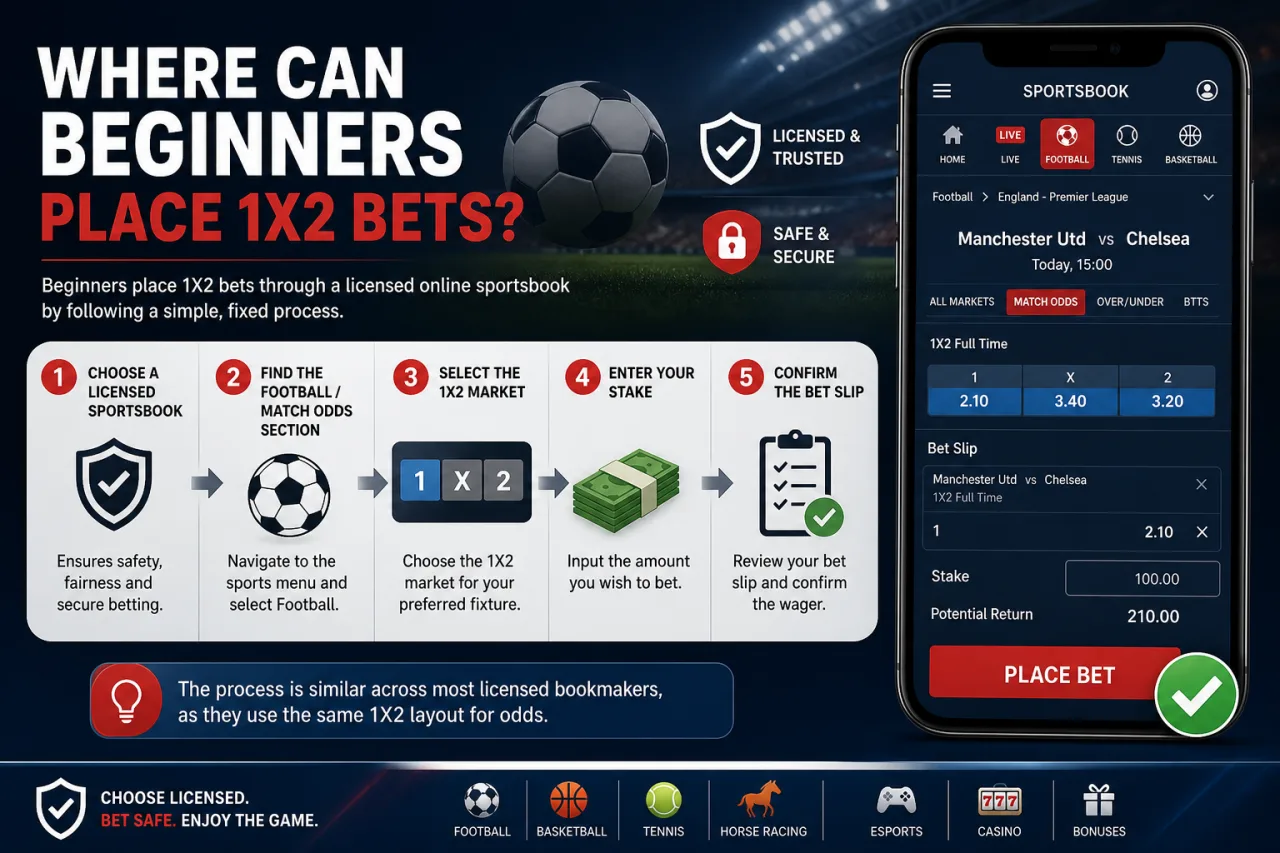
Beginners place 1X2 bets through a licensed online sportsbook by locating the football or match odds section, selecting the 1X2 market for a specific fixture, entering a stake, then confirming the bet slip. This placement process follows a fixed sequence rather than varying significantly between operators, since most licensed bookmakers structure their odds boards around the same 1X2 layout already described for this market.
- Choosing a licensed sportsbook comes first, as this determines whether the platform legally accepts bets in the bettor’s jurisdiction.
- Navigating to the football or match odds section narrows the listings down to fixtures offering a 1X2 market.
- Selecting the 1X2 market for the chosen fixture displays the Home, Draw, and Away odds side by side.
- Entering the stake amount calculates the potential payout automatically based on the selected outcome’s odds.
- Confirming the bet slip locks in the selection and stake, finalizing the wager before kickoff.
ClickZen reviews and compares licensed betting sites to help readers evaluate which platform fits their needs, though ClickZen itself does not accept bets or process any wagers. Checking a platform’s licensing status and the gambling laws in one’s own country matters before registering or placing any stake. This content targets readers of legal gambling age. 18+.
What Are the Best Tips and Strategies for Winning 1X2 Bets?
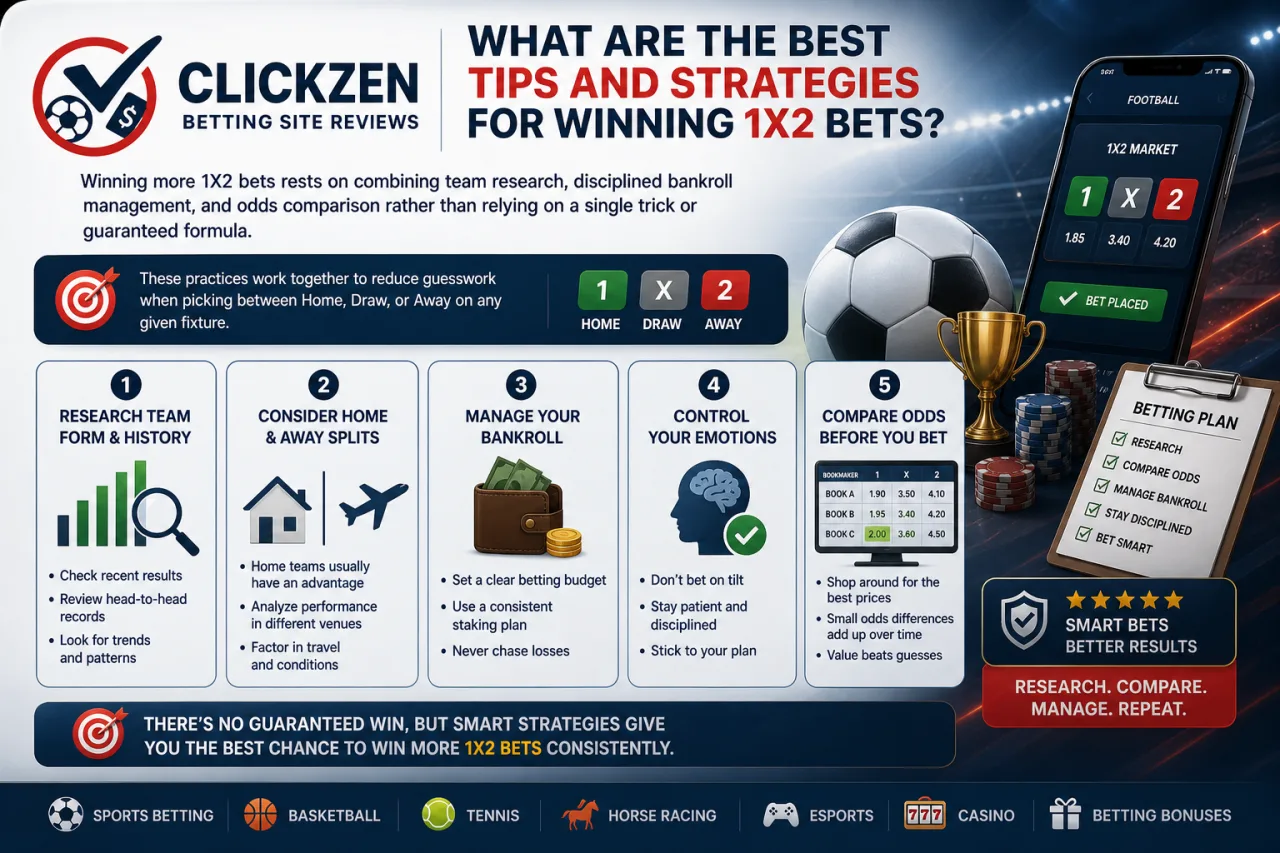
Winning more 1X2 bets rests on combining team research, disciplined bankroll management, and odds comparison rather than relying on a single trick or guaranteed formula. These practices work together to reduce guesswork when picking between Home, Draw, or Away on any given fixture. The points below cover researching form and history, weighing home/away splits, controlling emotion, managing stakes, and comparing odds before confirming a bet slip.
What Common Mistakes Should Beginners Avoid in 1X2 Betting?
Beginners commonly make four mistakes in 1X2 betting: ignoring the draw outcome, betting on team reputation alone, chasing losses, and skipping odds comparison across bookmakers. Each error stems from overlooking a factor already built into how the 1X2 market and its odds work.
- Ignoring the draw outcome overlooks how often matches end level, particularly between closely matched teams, which skews a beginner’s read of the true odds.
- Betting purely on team reputation disregards current form, injuries, and home advantage, factors that move 1X2 odds regardless of a club’s overall standing.
- Chasing losses pushes a bettor toward larger stakes on the next fixture to recover a previous loss, a pattern that departs from disciplined bankroll management.
- Skipping odds comparison across bookmakers settles for a lower payout on the same outcome when other licensed platforms list better 1X2 odds for that identical fixture.
Avoiding these four pitfalls keeps a beginner’s approach to 1X2 betting grounded in the same research, discipline, and odds-checking habits that separate a calculated selection from a guess.
What Are Some Lesser-Known Facts About 1X2 Betting?
1X2 betting includes several lesser-known aspects beyond the beginner basics already covered, spanning historical origin, market pricing quirks, and niche variants used by experienced bettors. These niche insights sit outside the core mechanics of choosing Home, Draw, or Away, and instead touch on where the format came from and how odds behave in less obvious situations.
Why Is the Draw Outcome Historically Underestimated by Bettors?
The draw outcome sits historically underestimated by bettors because casual bettors gravitate toward backing a clear winner, leaving the Draw price inflated relative to its true statistical frequency in balanced fixtures. This gap between perceived and actual draw probability ties back to the same 1X2 structure covered earlier, where Home and Away carry more emotional appeal than a neutral result.
Psychological bias drives much of this underestimation, since bettors favor a definitive outcome over a “nothing happens” result, even when the fixture involves two closely matched sides.
Bookmakers and betting analysts commonly observe that casual bettors underweight the draw outcome compared to its actual occurrence rate in balanced fixtures.
This pattern shows up more in certain leagues than others, where tightly contested mid-table matchups produce draws at a rate the betting public consistently discounts.
Some sharp bettors look for leagues or matchups where draws appear to occur more often than the initial odds suggest, using that pattern to inform their bets.
Sharp bettors exploit this value gap by targeting the Draw selection specifically in matches where team form, home advantage, and recent head-to-head results point toward a level contest rather than a lopsided one.
How Do Professional Bettors Use 1X2 Odds for Arbitrage Betting?
Professional bettors use 1X2 odds for arbitrage betting by placing simultaneous bets on all three outcomes of the same fixture across different bookmakers, locking in a profit regardless of the final result whenever the combined odds create a pricing gap. This tactic sits well beyond typical beginner use of the 1X2 market covered so far.
Arbitrage depends on odds discrepancies rather than prediction skill, since each bookmaker prices Home, Draw, and Away independently based on its own liability and market demand. A profitable arbitrage opportunity across bookmakers on a single 1X2 market appears infrequently and requires fast execution before odds correct.
This technique demands constant odds monitoring across multiple licensed platforms, precise stake calculation to guarantee a return on every outcome, and accounts open with several bookmakers at once. Beginners typically skip this method given its complexity and the speed required to act before odds shift.
Conclusion
At its core, 1X2 betting reduces a football match to three possible results, Home, Draw, or Away, with odds reflecting the bookmaker’s view of each outcome’s likelihood and a payout determined by the stake and the format those odds are shown in. Full-Time, Half-Time, and Second-Half variants apply that same structure to different portions of a game, while comparisons with Double Chance and Asian Handicap highlight where 1X2 sits on the risk-and-payout spectrum. For a beginner, grasping this three-way framework, how odds move, and where to place a bet through a licensed platform covers everything needed to approach the market with confidence. 18+, gamble responsibly.
Zorvan Hale is a Betting & Casino Analyst at ClickZen with over eight years of experience. He provides objective reviews of global betting platforms, focusing on withdrawal terms, KYC processes, and real user experience to help you make informed and safer betting decisions.

New Casinos

Zula Casino is a U.S.-focused social and sweepstakes gaming platform offering casino-style games through Gold Coins and Sweeps Coins. Eligible users can earn Sweeps Coins through no-purchase methods and promotions, with prize redemptions starting from 50 SC.

William Hill is a long-established sportsbook and casino brand founded in 1934. Its UK and international operations are owned by evoke plc and regulated through recognised authorities including the UK Gambling Commission. The platform offers sports betting, Bet Builder, selected Cash Out, casino games, mobile betting and multiple payment options, although features and promotions vary by jurisdiction.

Winamax is a regulated European betting and poker operator with licensed operations in France, Spain, and Germany. It combines pre-match and live sports betting with a dedicated poker ecosystem featuring cash games, tournaments, Sit & Go, and Expresso, while product availability varies by jurisdiction.

Vave is a crypto-focused sportsbook and casino offering sports, esports, slots and live dealer games, but its unclear current licensing status remains a significant trust concern.

W88 is a multi-product betting brand offering sportsbook, live betting, slots, and live casino games. Its operator, licence, promotions, and payment methods vary by regional domain.

Videoslots is a Malta-based online casino and sportsbook with a large game library, multiplayer casino features and licences across several regulated markets.


Top Rated Casinos

FanDuel is a regulated North American betting and gaming brand offering Sportsbook, Casino, Fantasy, Racing and prediction markets, with product availability determined by state or provincial regulations.

DraftKings is a regulated North American sportsbook and gaming operator offering sports betting, live wagering, casino games, daily fantasy sports, Pick6 and horse racing in eligible jurisdictions.

Fanatics Sportsbook is a regulated U.S. betting platform available in 23 states plus Washington, D.C., offering major sports markets, live betting, same game parlays and a distinctive FanCash rewards ecosystem.


ClickZen is an independent betting information and review website providing clear, practical insights into sportsbooks, online casinos, betting apps, bonuses, and related services for a global audience.
This website is intended for users aged 18 and over. Gambling can be addictive, so please gamble responsibly. The content on this website is for informational purposes only.
About ClickZen