
New to moneyline bets? Discover how they work, how odds convert to payouts, and how they compare to spreads and totals—start betting smarter today.
Moneyline Betting Explained: Complete Guide for Bettors

Moneyline betting is a wager on which side wins a game or match outright, without requiring the bettor to predict a point spread or margin of victory. This bet type is common across sports such as baseball, hockey, boxing, MMA, and soccer, although settlement rules and available moneyline markets can vary by sport and sportsbook.
Moneyline odds are commonly displayed as positive or negative numbers when using American odds, such as -150 or +130. In a typical two-way market, negative odds usually indicate the favorite, while positive odds usually indicate the underdog.
Converting moneyline odds to implied probability requires a different formula depending on whether the American odds are negative or positive. For negative odds, divide the absolute value of the odds by the absolute value of the odds plus 100. For positive odds, divide 100 by the odds plus 100. Multiply the result by 100 to express it as a percentage.
Moneyline bets differ from point spread and totals bets because they focus on the winner rather than the margin of victory or combined score. Point spreads apply a handicap to the result, while totals bets ask whether the combined score finishes over or under a number set by the sportsbook.
Calculating moneyline payouts depends on the odds and stake, while the factors used to evaluate a moneyline can differ significantly by sport. This guide from ClickZen explains how moneyline betting works, how odds and implied probability are calculated, and how moneyline markets compare with other common sports bets.
What Is Moneyline Betting?

Moneyline betting is a wager on which side wins a game or match outright, without requiring the bettor to predict a point spread, handicap, or margin of victory. The bettor selects an outcome, and the odds attached to that selection reflect the sportsbook’s pricing of its probability and potential payout.
This straightforward structure makes the moneyline one of the easiest sports-betting markets to understand. However, the exact settlement rules can differ depending on the sport and the type of moneyline offered.
Moneyline betting is particularly common in sports such as:
- Baseball, where bettors can back the outright winner instead of using the run line
- Hockey, where moneyline markets provide an alternative to the puck line
- Boxing and MMA, where betting often focuses directly on which fighter wins
- Soccer, where three-way moneyline markets can include home win, draw, and away win
Because moneyline betting does not require bettors to predict a margin of victory, the primary question is simply which listed outcome will win under the sportsbook’s settlement rules.
Why Is It Called a ‘Moneyline’?
The term “moneyline” refers to the odds line that determines how much a bettor must risk or can win when betting directly on an outcome. Unlike a point spread, the number does not represent a scoring handicap.
In American odds, the moneyline indicates the relationship between stake and potential profit. A negative price shows how much generally must be risked to win $100 in profit, while a positive price shows how much profit a $100 stake would return.
Sportsbooks therefore display the moneyline separately from spreads and totals because it prices the outcome itself rather than a scoring margin or combined score.
What Are the Main Types of Moneyline Bets?
Moneyline markets can generally be divided into two-way and three-way formats, with favorite and underdog pricing appearing within those markets depending on the matchup.
In a typical two-way American moneyline market, the favorite usually carries negative odds and the underdog usually carries positive odds. Negative odds indicate how much must be risked to generate $100 in profit, while positive odds indicate how much profit a $100 stake can generate.
Three-way moneyline betting is common in soccer and some regulation-time markets. It provides three possible selections:
- Home win
- Draw
- Away win
Because the draw is priced as a separate outcome, both teams can sometimes carry positive American odds even when one side is considered the favorite.
A pick’em market can also appear when neither side is clearly favored. In these situations, the two selections may be priced at identical or very similar odds.
How Are Moneyline Odds Formatted?

Moneyline odds can be displayed in American, decimal, or fractional format, with each format representing the same underlying price in a different way. Sportsbooks may use different default formats depending on their market and region.
American odds use positive and negative numbers referenced to $100. Decimal odds show the total return per unit staked, including the original stake. Fractional odds express potential profit relative to the amount staked.
The table below shows approximately equivalent prices:
| Format | Favorite Example | Underdog Example |
|---|---|---|
| American | -150 | +130 |
| Decimal | 1.67 | 2.30 |
| Fractional | 2/3 | 13/10 |
Many sportsbooks allow bettors to change the displayed odds format without changing the underlying probability or payout represented by the price.
American vs Decimal vs Fractional Odds: What’s the Difference?
American, decimal, and fractional odds differ mainly in how they display potential returns. Decimal odds show total return per unit staked, American odds use a $100 reference point, and fractional odds show profit relative to stake.
- Decimal odds can be multiplied directly by the stake to calculate total return
- American odds require different payout formulas for positive and negative prices
- Fractional odds show profit as a ratio, with the original stake added separately to calculate total return
For example, American odds of -150 convert to decimal odds of approximately 1.67 and fractional odds of 2/3. A $60 stake at the exact -150 price generates $40 in profit and a total return of $100. Small differences can appear when using rounded decimal prices such as 1.67.
How Do You Convert Moneyline Odds to Implied Probability?

Converting American moneyline odds to implied probability requires separate formulas for negative and positive prices. Implied probability translates the sportsbook’s listed odds into the percentage chance represented by that price before adjusting for bookmaker margin.
For negative odds:
Implied Probability = |Odds| ÷ (|Odds| + 100) × 100
For positive odds:
Implied Probability = 100 ÷ (Odds + 100) × 100
These calculations make it easier to compare the sportsbook’s price with a bettor’s own estimate of an outcome’s probability.
How Do You Calculate Implied Probability for Negative Moneyline Odds?
For negative American odds, divide the absolute value of the odds by the absolute value of the odds plus 100.
For example, a moneyline of -150 converts as follows:
150 ÷ (150 + 100) × 100 = 60%
The -150 price therefore represents an implied probability of 60% before removing the bookmaker’s margin.
How Do You Calculate Implied Probability for Positive Moneyline Odds?
For positive American odds, divide 100 by the odds plus 100.
For example, a moneyline of +130 converts as follows:
100 ÷ (130 + 100) × 100 ≈ 43.48%
The +130 price therefore represents an implied probability of approximately 43.48% before adjusting for bookmaker margin.
What Is Bookmaker Margin in Moneyline Odds?
Bookmaker margin is reflected when the implied probabilities of all outcomes in a market add up to more than 100%. The amount by which the total exceeds 100% is commonly called the overround.
Consider a two-way moneyline market where one side has an implied probability of 55% and the other has an implied probability of 50%.
55% + 50% = 105%
The market therefore has an overround of 5 percentage points. This reflects the sportsbook’s built-in pricing advantage rather than a separate fee charged after the bet is placed.
A market whose combined implied probabilities are closer to 100% generally has a tighter pricing structure. However, overround should not be treated as mathematically identical to the sportsbook’s actual realized hold, since actual hold also depends on how money is wagered across the available outcomes.
How Does Moneyline Betting Compare to Point Spread and Totals Betting?
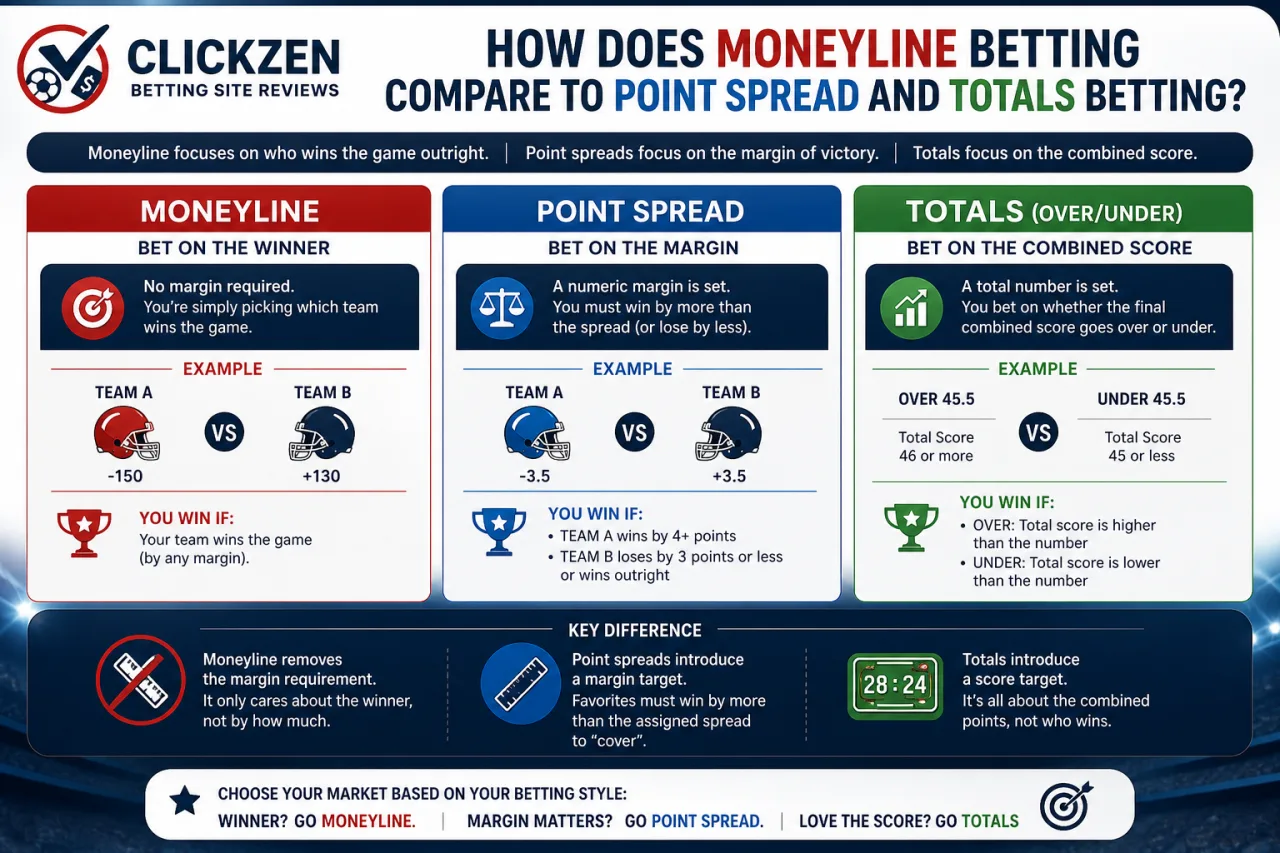
Moneyline betting focuses on the winning outcome, while point spread betting applies a scoring handicap and totals betting focuses on the combined score. Each market therefore asks the bettor to evaluate a different aspect of the same game.
With a point spread, a favorite usually needs to win by more than the assigned handicap for the wager to cover. An underdog can cover by winning outright or, depending on the spread, losing by fewer points than the assigned number.
Totals betting ignores which team wins and instead asks whether the combined score finishes above or below a number set by the sportsbook.
The pricing also differs. Moneyline odds can vary significantly between favorites and underdogs, while standard spread and totals markets often use prices close to even money on both sides, with the sportsbook primarily adjusting the spread or total itself.
Moneyline vs Point Spread: Which Should You Choose?
Moneyline betting is useful when the bettor wants to focus only on the winner, while point spread betting becomes relevant when the expected margin of victory matters.
In baseball and hockey, moneyline markets are especially common because they allow bettors to select the outright winner without requiring a run or goal handicap. Run lines and puck lines remain widely available alternatives for bettors who prefer margin-based markets.
In higher-scoring sports such as basketball and American football, point spreads are also widely used because they can create a more balanced market when one team is a substantial favorite.
A heavy favorite may offer a relatively small potential profit on the moneyline. In that situation, some bettors may instead consider the spread, although the two bets carry different conditions and should not be treated as interchangeable.
Moneyline vs Totals (Over/Under): How Do They Differ?
Moneyline betting asks which side wins, while totals betting asks how many points, runs, or goals will be scored in total.
A moneyline bettor selects an outcome and is graded according to the winner under the market’s settlement rules. A totals bettor chooses whether the combined score will finish over or under the sportsbook’s posted number.
- Moneyline betting requires identifying the winning outcome
- Totals betting requires estimating total scoring output
- Moneyline prices can differ significantly between favorite and underdog selections
- Totals markets often keep both sides near similar prices while adjusting the posted total
The two markets can therefore produce entirely different results from the same game. A team can win while the total finishes either over or under, depending on the final score.
How Do You Calculate Moneyline Payouts?

Moneyline payout calculations use different formulas for negative and positive American odds. Negative odds show how much must generally be risked to generate $100 in profit, while positive odds show how much profit a $100 stake would generate.
For negative odds:
Profit = Stake × 100 ÷ |Odds|
For positive odds:
Profit = Stake × Odds ÷ 100
Total return equals the original stake plus the calculated profit.
- A $100 stake at -150 generates $66.67 in profit and a total return of $166.67
- A $100 stake at +130 generates $130 in profit and a total return of $230
| Stake | -150 Total Return (Profit) | +130 Total Return (Profit) |
|---|---|---|
| $50 | $83.33 ($33.33) | $115 ($65) |
| $100 | $166.67 ($66.67) | $230 ($130) |
| $200 | $333.33 ($133.33) | $460 ($260) |
The difference reflects the probability embedded in the odds. Favorites generally produce less profit relative to the same stake, while underdogs offer larger potential profits because they are priced as less likely outcomes.
How Much Do You Win on a Favorite vs an Underdog Bet?
A favorite generally produces a smaller potential profit relative to stake, while an underdog generally produces a larger potential profit at the same stake.
At -150, risking $150 would generate $100 in profit if the bet wins. A $100 stake at that same price generates $66.67 in profit.
At +130, a $100 stake generates $130 in profit if the bet wins.
The larger potential payout on the underdog does not automatically make it a better bet. The price also reflects the sportsbook’s assessment that the underdog is less likely to win. Evaluating value therefore requires comparing the offered odds with an independent estimate of the outcome’s probability.
What Strategies Can Bettors Use With Moneyline Bets?

Moneyline betting strategy generally involves evaluating price rather than simply trying to identify the most likely winner. Bettors can also consider bankroll management and compare odds across sportsbooks before placing a wager.
A side can be highly likely to win but still offer poor value if the price requires a probability greater than the bettor believes is justified. Conversely, an underdog can lose more often than it wins while still represent value if its offered price is sufficiently high relative to its estimated chance of winning.
Common considerations include:
- Comparing implied probability with an independently estimated probability
- Comparing the same moneyline across multiple sportsbooks
- Controlling stake size rather than increasing bets simply because a side is heavily favored
- Accounting for sport-specific factors that influence win probability
Does Moneyline Strategy Differ Across Sports?
Yes, the factors used to evaluate a moneyline differ across sports because each sport has different scoring patterns, lineup variables, and game-state influences.
In baseball, starting pitchers, bullpen availability, lineups, and venue conditions can influence the probability of each team winning. In hockey, goaltending, injuries, special teams, and scheduling factors can affect the matchup.
In boxing and MMA, analysis is more fighter-specific and may include style matchups, recent performance, physical attributes, and preparation. Soccer moneyline analysis must also account for the draw when using a three-way market, which changes the probability distribution compared with a two-way market.
The mathematical relationship between odds, implied probability, and payout remains the same even though the information used to estimate win probability changes from one sport to another.
What Are the Pros and Cons of Moneyline Betting?
Moneyline betting offers simplicity and removes the need to predict a margin of victory, but heavily favored selections can provide relatively small potential returns.
Advantages include:
- The bettor only needs to identify the winning outcome under the market rules
- No point spread or handicap needs to be covered
- The market is straightforward for newer bettors to understand
- Moneylines work naturally in sports where selecting the outright winner is a primary betting market
Potential disadvantages include:
- Heavy favorites can require a relatively large risk for a comparatively small potential profit
- A high probability of winning does not automatically mean the offered odds provide good value
- Comparing a moneyline with alternative spread or handicap markets may require additional analysis
- Sportsbook margin is already incorporated into the listed prices
No betting market is inherently superior in every situation. Whether the moneyline, spread, or another market is appropriate depends on the matchup, available odds, and the bettor’s assessment of probability.
What Advanced or Situational Moneyline Concepts Should Bettors Know?
Three situational moneyline concepts bettors may encounter are three-way markets, live moneyline betting, and moneyline parlays. Each uses the same basic relationship between odds, probability, and payout but applies it to a different market structure.
How Does a Three-Way Moneyline Work?
A three-way moneyline provides three separate outcomes to bet on, typically home win, draw, or away win. This format is especially common in soccer and can also appear in regulation-time markets for other sports.
The key difference from a two-way moneyline is that a draw is treated as its own betting selection rather than being removed through overtime or another settlement rule.
For example, if a bettor selects the home team in a three-way soccer moneyline and the match ends in a draw after the market’s specified settlement period, the home-team wager loses because the draw was a separate available outcome.
Bettors should therefore check whether a market is two-way or three-way and confirm whether overtime, extra time, or another period is included in settlement.
How Does Live Moneyline Betting Work During a Game?
Live moneyline betting allows odds to change during an event as the sportsbook updates the estimated probability of each outcome.
Live prices can change in response to factors such as:
- Changes in the score
- Time remaining
- Possession or game state
- Penalties or red cards
- Pitching or goaltending changes
- Player injuries or substitutions
The impact of these events varies by sport. A one-goal lead late in a hockey game, for example, has a different effect on win probability than the same lead early in the first period.
Because live odds can move rapidly, the price available when a bettor attempts to place a wager may differ from the price shown only moments earlier.
Can Moneyline Bets Be Combined Into Parlays?
Yes, moneyline selections can generally be combined with other eligible bets in a parlay, subject to the sportsbook’s rules. A parlay links multiple selections into one wager and offers a larger potential payout because all required legs generally need to win.
The combined decimal price of a standard parlay can be calculated by multiplying the decimal odds of its individual legs.
If one required leg loses, the parlay normally loses as well. If a leg is graded as a push or void, sportsbooks commonly remove that selection and recalculate the parlay using the remaining valid legs, although exact settlement rules can vary by operator and market.
Parlays therefore offer larger potential payouts than individual straight bets but also carry greater risk because multiple outcomes must be correct.
Conclusion
Moneyline betting focuses on one central question: which listed outcome will win under the sportsbook’s settlement rules. Understanding American, decimal, and fractional odds makes it easier to interpret prices, while converting those prices into implied probability helps bettors understand what probability is built into the market.
Negative and positive American odds use different formulas for both implied probability and payout calculation. Bettors should also account for bookmaker overround, distinguish two-way markets from three-way markets, and check individual settlement rules for draws, overtime, pushes, and void selections.
Moneyline betting can be simpler than predicting a point spread or total, but correctly identifying a likely winner does not automatically mean a wager offers favorable value. Comparing the offered price with a realistic assessment of probability remains an important part of evaluating any moneyline bet.
Zorvan Hale is a Betting & Casino Analyst at ClickZen with over eight years of experience. He provides objective reviews of global betting platforms, focusing on withdrawal terms, KYC processes, and real user experience to help you make informed and safer betting decisions.


Top Rated Casinos

FanDuel is a regulated North American betting and gaming brand offering Sportsbook, Casino, Fantasy, Racing and prediction markets, with product availability determined by state or provincial regulations.

DraftKings is a regulated North American sportsbook and gaming operator offering sports betting, live wagering, casino games, daily fantasy sports, Pick6 and horse racing in eligible jurisdictions.

Fanatics Sportsbook is a regulated U.S. betting platform available in 23 states plus Washington, D.C., offering major sports markets, live betting, same game parlays and a distinctive FanCash rewards ecosystem.


ClickZen is an independent betting information and review website providing clear, practical insights into sportsbooks, online casinos, betting apps, bonuses, and related services for a global audience.
This website is intended for users aged 18 and over. Gambling can be addictive, so please gamble responsibly. The content on this website is for informational purposes only.
About ClickZen