
New to point spread betting? Discover how it works, key terms, and real examples to bet smarter across football, basketball and more.
Point Spread Betting Explained: A Complete Beginner’s Guide

Point spread betting is a wager in which a sportsbook assigns a handicap to each side of a matchup to account for the difference in perceived strength between the teams. Instead of simply choosing who will win, bettors predict whether the favorite can win by more than the spread or whether the underdog can stay within the assigned margin.
A favorite normally carries a negative spread, such as -6.5, while an underdog carries a positive spread, such as +6.5. The handicap is applied when settling the wager, determining whether a team covers the spread, fails to cover, or produces a push.
Point spread betting differs from moneyline and totals betting because it focuses on the margin of victory. A moneyline bet is based only on which team wins outright, while a totals bet is based on whether the combined score finishes over or under a sportsbook’s posted number.
For example, a football team listed at -6.5 must win by 7 or more points to cover. Its opponent at +6.5 covers by winning outright or losing by 6 points or fewer.
Understanding these mechanics provides the foundation for using point spreads across football, basketball, hockey, soccer handicap markets, and other sports. ClickZen also covers related betting concepts such as odds formats, moneylines, totals, and sportsbook terminology.
What Is Point Spread Betting?
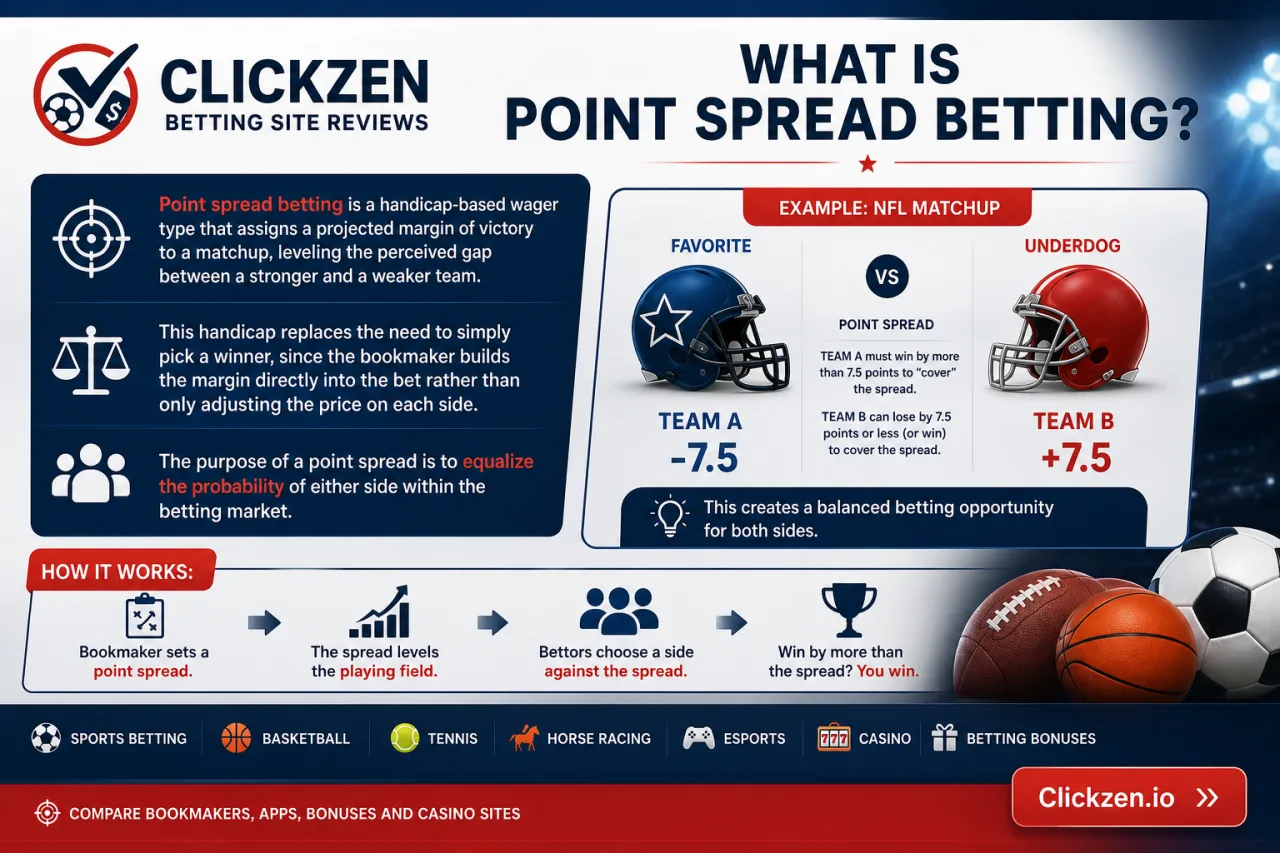
Point spread betting is a handicap-based betting market in which a sportsbook assigns points to each side of a matchup before the game begins. The purpose is to create a more balanced betting proposition between teams of different perceived strengths.
Rather than simply asking which team will win, the spread introduces a margin that the favorite must overcome. The underdog receives the same number of points as a virtual scoring advantage.
For example:
- Favorite: -6.5
- Underdog: +6.5
A bet on the favorite wins if that team wins by at least 7 points. A bet on the underdog wins if it wins outright or loses by no more than 6 points.
Sportsbooks often attach similar prices to both sides of the main spread, commonly around -110 in American odds, although both the spread and its price can change as the market develops.
Point spreads therefore differ from moneyline bets, where only the outright winner matters, and totals bets, where bettors predict the combined score of both teams.
How Does Point Spread Betting Work?
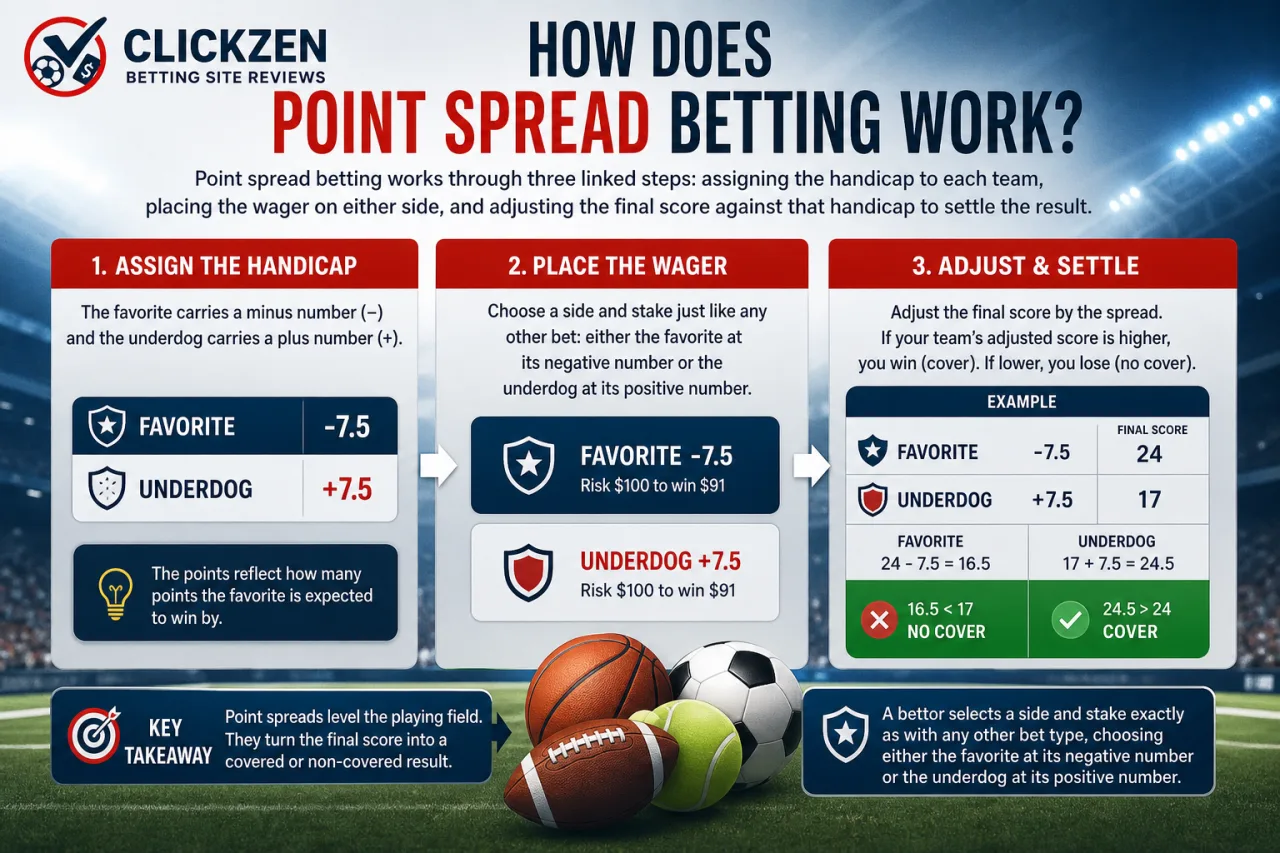
Point spread betting works by assigning a handicap to both teams and applying that handicap when the wager is settled.
The process generally involves three steps:
- Identify the favorite and underdog
- Choose one side of the spread and place a stake
- Compare the final scoring margin with the assigned spread
Suppose a basketball matchup is listed as:
- Team A: -5.5
- Team B: +5.5
If Team A wins 105-98, its winning margin is 7 points. Because 7 is greater than 5.5, Team A covers the spread.
If Team A wins only 101-98, its winning margin is 3 points. Team A wins the game outright but fails to cover, meaning Team B +5.5 wins the spread bet.
What Do the Plus (+) and Minus (−) Signs Mean in a Point Spread?
A minus sign normally identifies the favorite, while a plus sign normally identifies the underdog.
A favorite at -6.5 effectively has 6.5 points subtracted from its final score for betting purposes. It therefore needs to win by at least 7 points to cover.
An underdog at +6.5 effectively receives an additional 6.5 points. It covers by:
- Winning the game outright
- Losing by 1 to 6 points
For example, if the favorite is -6.5 and wins 27-20, the 7-point margin is enough to cover.
If the favorite wins 24-20, the 4-point margin is not enough. The underdog +6.5 covers instead.
Half-point spreads such as 6.5 also prevent a push because a game’s scoring margin cannot finish at exactly half a point.
One exception is a pick’em, often displayed as PK or PICK. In that market, neither team receives a point advantage, so bettors simply choose which side will win.
How Are Point Spread Odds Priced?
Point spread odds are frequently priced around -110 on both sides of the main line, although the exact price can vary by sportsbook and market conditions.
At -110, a bettor risks $110 to make $100 in profit.
The -110 price also creates a theoretical margin for the sportsbook. In implied probability terms:
- -110 = approximately 52.38%
- Two sides at -110 = approximately 104.76% combined implied probability
The amount above 100% represents the market’s theoretical bookmaker margin or overround.
However, this does not mean a sportsbook earns that exact margin on every game. Actual results depend on how much money is wagered on each side, the prices offered, liability, and the final outcome.
Sportsbooks may also adjust either the spread or the price. For example, a line could move from -6.5 (-110) to -6.5 (-120), or the spread itself could move from -6.5 to -7.
What Key Terms Should You Know in Point Spread Betting?
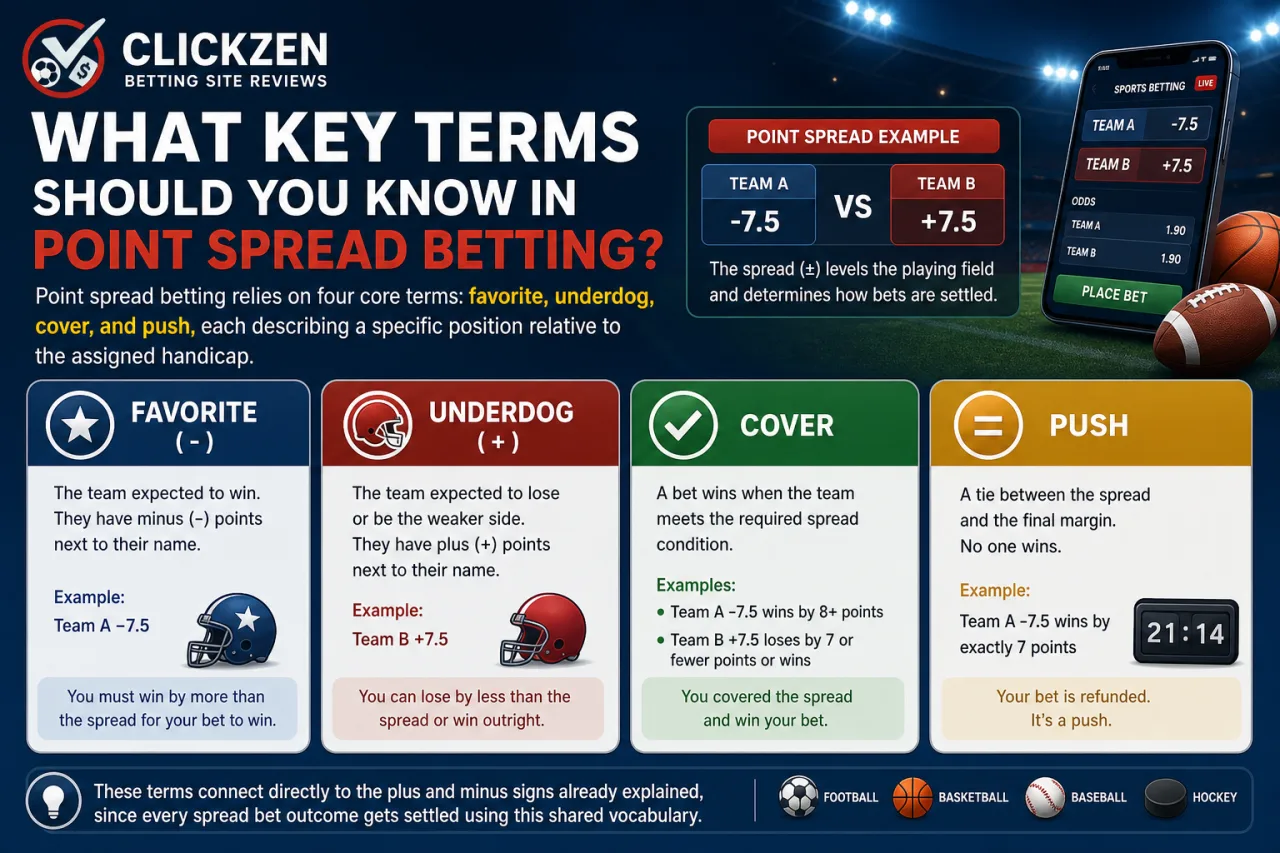
The most important point spread terms include favorite, underdog, cover, fail to cover, and push.
The favorite is the team expected by the market to be stronger and usually carries a negative spread.
The underdog receives a positive spread, giving it a scoring cushion for settlement purposes.
A team covers the spread when its adjusted result beats the opposing side after the handicap is applied.
A team fails to cover when its result does not meet the required spread.
A push occurs when the final margin matches a whole-number spread exactly.
What Does It Mean to Cover the Spread?
Covering the spread means a team performs well enough against its assigned handicap for the bet on that team to win.
For a favorite, this normally means winning by more than the spread.
For an underdog, it means either:
- Winning outright
- Losing by fewer points than the spread
For example, consider:
- Favorite: -6.5
- Underdog: +6.5
If the favorite wins 24-16, the margin is 8 points. The favorite covers.
If the favorite wins 24-20, the margin is only 4 points. The favorite fails to cover, while the underdog +6.5 covers.
This is why correctly predicting the winner of a game does not necessarily mean winning a point spread bet.
What Is a Push in Point Spread Betting?
A push occurs when the final scoring margin lands exactly on a whole-number spread.
Suppose the line is:
- Favorite: -7
- Underdog: +7
If the favorite wins by exactly 7 points, neither side covers.
For a standard straight spread bet, the stake is typically refunded.
Push rules can differ for parlays and other multi-leg wagers, so bettors should check the sportsbook’s settlement rules before placing those bets.
Half-point lines such as -6.5 or +6.5 avoid pushes because a scoring margin cannot finish at exactly 6.5.
Point Spread vs Moneyline vs Totals: What Is the Difference?
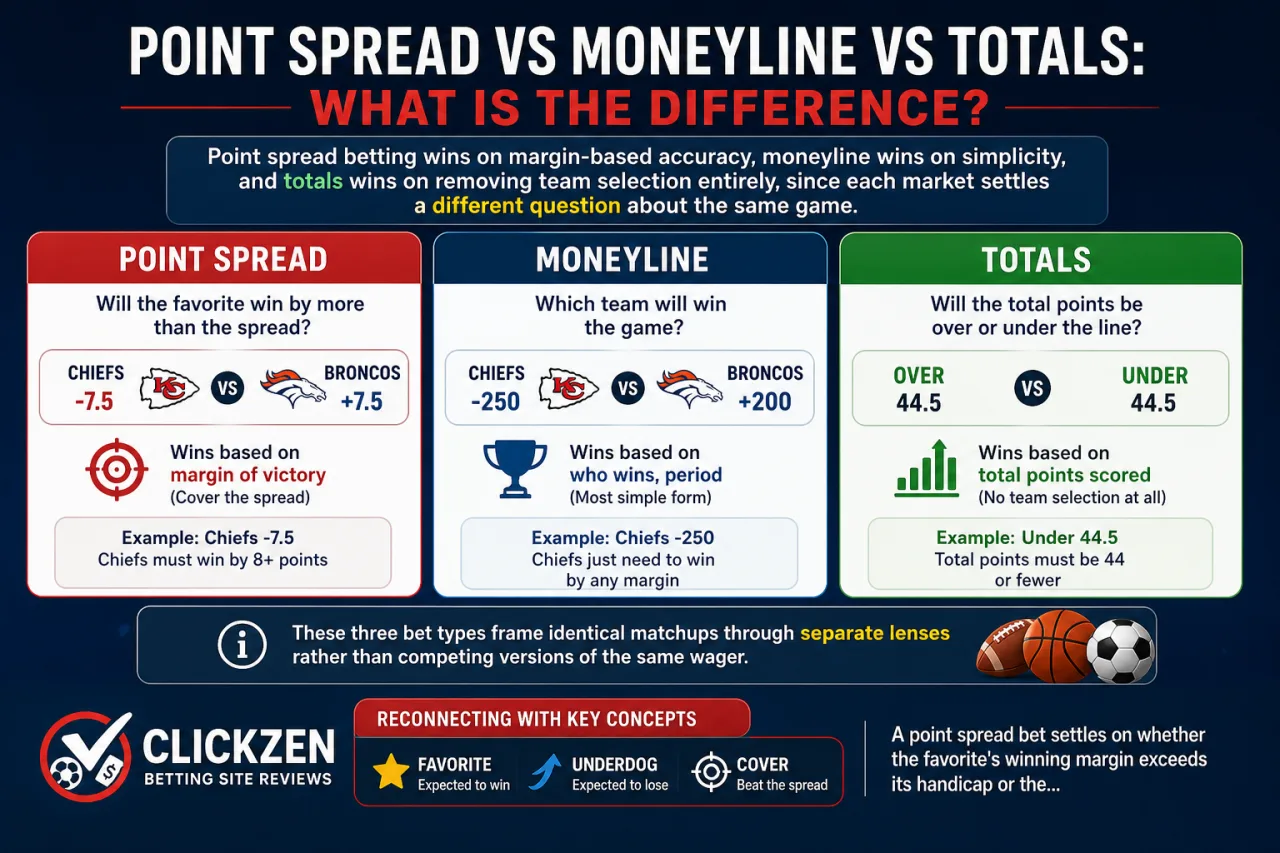
Point spread, moneyline, and totals bets settle different questions about the same sporting event.
A point spread asks whether a team can perform better than its assigned handicap.
A moneyline asks only which team will win outright.
A totals bet asks whether the combined score will finish above or below a sportsbook’s posted total.
| Bet Type | Main Question |
|---|---|
| Point Spread | Will the team cover the handicap? |
| Moneyline | Which team will win? |
| Totals | Will the combined score go over or under the line? |
The most suitable market depends on the bettor’s view of the matchup.
A bettor who expects a favorite to win but is unsure whether it can cover a large spread may prefer the favorite’s moneyline.
A bettor who expects the underdog to keep the game competitive may prefer the underdog spread.
If the bettor’s analysis focuses more on pace, offensive production, defensive strength, or expected scoring than on the winner, the total may be more relevant.
How Do You Read and Calculate a Point Spread Bet?
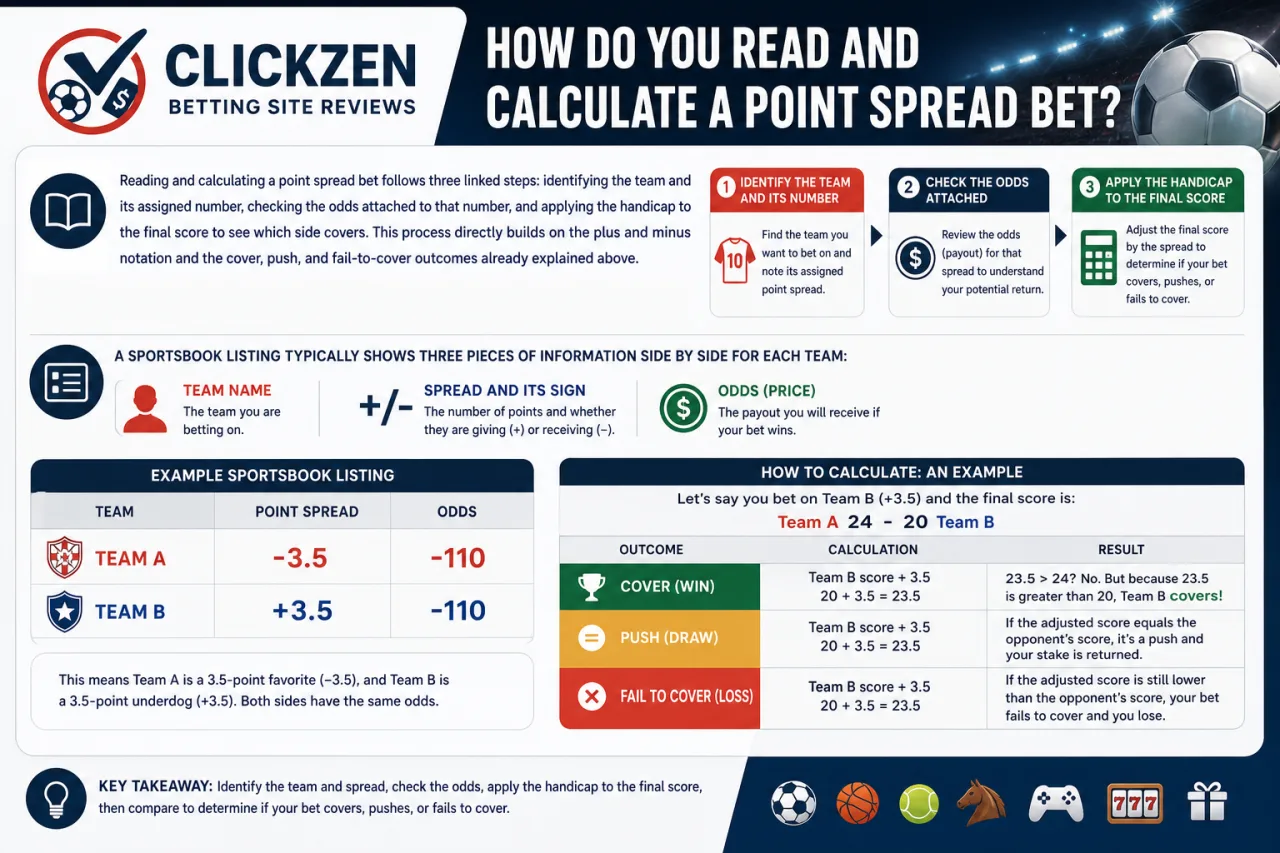
Reading a point spread requires identifying the team, its handicap, and the odds attached to that handicap.
A sportsbook may display a basketball market like this:
- Home Team -5.5 (-110)
- Away Team +5.5 (-110)
The home team is the favorite. It must win by at least 6 points to cover.
The away team covers if it wins outright or loses by no more than 5 points.
Suppose the final score is:
Home Team 102-95 Away Team
The home team’s margin is 7 points.
Because 7 is greater than 5.5:
- Home -5.5 wins
- Away +5.5 loses
If the final score is instead:
Home Team 100-97 Away Team
The home team wins the game by 3 points but fails to cover -5.5.
The away team +5.5 therefore covers despite losing the game outright.
What Are Examples of Point Spread Bets Across Different Sports?
Point spread concepts appear in several sports, although the terminology and typical handicap sizes vary.
In American football, a team might be listed at -7.5. It must win by 8 or more points to cover.
Basketball spreads use the same principle, although lines can be larger because basketball games generally involve more scoring.
Hockey commonly uses a variation known as the puck line, which is frequently based around a 1.5-goal handicap.
Rugby also uses point handicaps that operate in a similar way to football and basketball spreads.
Soccer commonly uses Asian Handicap and European Handicap markets.
Asian Handicap removes the traditional three-way draw option from the main betting decision by assigning a goal handicap to the teams. Depending on the line, possible settlements can include:
- Full win
- Full loss
- Push
- Half-win
- Half-loss
For example, whole-number Asian Handicap lines can produce a push, while quarter-goal lines such as -0.25 or -0.75 can split a stake across two adjacent handicap levels.
European Handicap typically retains three possible outcomes after the handicap is applied: home win, draw, or away win.
How Do You Calculate Potential Payout on a Point Spread Bet?
The spread itself determines whether the wager wins, while the attached odds determine the potential payout.
For negative American odds, use:
Profit = Stake × 100 ÷ |Odds|
For example, with a $110 bet at -110:
$110 × 100 ÷ 110 = $100 profit
The bettor receives:
- $100 profit
- $110 original stake
Total payout = $210
For positive American odds, the formula changes:
Profit = Stake × Odds ÷ 100
For example, a $100 stake at +150 produces:
$100 × 150 ÷ 100 = $150 profit
The total payout would therefore be $250, including the original $100 stake.
This distinction is important because negative and positive American odds are calculated differently.
What Are the Advantages and Disadvantages of Point Spread Betting?
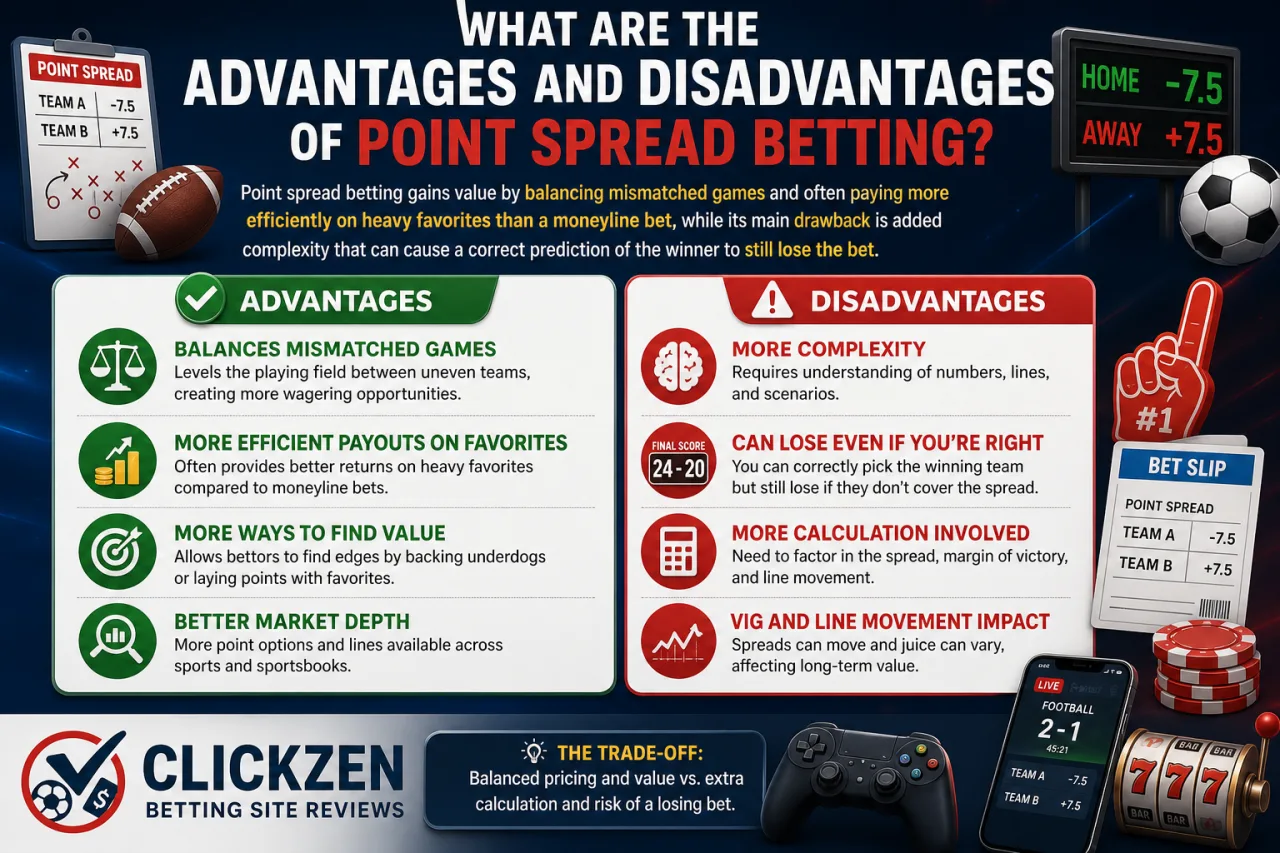
Point spread betting can create more balanced prices in mismatched games, but it also requires bettors to predict performance against a handicap rather than simply identify the winner.
Advantages include:
- Creates a more balanced betting market between stronger and weaker teams
- Can provide more attractive pricing on heavy favorites than an expensive moneyline
- Allows bettors to wager on an underdog without requiring it to win outright
- Rewards analysis of expected winning margins rather than only match winners
- Provides widely available markets across major sports
The disadvantages include:
- A team can win the game but fail to cover the spread
- Spread numbers can move before the bet is placed
- Bettors must understand plus and minus handicaps correctly
- Half-point differences can determine whether a bet wins or loses
- Standard prices such as -110 include a sportsbook margin
A common beginner mistake is choosing a favorite simply because it is expected to win without considering whether it can win by enough points to cover.
The better approach is to evaluate the expected scoring margin and compare it with the available spread before placing a wager.
What Other Point Spread Concepts Should Bettors Explore Further?
Line movement, alternate spreads, and sport-specific handicap rules are important concepts for bettors who want to understand spread markets beyond the basics.
These concepts do not change the fundamental definition of covering a spread, but they affect which handicap and price a bettor receives.
Why Do Point Spreads Move Before a Game Starts?
Point spreads can move because sportsbooks and the broader betting market continuously react to new information and wagering activity.
Factors that can influence line movement include:
- Injury news
- Starting lineup changes
- Weather conditions
- Professional or respected betting action
- Heavy betting volume on one side
- New information about teams or players
- Price movements at other sportsbooks
- Changes in sportsbook liability
Sharp money generally refers to wagers placed by professional, sophisticated, or highly respected bettors whose action may be considered informative by sportsbooks.
A sportsbook may respond to new information by changing the spread, adjusting the odds attached to the existing spread, or both.
For example:
- Opening line: Team A -6.5 (-110)
- Later line: Team A -7 (-110)
Alternatively:
- Opening line: Team A -6.5 (-110)
- Later price: Team A -6.5 (-120)
Line movement should not be interpreted only as an attempt to create exactly equal betting volume on both teams. Sportsbooks also manage market information, pricing, and risk.
What Is an Alternate Point Spread?
An alternate point spread is a modified version of the main spread that allows bettors to choose a different handicap in exchange for different odds.
Suppose the main line is:
Favorite -6.5 (-110)
A sportsbook might also offer:
- Favorite -3 at shorter odds
- Favorite -6.5 at the standard price
- Favorite -10 at larger potential odds
Reducing the favorite’s required margin makes the bet easier to cover but normally results in a smaller potential return.
Increasing the required margin makes the bet harder to cover but normally offers a larger potential return.
The opposite principle applies to the underdog.
A larger positive cushion makes the underdog easier to cover but usually lowers the potential return. A smaller cushion increases risk but can provide a higher payout.
Alternate spreads should not be confused with teasers. An alternate spread is normally a standalone market with its own price, while a teaser combines multiple adjusted point spreads into a multi-leg wager.
Conclusion
Point spread betting uses a handicap to create a margin-based wager between two teams rather than asking only which side will win outright.
The favorite normally receives a negative spread, while the underdog receives a positive spread. The outcome depends on whether the selected team covers the handicap, fails to cover, or produces a push on an eligible whole-number line.
Understanding the spread number, attached odds, payout calculation, line movement, and differences between spread, moneyline, and totals markets helps bettors read sportsbook markets more accurately.
Point spreads can offer more balanced pricing than an outright moneyline in mismatched games, but they also create an additional challenge: correctly predicting the winner is not always enough. The team must also perform well enough against the assigned handicap for the wager to win.
Zorvan Hale is a Betting & Casino Analyst at ClickZen with over eight years of experience. He provides objective reviews of global betting platforms, focusing on withdrawal terms, KYC processes, and real user experience to help you make informed and safer betting decisions.


Top Rated Casinos

FanDuel is a regulated North American betting and gaming brand offering Sportsbook, Casino, Fantasy, Racing and prediction markets, with product availability determined by state or provincial regulations.

DraftKings is a regulated North American sportsbook and gaming operator offering sports betting, live wagering, casino games, daily fantasy sports, Pick6 and horse racing in eligible jurisdictions.

Fanatics Sportsbook is a regulated U.S. betting platform available in 23 states plus Washington, D.C., offering major sports markets, live betting, same game parlays and a distinctive FanCash rewards ecosystem.


ClickZen is an independent betting information and review website providing clear, practical insights into sportsbooks, online casinos, betting apps, bonuses, and related services for a global audience.
This website is intended for users aged 18 and over. Gambling can be addictive, so please gamble responsibly. The content on this website is for informational purposes only.
About ClickZen