
New to futures betting? Discover how it works, key terms, odds movement, and how it compares to other bet types—read our full guide now.
Futures Betting Explained: A Complete Guide for Bettors

Futures betting is a wager placed on a long-term outcome that will not be settled until the end of a season, tournament, or event, such as which team wins a league title. This bet type contrasts with single-game markets because the result is determined weeks or months after the bet is placed, not within hours.
Futures betting works by locking in odds on an outcome at the moment the bet is placed, with the stake typically remaining committed until the market settles unless an eligible Cash Out option is available. Bettors select a team, player, or outcome from a published list, and the payout depends on whether that specific outcome occurs under the sportsbook’s settlement rules.
Futures market odds shift continuously as real-world results unfold, while the odds attached to an accepted wager remain locked at the price confirmed when the bet was placed. A team’s current market price typically shortens after strong performances and lengthens after losses, meaning the same futures selection placed early or late can carry very different odds and potential returns.
A futures bet differs from a moneyline, outright, or prop bet mainly in timing and settlement structure. While a moneyline usually settles after one game and prop bets generally focus on a specific player, statistic, occurrence, or secondary outcome, futures and outright bets typically track outcomes decided at the end of a broader competition or defined long-term market.
The main risks of futures betting include funds being committed for extended periods, fluctuating market value, and limited early-exit flexibility. Under standard settlement, bettors generally cannot reuse the original stake until the market is resolved, although some sportsbooks may offer Cash Out. Hedging can reduce exposure to the original position, but it can also reduce the maximum net profit if the original selection wins.
This guide from ClickZen breaks down what futures betting is, how it works, and how its odds evolve over time, starting with a clear definition below.
What Is Futures Betting?

Futures betting is a bet type placed on the outcome of a season-long or tournament-long event, such as which team lifts a league title or which player wins an MVP award, with settlement occurring only after the competition concludes. This section outlines where futures fit within the broader family of sports betting markets before the following parts look more closely at how these wagers are structured and settled.
Futures sit alongside outrights, moneylines, and prop bets as one of several recognised bet categories in sportsbook terminology. What separates futures from most other bet types is the settlement horizon: instead of resolving after a single match or event, a futures wager stays open for weeks or months while the underlying competition plays out.
Common examples include betting on a league champion before the season starts, picking a tournament winner ahead of a multi-week event, or selecting an individual award winner such as top scorer or MVP. Because the outcome depends on cumulative performance rather than one game, futures betting is generally treated as a longer-term, lower-frequency market compared to single-game bet types.
Why Do Bettors Use Futures Bets?
Bettors use futures bets mainly for their long-term entertainment value, the chance of larger payouts on long-shot outcomes, and the appeal of following a team or player throughout an entire season. This section builds on the earlier explanation of what futures betting is by outlining the specific reasons this bet type attracts sustained interest.
A futures wager keeps a bettor emotionally invested in a competition across many weeks or months, turning otherwise ordinary games into events with added personal stakes. Unlike a single-match bet that resolves within hours, a futures position on a season-long title race adds context to nearly every game that team plays afterward.
Long-shot futures also carry the potential for considerably higher payouts than short-priced single-game markets, since underdog teams or players typically open at longer odds before a season begins. This makes futures attractive to bettors seeking a larger potential return from a comparatively small stake, though longer odds also reflect a lower likelihood of that outcome occurring.
Three main motivations summarise the appeal:
- Entertainment value from tracking one outcome across an entire season or tournament.
- Payout potential on long-shot selections priced well above typical single-game odds.
- Engagement with a specific team, player, or award race from start to finish.
How Does Futures Betting Work?

Futures betting works through a sequential process that starts with selecting an event, choosing a specific outcome, placing a stake at the current odds, and waiting until the competition finishes for settlement. This process differs from single-game betting mainly in timing, since each stage of a futures wager unfolds over an extended period rather than within one match. The subsections below break down each stage of this process in more detail.
How Are Futures Bets Settled?
Futures bets settle by holding the stake locked from the moment of placement until the season, tournament, or award race reaches its final result, with the payout then calculated using the odds confirmed at the time the bet was placed. This settlement process connects directly to the earlier stages of selecting an outcome and placing a stake, since it determines when and how that original wager finally pays off.
Under standard settlement, the wager remains open while the event is active, although some sportsbooks may offer an eligible Cash Out before the final result. A bettor who locks in odds of +800 on a title contender keeps that exact price for settlement purposes even if the market later shifts to +300 or +2000 as results unfold, unless the bettor accepts a Cash Out or another sportsbook-specific settlement option.
Once the competition concludes and an official winner is confirmed, the sportsbook settles futures wagers on that market according to its house rules. Winning bets are paid using the original stake and the odds secured at placement, with the exact calculation depending on the odds format used, while losing selections generally return nothing.
Two conditions define this process:
- Funds stay locked with the sportsbook until the outcome is officially determined.
- Payout calculations use the odds locked in at placement, not the odds available at settlement.
What Happens If You Place a Futures Bet Early vs Late?
Placing a futures bet early can secure longer odds when uncertainty is greater, while placing it later may mean shorter odds once more information is available and the market assigns a higher implied probability to the selection. This timing effect connects directly to how futures odds shift as a season develops, since the value available before or early in a competition can differ sharply from the value available midway through it.
An early futures bet locks in a price before any games are played, when little separates contenders and the eventual outcome remains largely unknown. This uncertainty is exactly why early odds tend to run longer, rewarding bettors willing to accept that a team’s form, injuries, or roster changes could shift dramatically before the season ends.
A later futures bet, placed once a team has already shown strong form or a clear title race has emerged, typically comes with shorter odds because more information is available and the market may assign that outcome a higher implied probability. The shorter price reduces the potential return for a given stake, but it does not remove the possibility that the selection still loses.
Odds keep adjusting between these two points as new information emerges, including results, injuries, and roster changes. Two practical outcomes follow from this dynamic:
- Early bets can offer longer odds but involve greater uncertainty because less performance information is available.
- Late bets often carry shorter odds when results and form have increased a selection’s implied probability, although shorter odds do not eliminate the risk of losing.
How Do Futures Odds and Payouts Change Over Time?
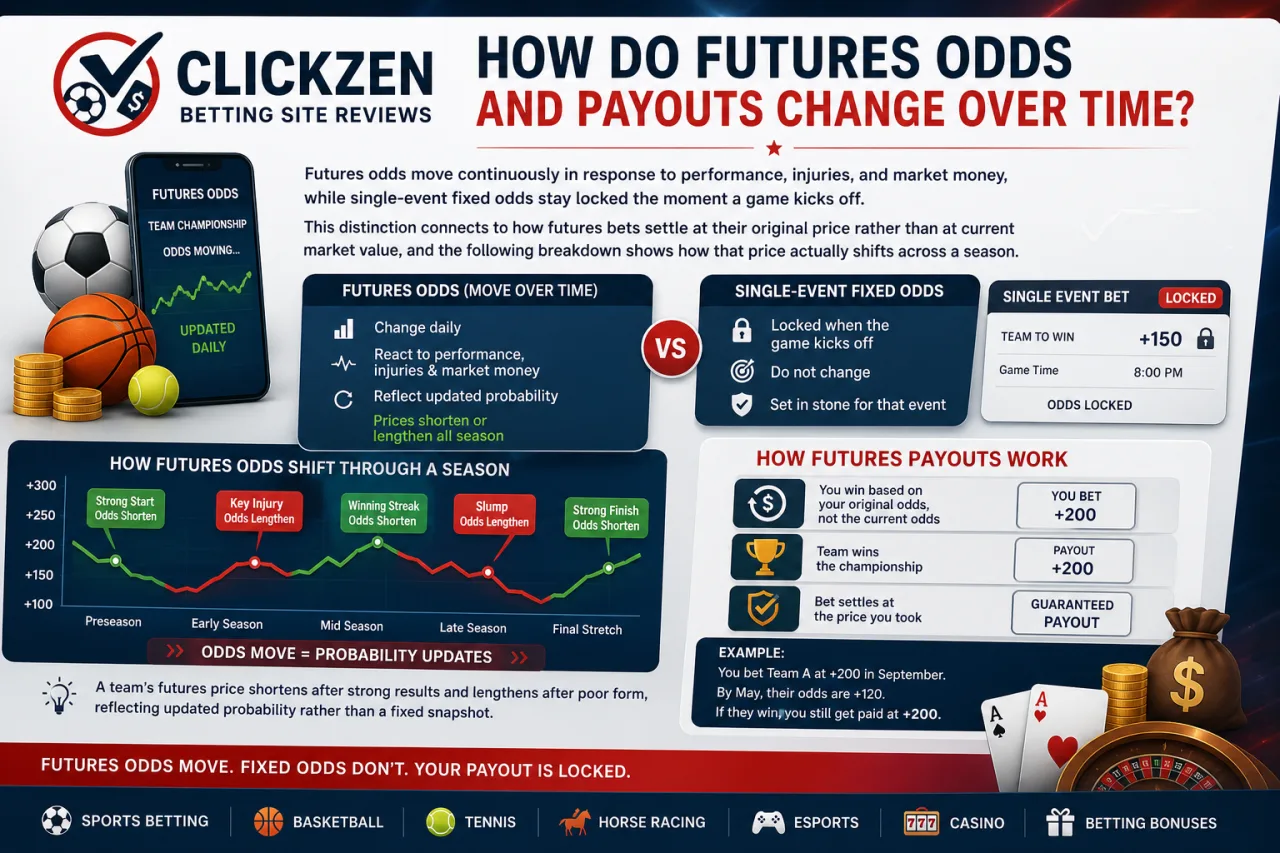
Futures market odds move continuously in response to performance, injuries, and betting activity, while the odds attached to any accepted wager are locked at the price confirmed when that bet is placed. This distinction connects to how a futures ticket settles at its original accepted price rather than at the market price available later, and the following breakdown shows how the market itself can shift across a season.
A team’s futures price shortens after strong results and lengthens after poor form, reflecting updated probability rather than a fixed snapshot taken at the start. Heavy betting volume on one contender also moves the number, since sportsbooks adjust prices to manage exposure across the whole market.
A simple example illustrates this: a team’s futures odds to win a league title might open at a long price before the season starts, shorten considerably after a strong opening stretch, then lengthen again following a losing run.
A bettor who placed a stake at the original +1500 still receives a payout calculated on that accepted price at settlement, regardless of where the market odds sit when the season ends. The same basic principle applies to an accepted single-game wager: its ticket price is locked when the bet is accepted, even though the sportsbook may continue to update the market price for new bets before the event starts and, where live betting is offered, during play.
Why Do Bookmakers Adjust Futures Odds Throughout a Season?
Bookmakers adjust futures odds mainly to reflect updated probability as team form, injuries, betting volume, and standings changes alter the likelihood of each outcome. This connects directly to the earlier point that a futures price shortens or lengthens over the course of a season rather than staying fixed at the opening number.
Four factors typically drive this repricing:
- Form shifts a team’s price after a strong or weak run of results changes its perceived title chances.
- Injuries move a line when a key player’s absence or return alters a squad’s expected performance.
- Betting volume pushes odds when heavy stakes on one contender lead a sportsbook to shorten that price and manage overall exposure.
- Standings changes reprice a market as the number of realistic contenders narrows or widens with each round of fixtures.
The pace and scale of these adjustments differ by bookmaker and by sport, as some operators reprice futures markets more frequently than others and some competitions tend to produce sharper swings than others. A knockout tournament with few remaining rounds tends to show steeper odds movement than a long league season still in its early stages, simply because fewer results are needed to confirm or eliminate a contender.
What Is the Difference Between Futures Bets and Other Bet Types?

Futures bets differ from moneyline, outright, and prop bets mainly in settlement timing and the scope of the outcome being wagered on. A moneyline usually settles after one game, an outright often overlaps with futures terminology, and a prop bet generally targets a specific player, statistic, occurrence, or secondary outcome rather than simply the overall winner of a competition. The comparison below breaks down how each bet type is structured and when it settles.
| Bet Type | Settlement Timing | Scope of Outcome |
|---|---|---|
| Futures | End of season, tournament, or award race | Long-term result decided over weeks or months |
| Moneyline | End of a single game | Winner of one match only |
| Outright | End of a tournament or competition | Often used interchangeably with futures, though some bookmakers reserve the term for single-elimination or one-off events |
| Prop bet | Varies by market; often during or at the end of a game or event | A specific player, statistic, occurrence, or secondary outcome, such as player points or first scorer |
Moneyline bets generally resolve quickly because they track a single game’s result, while futures and outright bets often share a longer settlement window because both can depend on how an entire competition plays out. Bookmaker terminology frequently treats “futures” and “outright” as overlapping terms, although naming conventions vary by operator, sport, and region. Prop bets stand apart because they focus on a specific player, statistic, occurrence, or secondary outcome rather than simply the overall winner.
Futures Bets vs Moneyline Bets: What’s the Difference?
Futures bets and moneyline bets differ mainly in scope and timeframe, since a moneyline settles after one single game while a futures bet stays open across an entire season or tournament. This scope gap connects directly to the settlement comparison covered earlier, where futures share a long timeline with outright bets rather than with single-match markets.
A moneyline wager picks the straight winner of one specific matchup, with the result confirmed within hours once the final whistle blows. That narrow scope makes moneyline betting a short-term, single-outcome market with no exposure to events happening outside that one game.
A futures bet, in contrast, tracks a broader outcome such as a league champion or an award winner, with the stake locked for weeks or months until every relevant game has been played. Three practical differences follow from this gap in scope and timeframe:
- Moneyline bets resolve within hours; futures bets resolve only at season’s end.
- Moneyline bets depend on one game’s result; futures bets depend on cumulative results across a full competition.
- The odds on an accepted moneyline bet are locked when the wager is placed, while futures market odds can continue shifting for new wagers as the underlying competition develops.
Futures Bets vs Outright Bets: Are They the Same?
Yes, futures bets and outright bets largely overlap, since most sportsbooks use both terms to describe the same long-term wager settled at the end of a season or tournament. This terminology question follows directly from the comparison table above, which already noted that the two labels are often interchangeable.
Three points clarify how this overlap works in practice:
- Sportsbooks apply “futures” and “outrights” to the same market type in most everyday usage, covering season-long titles, tournament winners, and award races alike.
- Some operators may prefer one label over the other for particular sports or competition formats, but that naming choice does not create a universal mechanical distinction.
- Regional and sport-specific naming conventions can shift which label appears on a given market, without changing how the bet actually settles.
No universal rule fixes this distinction across every bookmaker, sport, or region, so the exact terminology used on a betting slip varies by operator. Bettors comparing markets across different sportsbooks benefit from checking each site’s own glossary rather than assuming one fixed convention applies everywhere.
Futures Bets vs Prop Bets: How Do They Differ?
Futures bets and prop bets differ mainly in scope, since a prop bet generally targets a specific player, statistic, occurrence, or secondary outcome while a futures bet tracks a broader outcome across an entire season, tournament, or long-term market. Many props settle within a single game or event, while futures usually remain open for a much longer period.
A prop bet isolates a specific outcome, such as a player’s total points in one game or which team scores first. Many prop markets are game-specific and settle during or after that event, although the exact timeframe depends on the market offered by the sportsbook. This narrower focus separates props from broader futures markets built around season, tournament, or award outcomes.
A futures bet, by contrast, depends on cumulative results building toward a final outcome, such as a league champion or an award winner decided only once every relevant game has been played. Three practical differences follow from this gap in scope:
- Many prop bets settle within a single game or event; futures usually settle at the end of a season, tournament, or other long-term market.
- Prop bets track a specific player, statistic, occurrence, or secondary outcome; futures generally track a broader competition or season outcome.
- The odds on an accepted prop wager are locked when the bet is placed, while futures market odds can continue shifting for new wagers as the long-term event develops.
What Are the Pros, Cons, and Risks of Futures Betting?

Futures betting carries three main advantages, entertainment value, larger payout potential, and long-term engagement, alongside risks tied to locked funds, shifting value, and opportunity cost. This grouping connects directly to the earlier comparison of futures against moneyline, outright, and prop bets, since the extended timeframe that defines futures also produces its distinct benefits and drawbacks. The following breakdown separates the upside of this bet type from the trade-offs bettors accept when locking in a long-term position.
What Does It Mean That Futures Bet Funds Are Locked?
Locked futures funds mean the original stake normally remains committed from placement until the market settles, unless the sportsbook offers and the bettor accepts an eligible early-exit option such as Cash Out. This lock-up defines the core liquidity trade-off of futures betting, since committing money to a season-long outcome generally removes that stake from use elsewhere while the wager remains open.
A single-game bet often ties up capital for a much shorter period, but a futures bet on a league title or award race can hold that same stake for weeks or months. During this period, the bettor generally cannot redirect the original stake toward another opportunity unless the sportsbook offers an eligible Cash Out. Hedging is different because it requires placing one or more additional wagers rather than releasing the original stake.
This lack of liquidity carries practical consequences:
- Reduces flexibility to react to new information, injuries, or form changes after the bet is placed.
- Ties up bankroll that stays unavailable for other bets until the futures market resolves.
- Limits early exit options to whatever Cash Out or hedging tools a bookmaker makes available, often at reduced value.
Bettors weighing a futures wager account for this lock-up alongside potential payout, since the extended timeframe is what separates futures from faster-settling bet types.
Can You Cash Out or Hedge a Futures Bet Before It Settles?
Some bookmakers allow Cash Out on futures markets as odds shift, and bettors otherwise hedge manually by placing an opposing bet before settlement. This mid-market exit question connects directly to the locked-funds limitation described above, since Cash Out and hedging represent the two main workarounds available before a futures market reaches its final result.
Cash Out on a futures bet lets a bettor close an eligible wager before the season or tournament finishes. When offered, the Cash Out amount reflects the sportsbook’s current valuation of the position and may be higher or lower than the original stake depending on how the market has moved. Cash Out availability is not guaranteed and can change or disappear as an event develops.
Hedging works differently: instead of exiting through the sportsbook’s own tool, a bettor places one or more additional wagers on alternative outcomes to reduce exposure to the original position. Cash Out availability varies by bookmaker, sport, and specific market, while the practicality and cost of hedging depend on what alternative markets and prices are available.
A dedicated futures betting strategy resource covers the practical mechanics and trade-offs of hedging in more depth. For a closer look at how odds and payouts move across a market before settlement, see the earlier section on how futures odds and payouts change over time.
What Are Some Lesser-Known Aspects of Futures Betting?
Futures betting includes several lesser-known nuances beyond core mechanics, mainly wider bookmaker margins than single-game markets and specific conditions under which a market gets suspended or voided. These points sit outside the core explanation of how futures bets work, settle, and shift in value, but they still shape the practical experience of holding a long-term position. The two subsections below cover each nuance in more detail.
Why Do Futures Markets Often Have Higher Bookmaker Margins?
Futures markets typically carry wider bookmaker margins because they involve many possible outcomes and settle only after a long timeframe, both of which increase the bookmaker’s pricing risk. A two-outcome or three-outcome single-event market, such as a moneyline, leaves little room for the bookmaker to misjudge probability across so few options.
A futures market, by contrast, might list ten, twenty, or more contenders for a league title or tournament win, each requiring its own probability estimate. Building margin into each of those individual prices compounds across the full list, producing a larger total overround than a market with only two or three selections.
The extended settlement window adds a second layer of risk, since months of unpredictable events, injuries, and form changes sit between the bet placement and the final result. Wider margins in long-term futures markets help offset this extended exposure compared to markets that resolve within hours.
This margin difference stays a general pattern across the industry rather than a fixed rule, since exact overround size varies by bookmaker, sport, and the specific market listed.
Can a Futures Bet Be Voided or Cancelled Before Settlement?
Yes, a futures bet can be voided before normal settlement, but the outcome depends on the sportsbook’s house rules, the sport, the market, and what happens to the underlying competition or participant. Cancellation, postponement, format changes, or participant withdrawal can affect settlement differently, so none of these situations automatically produces the same result across every sportsbook.
Three scenarios can affect settlement:
- If a season or tournament is cancelled or fails to reach the conditions required for settlement, the sportsbook may void affected futures wagers and return stakes according to its house rules.
- If a competition is postponed, shortened, or restructured, bets may stand or be voided depending on whether the sportsbook’s settlement conditions are still met.
- If a team or player withdraws, the wager does not automatically become a refund. Some sportsbooks or markets void non-participating selections, while others apply “all-in” or similar rules under which the futures bet can be graded as a loss.
Exact voiding rules differ by bookmaker, sport, and the specific terms attached to each futures market, so bettors holding an open futures position should check the operator’s house rules before assuming that a cancellation, postponement, format change, or withdrawal will produce a refund.
Conclusion
Futures betting stands apart from many single-game markets because the original stake is typically committed for a longer period and the wager normally settles only once a season, tournament, or award race reaches its final result, unless an eligible early-exit option such as Cash Out is used. Futures market odds keep shifting with form, injuries, and betting activity, yet the payout on an accepted wager traces back to the price secured at placement rather than the market price showing later. Compared with moneyline, outright, and prop bets, futures involve longer timeframes and reduced liquidity in exchange for the possibility of larger returns on longer-priced outcomes. Understanding these mechanics equips a bettor to weigh entertainment value and payout potential against committed funds and limited exit flexibility, though no futures position removes the underlying uncertainty of how a full competition ultimately plays out.
Marcus Zeno is the CEO and Lead Betting Analyst at ClickZen. With over eight years of experience in the iGaming industry, he specializes in evaluating global sportsbooks, mobile betting apps, and bonus terms. Marcus is dedicated to cutting through promotional noise to provide bettors with transparent, fact-based insights.


Top Rated Casinos

FanDuel is a regulated North American betting and gaming brand offering Sportsbook, Casino, Fantasy, Racing and prediction markets, with product availability determined by state or provincial regulations.

DraftKings is a regulated North American sportsbook and gaming operator offering sports betting, live wagering, casino games, daily fantasy sports, Pick6 and horse racing in eligible jurisdictions.

Fanatics Sportsbook is a regulated U.S. betting platform available in 23 states plus Washington, D.C., offering major sports markets, live betting, same game parlays and a distinctive FanCash rewards ecosystem.


ClickZen is an independent betting information and review website providing clear, practical insights into sportsbooks, online casinos, betting apps, bonuses, and related services for a global audience.
This website is intended for users aged 18 and over. Gambling can be addictive, so please gamble responsibly. The content on this website is for informational purposes only.
About ClickZen