
New to teasers? Discover how a teaser bet works, its payouts, rules and how it compares to parlays before you place your next wager.
Teaser Bet: The Complete Guide to This Sports Bet Type

A teaser bet is a type of parlay that lets bettors move the point spread or total in their favour on two or more games, in exchange for a reduced payout compared with combining the same selections at their original lines. This flexibility makes it a distinct wager category from standard spread or total bets offered by sportsbooks.
Teaser points and payouts differ from straight bets and standard parlays because the sportsbook applies a fixed points adjustment to each teaser leg while pricing the wager to reflect the more favourable lines. A straight bet keeps the original line untouched, while a standard parlay combines selections without applying a teaser points adjustment.
Teaser bets compare with parlays, pleasers and round robins based on how each format changes risk, payout and the treatment of individual selections. Pleasers move lines against the bettor for a potentially higher payout, while round robins split multiple selections into smaller parlay combinations without adjusting the original lines.
Teaser rules, risks and strategy considerations vary by sportsbook, sport and the number of legs selected, so checking the specific terms before betting matters. Understanding these variables helps bettors evaluate whether the adjusted odds still represent reasonable value compared with other bet types, a topic ClickZen covers across its sports betting guides.
The following sections break down what a teaser bet is, how it works in practice, and how its points and payouts compare with straight bets and parlays.
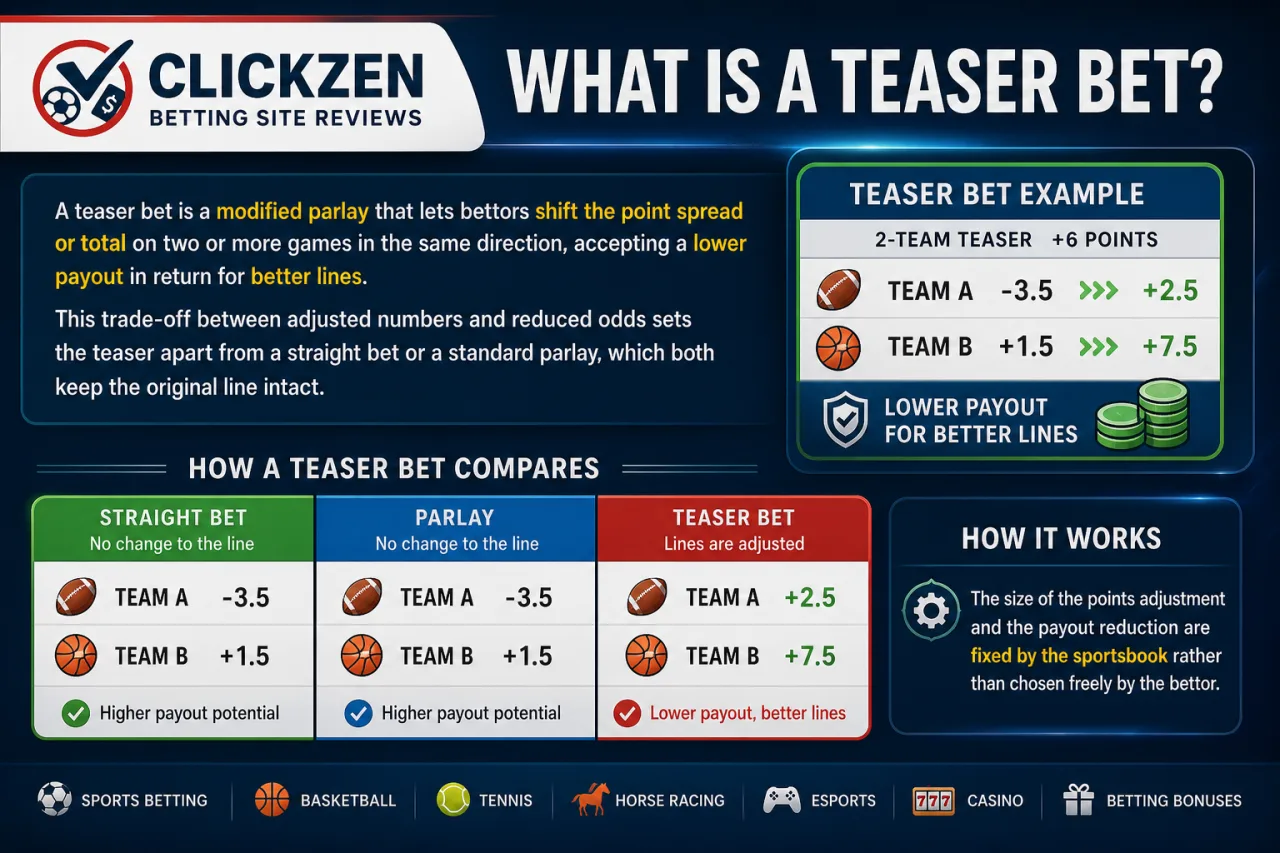
A teaser bet is a modified parlay that lets bettors shift the point spread or total on two or more games in a favourable direction, accepting a lower payout than they would typically receive from combining the same selections at their original lines. This trade-off between adjusted numbers and reduced pricing sets the teaser apart from a straight bet or a standard parlay.
The mechanics matter because the size of the points adjustment is set by the sportsbook’s available teaser options rather than chosen freely by the bettor. A common football teaser moves each spread or total by a fixed number of points, while the price reflects both the number of legs and the size of the adjustment. In a standard teaser, all non-push legs generally need to win for the wager to pay out, subject to the sportsbook’s rules for pushes, cancellations and no-action selections. Understanding this structure is central to evaluating how teaser points and payouts compare with other betting formats.
Bettors use teaser bets mainly to shift a point spread or total into a more favourable position, increasing the probability that each individual selection covers its adjusted line. This purpose distinguishes teasers from standard parlays, where the selections normally remain at their original betting lines.
Moving a spread away from a difficult number, or adjusting a total in the bettor’s preferred direction, can give a selection more margin for error. A common example involves shifting a favourite from -7.5 to -1.5 with a 6-point football teaser, which makes the adjusted spread substantially easier to cover. Bettors accept less favourable pricing than a comparable standard parlay in exchange for this additional points cushion.
Teaser betting is most commonly available on American football and basketball, including NFL, college football, NBA and college basketball markets at sportsbooks that support the format. Teasers are particularly suited to sports in which point spreads and totals can be shifted by a defined number of points.
NFL football is one of the most established teaser markets because common margins of victory make certain point-spread movements especially relevant. Basketball sportsbooks may also offer teasers on spreads and totals, although the number of points available is usually smaller than in football.
Availability outside football and basketball varies substantially by sportsbook. Some operators may offer specialised teaser-style products for other sports or markets, but bettors should not assume that baseball, hockey or soccer teasers are universally available. Checking the sportsbook’s rules page or betting menu confirms which leagues and markets are eligible.
How Does a Teaser Bet Work
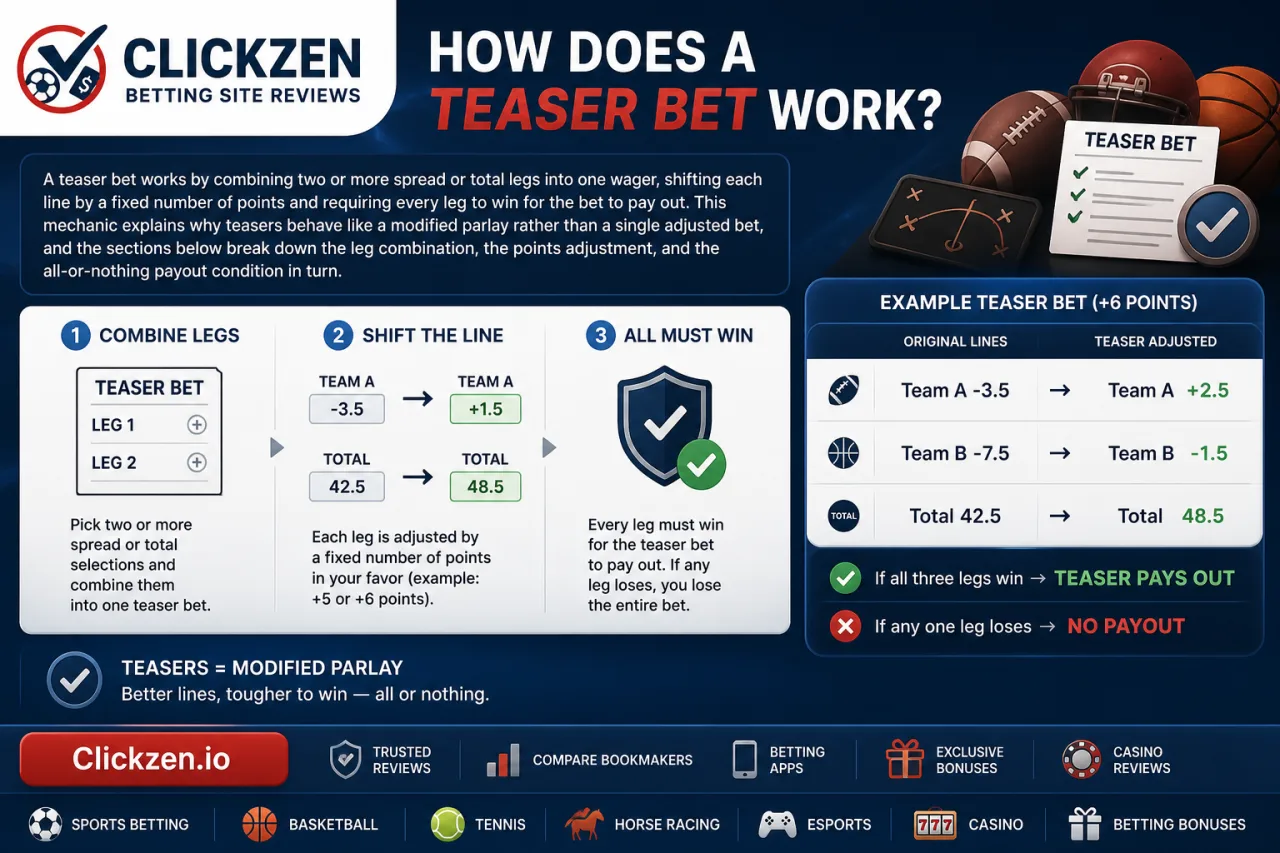
A teaser bet works by combining two or more spread or total selections into one wager and shifting each eligible line by a fixed number of points. Each non-push leg generally must win for the teaser to pay out, although rules for pushes, cancellations and reduced-leg teasers vary by sportsbook.
Teaser points apply by adding the fixed point value to an underdog’s spread and subtracting it from a favourite’s spread, while totals move up or down depending on whether the bettor is teasing the over or the under.
A 6-point NFL teaser illustrates the shift clearly: a favourite listed at -7 moves to -1, since 6 points are subtracted from the spread. The same 6 points are added to an underdog line, so a +3 underdog becomes +9. On totals, an over 44 could become over 38, while an under 44 could become under 50.
The available point adjustment varies by sport and sportsbook. Football teasers commonly use values such as 6, 6.5 or 7 points, while basketball teasers often use smaller adjustments such as 4, 4.5 or 5 points. Larger-point football formats, including 10-point or similar products, are generally offered as special teaser variants rather than the standard format.
Each leg within a traditional teaser usually receives the same points adjustment, although exact configuration rules depend on the operator.
A teaser bet is priced less favourably than a standard parlay built from comparable selections at their original lines because the adjusted spreads or totals increase the probability of each individual leg winning.
The potential payout depends primarily on the number of legs, the size of the teaser adjustment and the sportsbook’s pricing. Adding more legs generally increases the potential payout because more selections must win, while taking more teaser points generally reduces the payout because each adjusted line becomes easier to cover.
For example, a three-team 6-point football teaser will normally offer a larger potential return than a two-team 6-point teaser, but it also requires an additional selection to win. A larger points adjustment on otherwise comparable teaser configurations generally produces less favourable odds because the bettor receives a greater advantage on each line.
Traditional teasers often use predetermined payout tables based mainly on the number of legs and the size of the points adjustment. Exact pricing, eligible markets and restrictions can still vary by sportsbook and teaser product, so bettors should check the displayed odds before placing the wager.
How Do Teaser Points and Payouts Differ From Straight Bets and Parlays
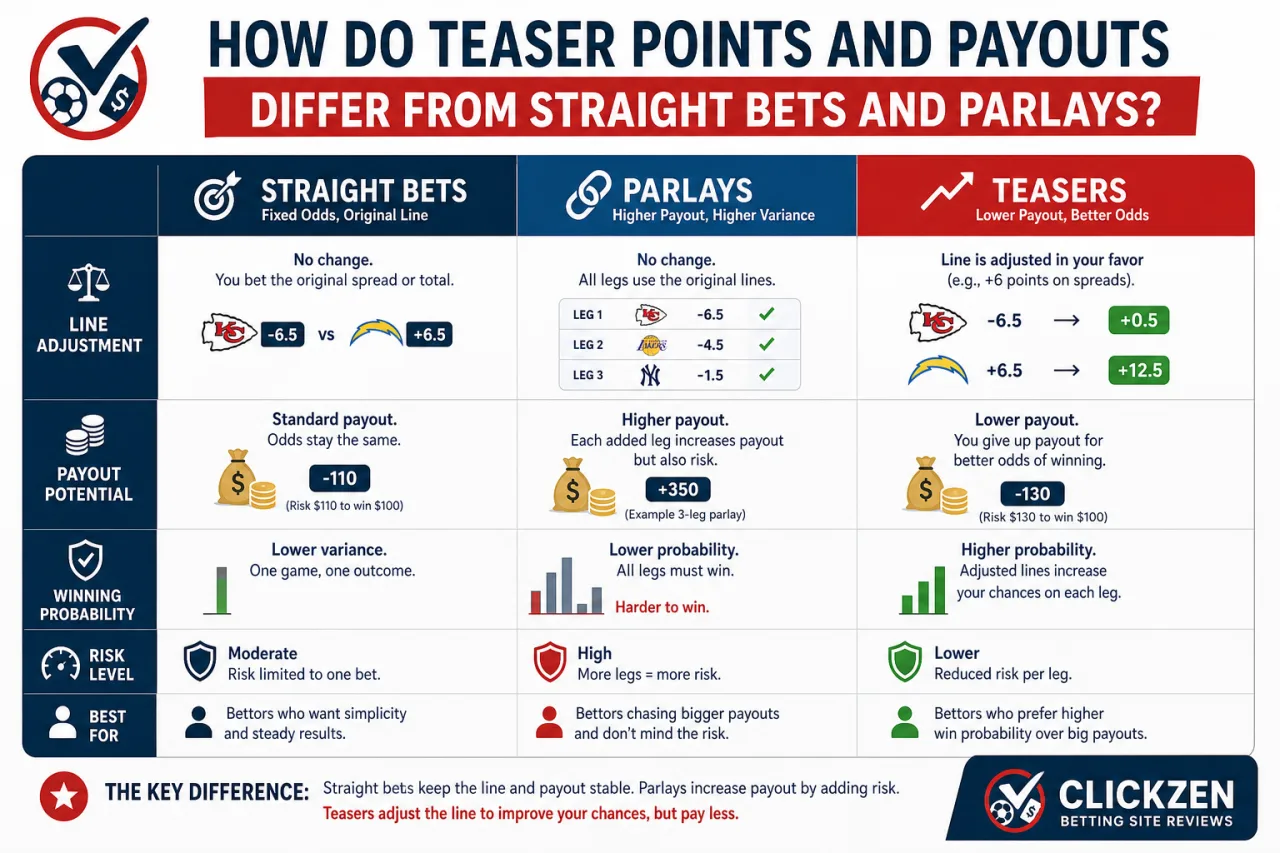
Teaser points and payouts differ from straight bets and parlays because straight bets use one original line, standard parlays combine multiple original selections, and teasers improve the line on each eligible leg in exchange for less favourable pricing. This distinction shapes how bettors weigh risk against reward across the three formats.
A straight bet settles on a single posted spread or total. A standard parlay combines multiple selections at their offered lines and increases the potential payout as more legs are added, while also reducing the probability of winning the entire wager. A teaser also combines multiple selections, but it adjusts each eligible spread or total before the wager is placed.
The comparisons below show how these structural differences affect teaser bets relative to straight bets and standard parlays.
A teaser bet differs from a straight bet because it combines two or more adjusted selections into one wager, while a straight bet normally places one selection at its original spread or total.
A straight bet has only one outcome determining whether the wager wins or loses. A teaser combines multiple legs, which means the bettor receives more favourable numbers on individual selections but still faces the risk that one losing leg can cause the entire teaser to lose, subject to the sportsbook’s push and cancellation rules.
The main differences include:
- Straight bets use one original spread, total or other eligible market.
- Teaser bets combine multiple adjusted spreads or totals.
- A straight bet depends on one selection, while a teaser generally requires every non-push leg to win.
- Teasers provide a more favourable line on each eligible leg but price that advantage into the wager.
Bettors choosing between the two formats weigh the simplicity of a single wager against the points flexibility offered by a teaser.
A teaser bet differs from a standard parlay because the teaser shifts each eligible spread or total by a fixed number of points, while a standard parlay normally uses the selections at their original betting lines.
Both formats combine multiple legs into one wager and normally require all relevant legs to succeed. The key difference is how the individual selections are priced and adjusted.
- Standard parlays generally leave each selected betting line unchanged.
- Teasers move eligible spreads or totals in the bettor’s favour.
- Standard parlays generally offer a higher potential return than a teaser built from comparable selections because they do not provide the same points adjustment.
- Teasers sacrifice part of that potential payout in exchange for more favourable numbers on each eligible leg.
Bettors seeking larger potential returns from multiple original lines may prefer a standard parlay, while bettors who value additional points on spreads or totals may consider a teaser.
Teaser Bet vs Pleaser Bet vs Round Robin: What Are the Differences
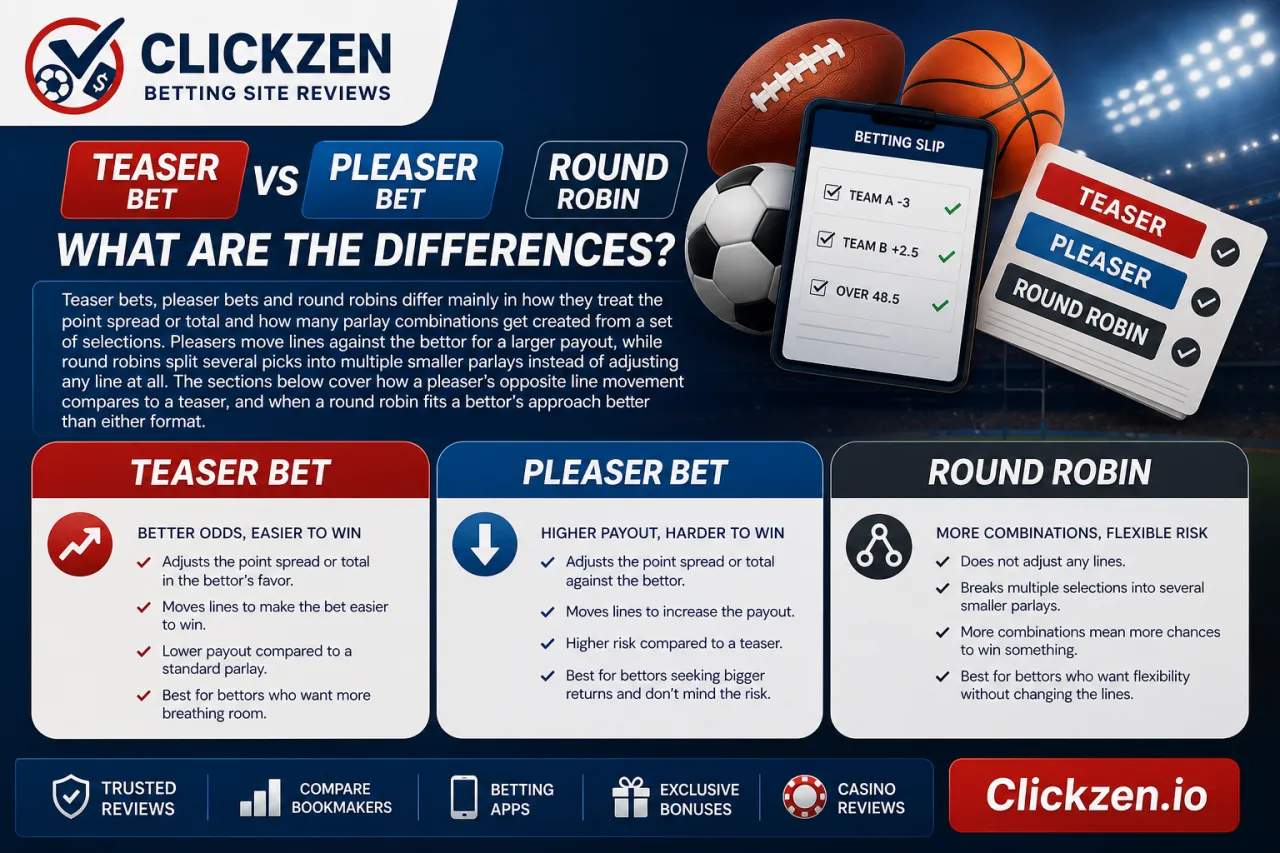
Teaser bets, pleaser bets and round robins differ mainly in how they treat betting lines and how selections are combined. A teaser moves eligible lines in the bettor’s favour, a pleaser moves them against the bettor, and a round robin creates multiple smaller parlays from a larger group of selections.
A pleaser bet is essentially the opposite of a teaser because it moves eligible spreads or totals against the bettor in exchange for a potentially higher payout.
Where a teaser shifts a line toward an easier number, a pleaser makes the line more difficult to cover. A favourite may be required to win by a larger margin, an underdog may receive fewer points, or a total may move farther against the bettor’s selected side.
Sportsbooks compensate for the greater difficulty with more favourable payout odds. This makes pleasers a higher-risk, higher-reward counterpart to teasers. Pleaser markets are also less widely available than standard teaser products, so availability should be confirmed with the sportsbook.
A round robin bet takes three or more selections and divides them into multiple smaller parlays, so one losing selection may still leave other parlay combinations eligible to win.
Unlike a teaser, a round robin does not need to shift the underlying spread or total. Instead, it creates separate combinations from the selected bets. A four-selection round robin, for example, can generate multiple two-leg or three-leg parlays depending on the bettor’s chosen configuration.
Because those combinations settle separately, one losing selection can eliminate the parlays containing that selection while leaving other combinations intact. A standard teaser, by contrast, remains a single multi-leg wager in which one losing leg generally causes the teaser to lose, subject to applicable push or cancellation rules.
Bettors who want to spread several selections across multiple smaller parlays may prefer a round robin, while those focused specifically on improving point spreads or totals may prefer a teaser.

What Are the Rules and Risks of Teaser Betting
Teaser betting involves sportsbook-specific rules governing eligible markets, leg counts, point adjustments and push handling, along with structural risks created by combining multiple selections into one wager.
Common teaser rules cover minimum leg counts, eligible markets, available point adjustments and the treatment of pushes or cancelled selections, but the exact rules vary by operator.
- Minimum legs: sportsbooks commonly require at least two selections, while maximum leg counts depend on the operator and teaser product.
- Eligible markets: traditional teasers generally focus on point spreads and totals rather than moneylines, props or outright markets.
- Point adjustments: the available number of teaser points varies by sport and product.
- Push handling: some sportsbooks reduce a teaser when one leg pushes, while other teaser products may grade a push differently. Bettors should check the operator’s specific rules before placing the wager.
- Sport restrictions: supported leagues and sports vary by sportsbook, with football and basketball being the most common teaser markets.
Jurisdictional rules can also affect teaser availability. Because these conditions vary between sportsbooks and markets, bettors should rely on the specific operator’s current teaser rules rather than assume that one sportsbook’s settlement policy applies everywhere.
Teaser betting carries three main risks: multiple selections still need to succeed, the bettor pays for the more favourable lines through less attractive pricing, and poorly chosen lines may receive little strategic benefit from the points adjustment.
The multi-leg structure remains the main source of risk because one losing selection generally causes the entire teaser to lose. The improved line on each individual leg does not eliminate the cumulative probability involved in combining several outcomes.
Pricing is another consideration. Although teaser points improve each spread or total, the sportsbook reduces the payout relative to combining comparable selections at their original lines. Bettors therefore need to determine whether the extra points justify the price they are paying.
Finally, not every spread benefits equally from the same points movement. Using six teaser points on a line that does not cross important scoring margins may provide less value than applying the same adjustment to a strategically stronger number.
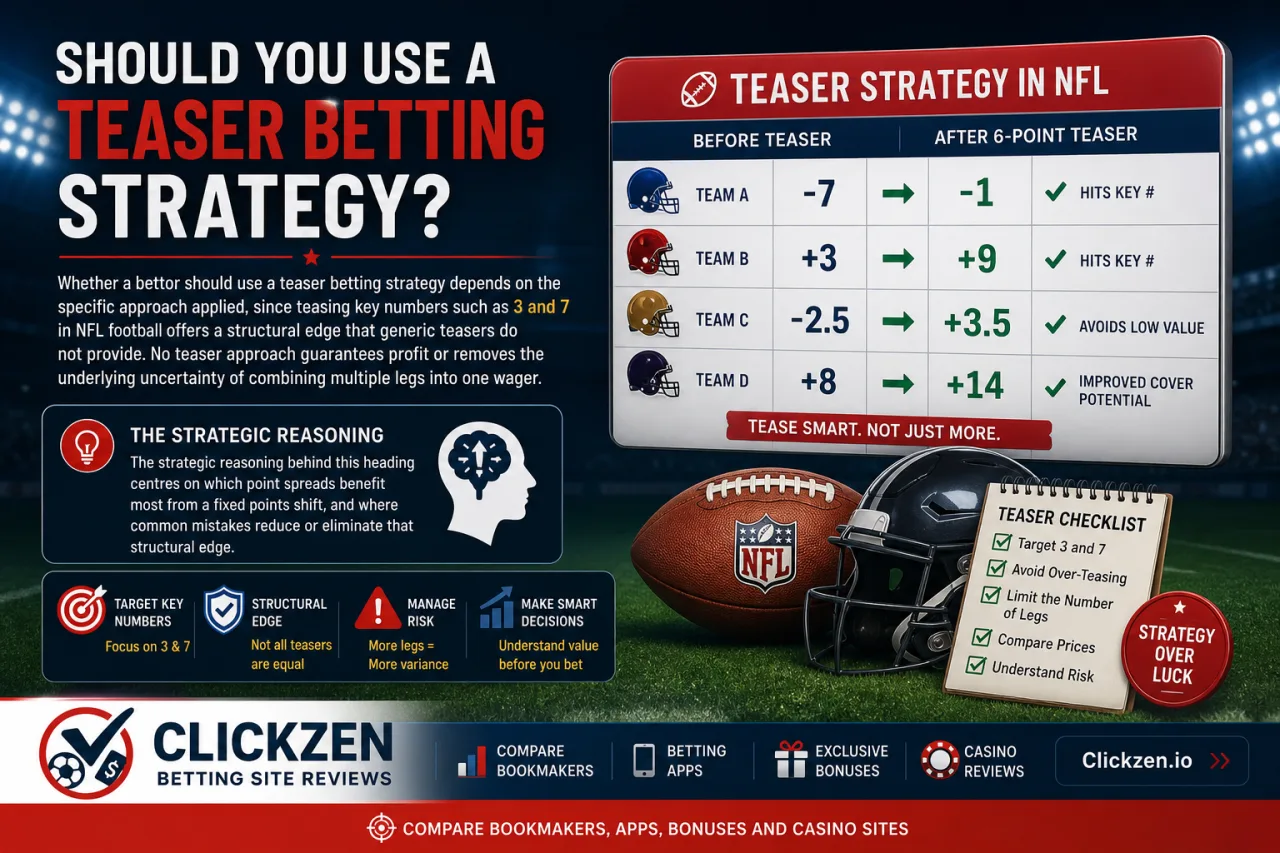
Should You Use a Teaser Betting Strategy
Whether a teaser strategy offers value depends on the original line, the number of teaser points, the sportsbook’s price and how much useful probability the adjustment adds. In NFL betting, moving through important margins such as 3 and 7 can provide more valuable line movement than teasing arbitrary spreads, although no teaser strategy guarantees a profit.
- Teasing an NFL favourite from -7.5 to -1.5 with six points crosses important margins including 7 and 3, making the adjustment strategically more significant than many other six-point moves.
- Moving a -14 favourite to -8 still improves the bettor’s line, but it generally captures less key-number value than a teaser that crosses important NFL margins such as 3 and 7.
- Adding more legs generally increases the potential payout, but it also reduces the probability that every required selection wins.
- Taking more teaser points generally improves individual lines but usually comes with less favourable payout odds.
- Ignoring sportsbook-specific push rules, eligible lines or teaser pricing can lead bettors to misjudge the true risk and value of the wager.
Bettors considering a teaser should therefore evaluate both the numerical benefit of the adjusted lines and the price charged for receiving those points rather than judging the wager only by how much easier each selection appears.
Teaser betting includes several less common variations, including larger-point teaser products and strategy-based approaches such as Wong teasers. Exact names, rules, payouts and eligibility requirements vary among sportsbooks.
A super teaser is a teaser variant that provides a larger point adjustment than a standard teaser, usually in exchange for less favourable pricing or additional restrictions.
Where a standard football teaser commonly offers around 6 to 7 points, larger-point products may offer substantially more. Sportsbooks compensate for the easier adjusted lines by reducing the potential return and may impose specific requirements on the number of legs or eligible markets.
Super teaser formats are not standardised across the industry. Their exact point values, prices and settlement rules depend on the sportsbook, so bettors should check the terms attached to the specific product being offered.
A Wong teaser is an NFL teaser strategy associated with Stanford Wong that focuses on using a 6-point adjustment to move qualifying spreads through the important margins of 3 and 7.
Classic examples include teasing certain favourites in the -7.5 to -8.5 range down through both 7 and 3, or teasing suitable small underdogs upward through those same key numbers. For example, a favourite at -7.5 becomes -1.5 with a 6-point teaser, while an underdog at +1.5 becomes +7.5.
Bettors use the approach because NFL games have historically landed on margins such as 3 and 7 relatively often, making movement through those numbers more valuable than shifting a spread across less important margins.
However, crossing key numbers alone does not guarantee positive expected value. Whether a Wong-style teaser is attractive still depends on the price offered by the sportsbook, the current scoring environment, the exact spread and the rules governing the teaser.
Conclusion
A teaser bet combines multiple spread or total selections while giving the bettor a fixed points adjustment on each eligible leg. In return for those more favourable lines, the wager is priced less generously than a comparable standard parlay. The number of teaser points, number of legs, sport, sportsbook rules and treatment of pushes can all affect how the bet works. Strategies based on NFL key numbers may make certain teaser combinations more attractive than arbitrary line adjustments, but the price of the wager remains critical when assessing whether a teaser offers reasonable value.
Marcus Zeno is the CEO and Lead Betting Analyst at ClickZen. With over eight years of experience in the iGaming industry, he specializes in evaluating global sportsbooks, mobile betting apps, and bonus terms. Marcus is dedicated to cutting through promotional noise to provide bettors with transparent, fact-based insights.

Top Rated Casinos

FanDuel is a regulated North American betting and gaming brand offering Sportsbook, Casino, Fantasy, Racing and prediction markets, with product availability determined by state or provincial regulations.

DraftKings is a regulated North American sportsbook and gaming operator offering sports betting, live wagering, casino games, daily fantasy sports, Pick6 and horse racing in eligible jurisdictions.

Fanatics Sportsbook is a regulated U.S. betting platform available in 23 states plus Washington, D.C., offering major sports markets, live betting, same game parlays and a distinctive FanCash rewards ecosystem.


ClickZen is an independent betting information and review website providing clear, practical insights into sportsbooks, online casinos, betting apps, bonuses, and related services for a global audience.
This website is intended for users aged 18 and over. Gambling can be addictive, so please gamble responsibly. The content on this website is for informational purposes only.
About ClickZen