
Discover practical cricket betting tips to read odds better, spot value bets, and bet smarter on your next match. Start improving your predictions today.
Cricket Betting Tips & Strategies for Smarter Bets

Effective cricket betting tips focus on match analysis, form study, odds evaluation, and disciplined bankroll management rather than guesswork. Combining team statistics with pitch conditions, player performance, weather, and match context can support better-informed decisions across formats such as Test, ODI, and T20 cricket.
Reading cricket betting odds means understanding how bookmakers express the price of an outcome through decimal, fractional, or moneyline formats. Converting those odds into implied probability and comparing prices across markets such as match winner, top run-scorer, or total runs can help bettors assess whether a wager offers reasonable value.
Trustworthy cricket tipsters are identified through transparent, timestamped records, clear reasoning, and consistent reporting of both wins and losses. Bettors should examine the underlying analysis rather than simply counting how many prediction sources support the same outcome.
Beginner-friendly cricket betting starts with small stakes, simple markets such as match winner, and strict budget limits. Responsible gambling practices, including setting loss limits and treating betting as entertainment rather than a source of income, should form the foundation for new bettors.
Bettors are responsible for checking gambling laws and legal-age requirements in their own jurisdiction before placing any wager, as rules vary between countries and regions. The following sections, curated by ClickZen, explain practical cricket betting strategies, odds, markets, prediction sources, and responsible betting principles.
What Are the Most Effective Cricket Betting Tips and Strategies for Smarter Bets?

Effective cricket betting combines match analysis, odds evaluation, market selection, and disciplined bankroll management into a repeatable decision-making process. A useful betting tip should connect relevant evidence to a specific market rather than rely on intuition or vague predictions.
For example, information about batting form, bowling matchups, venue history, or expected pitch conditions becomes useful only when it helps assess the probability of a particular outcome. A betting strategy goes further by applying the same analytical process across many matches while controlling stake size and avoiding emotional decisions.
Three elements are particularly important:
- Analyzing team and player form, pitch conditions, weather, venue characteristics, and match context before selecting a market.
- Comparing available odds and converting them into implied probabilities to identify potentially mispriced outcomes.
- Applying consistent bankroll rules and avoiding impulsive changes in stake size after short-term wins or losses.
No individual factor guarantees a successful prediction. The objective is to combine relevant information and make decisions based on probability and price rather than certainty.
What Types of Cricket Betting Strategies Exist for Different Match Formats?
Cricket betting strategies vary significantly between T20, ODI, and Test cricket because each format has a different pace, scoring pattern, and tactical structure.
T20 strategies often focus on short-term indicators such as recent strike rates, batting position, powerplay performance, boundary frequency, bowling economy, and death-over effectiveness. Markets involving powerplay runs, player runs, total boundaries, or innings totals can therefore require different inputs from those used in longer formats.
ODI strategies balance early-innings aggression with middle-over consolidation and late-innings acceleration. Bettors may consider opening partnerships, middle-order stability, death-over scoring, bowling resources, and how conditions change across a 50-over innings.
Test match strategies require a longer-term view. Session betting divides play into defined periods, while match-level analysis may need to account for how the pitch develops over several days, changing weather conditions, player workload, and possible declarations or follow-on scenarios.
Important Test-match factors can include:
- Pitch deterioration as the match progresses
- Weather interruptions and changing atmospheric conditions
- Team selection and bowling workload
- Declaration or follow-on scenarios that alter match strategy
The most relevant strategy therefore depends on the format being played and the specific market being evaluated.
Is It Possible to Consistently Win Using Cricket Betting Tips?
No cricket betting tip can guarantee consistent wins because match outcomes contain uncertainty and variance that analysis cannot fully eliminate.
Unexpected changes in player form, weather, injuries, tactical decisions, umpiring calls, and match conditions can affect results even when the pre-match analysis is reasonable. A strong betting process therefore focuses on long-term decision quality rather than whether an individual wager wins or loses.
Bankroll management is also essential. Bettors who increase stakes aggressively after losses can exhaust their bankroll even if their underlying analysis is sound. Using controlled stake sizes makes it easier to withstand normal losing streaks and evaluate performance over a meaningful sample of bets.
A betting tip should be treated as an estimate of probability, not a promise of profit. Even a wager with positive expected value can lose, while a poorly priced wager can still win on a single occasion.
How Do You Read Cricket Betting Odds to Choose the Best Markets?

Reading cricket betting odds means converting decimal, fractional, or moneyline prices into implied probability and comparing that probability with an independent assessment of the outcome.
Decimal odds show the total return per unit staked, including the original stake. Fractional odds express potential profit relative to the stake, while moneyline odds use a positive or negative figure to show the relationship between stake and potential profit.
For decimal odds, implied probability can be calculated as:
Implied Probability = 1 ÷ Decimal Odds × 100
For example, decimal odds of 2.50 correspond to a raw implied probability of 40% before considering the bookmaker’s margin.
A bettor may consider a wager to offer value when their independently estimated probability of the outcome is sufficiently higher than the probability implied by the available odds. Because probability estimates are uncertain and bookmaker prices include margin, this should be treated as an analytical judgment rather than proof that a wager will be profitable.
What Are the Different Types of Cricket Betting Markets?
Common cricket betting markets include match winner, top run-scorer, player performance, method of dismissal, innings or over markets, series winner, and in-play betting.
Match winner is one of the simplest markets, requiring bettors to predict the winning team or, where applicable, another listed match outcome. Top run-scorer and player-run markets focus on individual batting performance and may require analysis of current form, batting position, opposition bowling, and venue conditions.
Method-of-dismissal markets involve predicting how a batter will be dismissed, such as caught, bowled, LBW, stumped, or run out. These markets can require more detailed analysis of player tendencies and bowling matchups.
Session, innings, and over markets focus on shorter periods of play, such as the number of runs scored or wickets lost within a particular period. Series winner markets extend analysis across multiple matches, while in-play betting allows wagers after play has started and prices have begun responding to live events.
The best market is not necessarily the one with the highest potential return. It is the market in which a bettor can make the most reliable probability assessment relative to the price being offered.
Match Winner Odds vs Session Betting Odds: Which Suits Smarter Bets?
Match winner markets are generally easier to understand, while session betting requires more granular analysis of short-term match conditions and scoring patterns.
Match winner betting typically involves broader factors such as squad strength, recent form, venue history, team balance, and expected conditions. This simplicity can make the market more accessible to beginners, but it does not automatically make every match-winner wager lower risk.
Risk depends on factors including the odds, estimated probability, stake size, and market conditions. A high-odds match-winner selection, for example, may be more volatile than a shorter-priced session market.
Session betting requires closer attention to variables such as:
- Current pitch behavior
- Bowling changes and batter matchups
- Weather interruptions
- Required run rate and match situation
- Short-term scoring and wicket patterns
Session markets may provide more granular betting opportunities for experienced cricket followers, but greater complexity does not automatically mean higher returns.
How Do You Find Trustworthy Cricket Tipsters or Prediction Sources for Upcoming Matches?
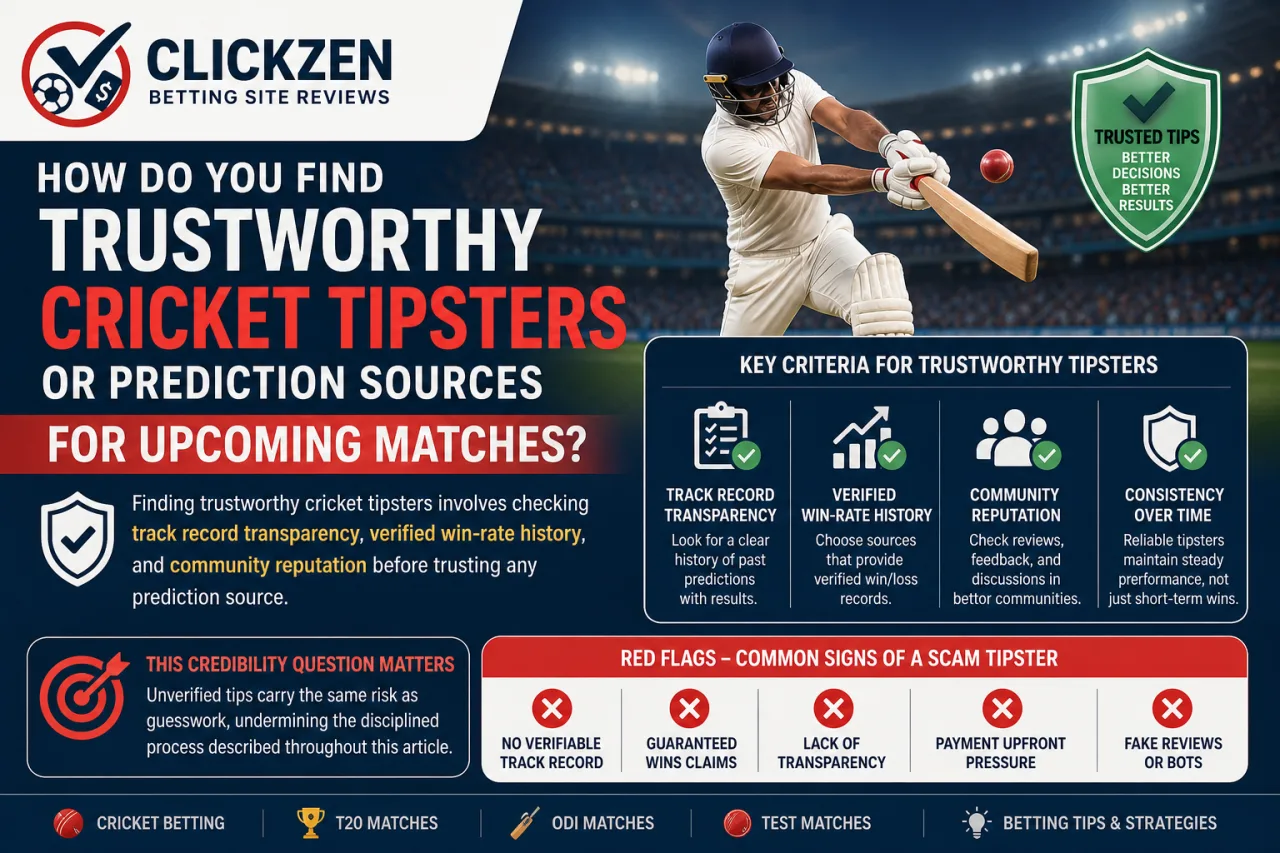
Trustworthy cricket tipsters should be evaluated through transparent historical records, timestamped selections, quoted odds, clear reasoning, sample size, and long-term performance rather than promotional claims alone.
Win rate by itself can be misleading because profitability also depends on the odds attached to each selection. A tipster winning a high percentage of very short-priced bets may perform worse financially than one with a lower strike rate at more favorable prices.
Useful performance information can include:
- Timestamped betting selections
- Odds available when each selection was published
- Total number of recorded bets
- Wins, losses, and void bets
- Profit or loss over a meaningful sample
- Return on investment or yield where accurately reported
Predictions should also include enough reasoning for readers to evaluate whether the argument is based on relevant cricket data.
What Distinguishes a Trustworthy Cricket Tipster from an Unreliable One?
A trustworthy cricket tipster provides evidence that can be checked independently, while an unreliable source often relies on selective results, exaggerated claims, or guarantees.
More credible sources generally:
- Publish selections before the event with clear timestamps.
- Record the odds available when the recommendation was made.
- Keep losing selections visible alongside winning ones.
- Explain the reasoning behind a prediction using relevant match data.
- Report performance over a sufficiently large sample rather than highlighting isolated winning streaks.
Warning signs can include:
- Claims of guaranteed or risk-free sports betting profits.
- Claims involving supposedly “fixed” matches without credible evidence.
- Showing only winning bet screenshots while hiding losses.
- Frequently changing or deleting previous predictions.
- Using extreme urgency to pressure followers into buying tips.
Bettors should verify a tipster’s history against actual results wherever possible rather than relying solely on testimonials or headline win-rate claims.
Are Free Cricket Prediction Sources as Reliable as Paid Ones?
Free cricket prediction sources can be as useful as paid services when they provide transparent reasoning and a verifiable historical record, while paying for predictions does not guarantee greater accuracy.
Public forums, independent analysts, statistical websites, and social-media accounts may provide useful information when their predictions and reasoning remain visible over time. Open discussion can also make it easier for readers to challenge weak analysis or identify inaccurate claims.
Paid services may offer additional research, proprietary models, or convenience, but price alone is not evidence of predictive skill. Some services advertise impressive win rates without providing enough historical information to verify how those figures were calculated.
The same evaluation standard should therefore apply to both free and paid sources: examine their records, quoted odds, sample size, reasoning, and long-term results.
Cross-checking multiple sources can help identify missing information, but bettors should compare the underlying evidence rather than assuming that an outcome becomes more likely simply because several tipsters select it.
How Can Beginners Start Betting on Cricket Responsibly?
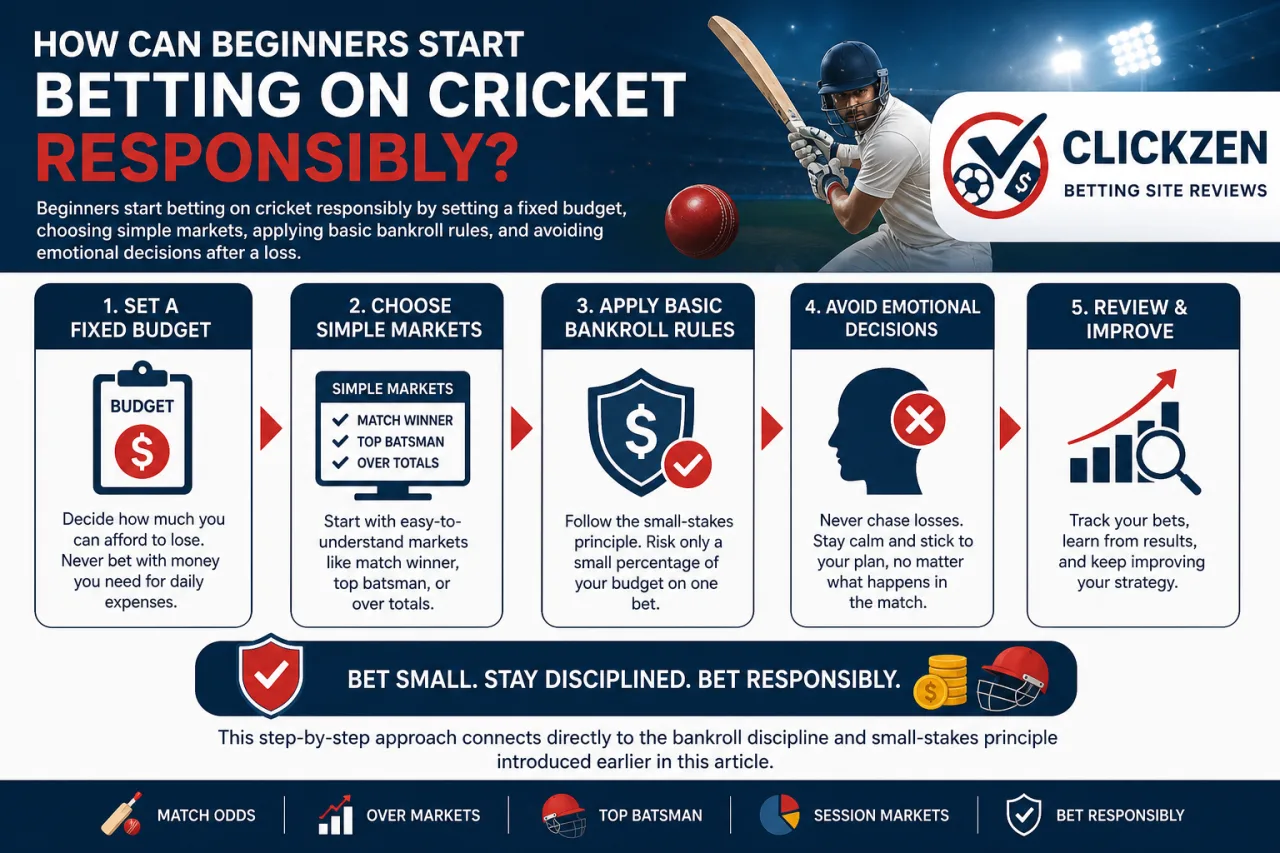
Beginners can approach cricket betting more responsibly by setting a fixed entertainment budget, starting with simple markets, using small stakes, and avoiding emotional decisions after wins or losses.
Understanding the sport should come before experimenting with complex betting strategies. New bettors benefit from learning how common markets and odds work, recording their bets, and evaluating decisions over time rather than reacting to short-term results.
What Are the Basic Rules of Responsible Cricket Betting for Beginners?
Responsible cricket betting involves setting limits, avoiding loss chasing, using only disposable funds, and recognizing signs that gambling is becoming difficult to control.
Setting limits means deciding in advance how much money can be spent and how much can be risked on an individual wager. Once the predetermined limit is reached, betting should stop rather than continue in an attempt to recover previous losses.
Only money that can be lost without affecting essential expenses should be used. Funds needed for rent, bills, food, debt payments, savings, or other financial obligations should not form part of a betting bankroll.
Potential warning signs include:
- Repeatedly exceeding a planned betting budget
- Increasing stakes primarily to recover previous losses
- Borrowing money to gamble
- Hiding gambling activity from people close to you
- Feeling distressed or unable to stop despite negative consequences
Cricket betting should remain an optional form of entertainment rather than a financial plan or source of expected income. Bettors must also meet the legal gambling-age requirement and comply with applicable gambling laws in their jurisdiction.
Beginner Strategy vs Advanced Strategy: What Should New Bettors Avoid?
Beginner betting strategies should prioritize simplicity and controlled stakes, while complex approaches such as live trading and arbitrage require more experience, faster execution, and a detailed understanding of betting mechanics.
Beginner tactics can include:
- Starting with straightforward markets such as match winner or basic player markets.
- Using small, predetermined stakes.
- Completing analysis before the match instead of reacting impulsively to live price movements.
- Recording bets and reviewing results over a meaningful sample.
Live in-play betting can be more difficult because odds change rapidly in response to wickets, boundaries, required run rates, weather, and tactical decisions. Fast-moving prices leave less time to evaluate information and can encourage impulsive betting.
Arbitrage betting attempts to cover all possible outcomes using price differences between bookmakers so that the combined positions theoretically produce a positive return. However, theoretical arbitrage is not completely free of practical risk. Odds may change before all wagers are placed, stakes can be restricted or rejected, markets may be voided, and bookmakers can apply different settlement rules.
New bettors should understand these execution risks before attempting complex strategies and should not treat arbitrage or live trading as guaranteed-profit methods.
What Advanced Data Can Sharpen Cricket Betting Predictions?
Advanced cricket analysis can incorporate venue history, pitch behavior, player matchup data, weather conditions, dew forecasts, toss tendencies, and other contextual statistics.
These factors can provide information beyond basic team form, but they remain inputs to a probability assessment rather than guaranteed predictors. The usefulness of any dataset depends on its relevance, sample size, reliability, and relationship to the specific betting market.
How Does Pitch and Weather Data Give an Edge in Cricket Betting Analysis?
Pitch and weather data can improve cricket betting analysis by helping bettors adjust expectations for scoring, wickets, bowling effectiveness, and match strategy at a specific venue.
Historical venue data can show whether a ground has tended to produce high or low scores, how teams batting first and second have performed, and whether particular bowling styles have historically been effective. However, historical averages should not be treated as fixed rules because pitch preparation, team strength, weather, and competition format can change.
In multi-day cricket, dry or deteriorating surfaces can increasingly assist spin or create variable bounce as a match progresses. In limited-overs cricket, the condition of the surface and outfield can influence expected scoring rates and the effectiveness of different bowling styles.
Weather also matters. Humidity, rain, wind, cloud cover, and temperature can influence match conditions, although their effects vary between venues.
Heavy dew during evening matches can make the ball more difficult for bowlers to grip and may favor the chasing side in some conditions. However, the effect depends on the venue, pitch, timing, and severity of the dew and should not be assumed automatically.
Toss decisions may also be influenced by expected dew, pitch behavior, weather, and team strategy. Combining these factors can produce a more venue-specific assessment than relying on recent team results alone.
What Is Value Betting and How Does It Differ from Typical Tipster Advice?
Value betting means looking for situations where the available odds imply a lower probability than the bettor’s own evidence-based estimate of the outcome’s chance. The concept focuses on the relationship between probability and price rather than simply predicting which team or player is most likely to win.
For example, decimal odds of 2.50 represent a raw implied probability of 40%. If a bettor independently estimates that the outcome has a 45% chance of occurring, the available price may represent positive expected value according to that estimate.
Expected value can be expressed as:
EV = (Probability of Winning × Net Profit if Won) − (Probability of Losing × Stake)
For example, consider a $100 wager at decimal odds of 2.50 where the bettor estimates a 45% probability of winning. The net profit on a winning wager would be $150.
EV = (0.45 × $150) − (0.55 × $100) = $12.50
Under that probability estimate, the wager has an expected value of +$12.50 per $100 staked. This does not mean the individual wager will win. It means that, if the probability estimate were accurate and similar opportunities could be repeated under comparable conditions, the mathematical expectation would be positive.
A negative EV occurs when the expected loss outweighs the expected profit at the available price. Importantly, the quality of an EV calculation depends heavily on the accuracy of the bettor’s probability estimate.
Typical tipster advice may simply recommend a team or player. Value betting instead asks two separate questions: how likely is the outcome, and is the available price high enough to justify the risk?
Conclusion
Smarter cricket betting depends on a repeatable process rather than guaranteed predictions. Understanding match formats, evaluating relevant cricket data, converting odds into implied probabilities, checking the quality of prediction sources, and maintaining strict bankroll discipline can support more informed decisions. Advanced information such as pitch behavior, weather, player matchups, and expected-value calculations can refine analysis, but no dataset or strategy removes uncertainty. Betting should remain controlled, legal, and entertainment-focused, with every wager evaluated according to both probability and price.
Zorvan Hale is a Betting & Casino Analyst at ClickZen with over eight years of experience. He provides objective reviews of global betting platforms, focusing on withdrawal terms, KYC processes, and real user experience to help you make informed and safer betting decisions.


Top Rated Casinos

FanDuel is a regulated North American betting and gaming brand offering Sportsbook, Casino, Fantasy, Racing and prediction markets, with product availability determined by state or provincial regulations.

DraftKings is a regulated North American sportsbook and gaming operator offering sports betting, live wagering, casino games, daily fantasy sports, Pick6 and horse racing in eligible jurisdictions.

Fanatics Sportsbook is a regulated U.S. betting platform available in 23 states plus Washington, D.C., offering major sports markets, live betting, same game parlays and a distinctive FanCash rewards ecosystem.


ClickZen is an independent betting information and review website providing clear, practical insights into sportsbooks, online casinos, betting apps, bonuses, and related services for a global audience.
This website is intended for users aged 18 and over. Gambling can be addictive, so please gamble responsibly. The content on this website is for informational purposes only.
About ClickZen