
Want to bet smarter on basketball? Discover practical basketball betting tips on odds, bankroll management, and top strategies before you place your next wager.
Basketball Betting Tips: A Beginner’s Guide to Smarter Wagers

Smarter basketball wagers come from understanding odds, managing a bankroll, and checking key stats before every bet. Beginners who apply these fundamentals avoid impulsive picks and treat betting as a long-term skill rather than a guessing game.
Basketball betting odds show both the implied probability of an outcome and the potential payout for a winning bet. Reading the format correctly, whether decimal, fractional, or American, helps bettors understand how much profit a stake can generate relative to the risk taken.
Moneyline, spread, totals, and player props are the four main basketball betting markets suited to beginners. Each market carries a different level of complexity, so starting with simpler bets like moneyline or totals reduces early confusion.
Bankroll management means setting a fixed betting budget and staking only a small, consistent percentage per wager. Common beginner mistakes include chasing losses and betting on emotion rather than data, both of which erode a bankroll quickly, so wagering only a small, consistent portion of a bankroll on each bet is a safer approach.
ClickZen breaks down these fundamentals step by step, starting with the most important basketball betting tips every beginner should know before placing a first wager. Readers must be of legal gambling age and should always check local gambling laws before betting.
What Are the Most Important Basketball Betting Tips for Beginners?

Four core beginner strategies define smarter basketball wagers: reading odds correctly, choosing suitable markets, managing a bankroll, and researching before betting. This overview connects the fundamentals already outlined, odds literacy and market selection, with the discipline of consistent staking and pre-bet research covered next. Together, these habits shift betting from impulsive guessing toward a repeatable, informed process for evaluating each game.
Why Is Understanding the Basics Essential Before Placing a Bet?
Yes, understanding basketball betting fundamentals before wagering real money is essential because skipping odds, market, and bankroll basics directly causes preventable losses. This section connects back to the four core habits above and explains why each one protects a beginner’s stake rather than exposing it to avoidable risk.
Three gaps commonly appear when bettors skip preparation:
- Misreading odds leads to underestimating the actual risk on a bet, since a bettor cannot judge whether a payout matches the implied probability without knowing the odds format.
- Picking unfamiliar markets like player props before mastering moneyline or totals adds complexity that increases the chance of a poorly informed pick.
- Ignoring bankroll limits allows a single loss or a losing streak to wipe out funds that a fixed staking plan would have preserved.
Learning these fundamentals first turns each wager into an informed decision rather than a reaction to a hunch or a recent result. Treating preparation as a prerequisite, not an afterthought, keeps early losses smaller and keeps the betting process sustainable over time.
What Key Stats Should You Check Before Betting on a Basketball Game?
Six core stats define pre-bet research: team form, injuries, home/away performance, pace, head-to-head history, and rest days. These figures build on the bankroll and market fundamentals covered earlier, giving a concrete checklist to run through before locking in a wager.
- Team form: recent win-loss results reveal whether a squad carries momentum or is trending downward.
- Injuries: absent starters or key rotation players shift scoring output and matchup advantages.
- Home/away performance: teams often post different results depending on whether they play on home or away court.
- Pace: a team’s possessions per game influences total points scored and affects totals bets.
- Head-to-head history: past matchups between the two teams expose stylistic advantages or recurring patterns.
- Rest days: fewer days between games raises fatigue risk, particularly on the second night of a back-to-back schedule.
Checking each factor before a bet replaces guesswork with a documented review process, aligning directly with the pre-bet research discipline outlined in the core beginner strategies above.
How Do You Read and Use Basketball Betting Odds Correctly?
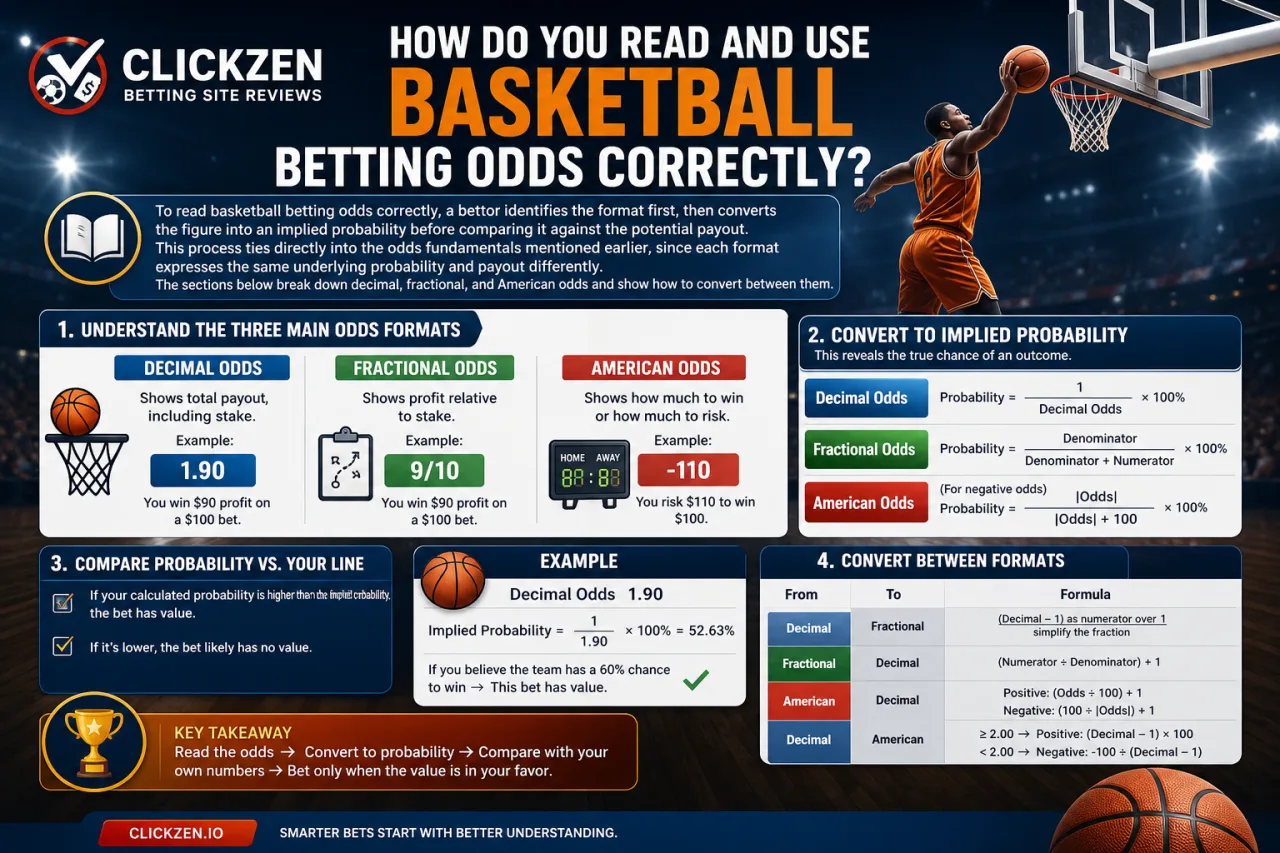
To read basketball betting odds correctly, a bettor identifies the format first, then converts the figure into an implied probability before comparing it against the potential payout. Decimal, fractional, and American odds each express the same underlying probability and payout in a different way, and this ties directly into the odds fundamentals mentioned earlier. The sections below break down each format and show how to convert between them.
What Is Implied Probability and How Do You Calculate It From Odds?
Implied probability is the conversion of betting odds into a percentage chance that a given outcome occurs, expressed on the same scale sportsbooks use to set payouts. This figure builds directly on the odds-reading process outlined earlier, turning decimal, fractional, or American odds into a single comparable number.
For decimal odds, the formula divides 1 by the decimal value, then multiplies by 100 to get a percentage. Decimal odds of 2.00 produce an implied probability of 50%, since 1 divided by 2.00 equals 0.50.
For American odds, negative numbers use the formula |odds| / (|odds| + 100), while positive numbers use 100 / (positive odds + 100). Using the standard American odds formula, odds of -150 convert to a 60% implied probability, while odds of +150 convert to a 40% implied probability.
Comparing this calculated percentage against a bettor’s own estimate of an outcome’s likelihood identifies whether a wager offers value, tying directly back to the odds-format basics already covered.
How Do Odds Differ Between Sportsbooks and Why Does Line Shopping Matter?
Sportsbooks price the same basketball game differently because each book sets its own odds based on its own model, exposure, and betting volume, and comparing these lines, known as line shopping, captures better long-term value on every wager. This variance ties directly into the implied probability calculations covered above, since even a small shift in the odds format changes the payout on an identical outcome.
Odds variance across books stems from a few practical factors:
- Books adjust lines to balance action on both sides of a bet, so heavy public money on one team can shift a line away from the market average.
- Books apply different margins, commonly called vig or juice, which changes the payout offered on the same outcome.
- Books update at different speeds after injury news or lineup changes, leaving gaps between a fast-moving line and a slower one.
Line shopping means checking the odds for the same game across multiple sportsbooks before placing a bet, then choosing the version offering the higher payout or the more favorable spread. Over many wagers, consistently picking the best available number on each bet compounds into a meaningfully larger return compared to using a single book by default. This habit fits directly alongside the bankroll and market fundamentals outlined earlier, turning odds comparison into another repeatable step in the pre-bet process.
Which Basketball Betting Markets Are Best for Beginners?

Moneyline and totals bets rank as the best basketball betting markets for beginners, since both markets require reading only one variable, a winner or a combined score, rather than a spread margin or a specific player stat. This builds directly on the market overview covered earlier, narrowing the four core markets down to the two that fit a newcomer’s first wagers. The following breakdown covers why simplicity matters and how each entry-level market compares against spreads and player props.
Moneyline vs Point Spread: Which Bet Type Should Beginners Start With?
Moneyline wins on simplicity for beginners, while point spread wins on payout balance, making moneyline the more practical starting market. A moneyline bet only requires picking the team that wins the game outright, with no margin to calculate. A point spread bet requires picking a team to cover a projected margin set by the sportsbook, adding a layer of analysis beyond simply judging the stronger side.
Moneyline suits beginners because the bet resolves on a single outcome, win or lose, which keeps the decision-making process straightforward. The tradeoff comes in payout structure: heavy favorites return smaller profits relative to the stake, while underdogs offer larger payouts tied to lower implied probability.
Point spread bets level the payout across mismatched teams by requiring the favorite to win by more than the set margin, or the underdog to lose by less than that margin. This structure rewards a more nuanced read of team strength and matchup context, which raises the risk of misjudging a close game.
Beginners narrowing their first wagers gain the clearest entry point from moneyline bets, then move to point spreads once comfortable reading team strength beyond just win-loss outcomes.
What Are Totals (Over/Under) Bets and How Do They Work?
A totals bet, also called an over/under bet, asks a bettor to predict whether the combined final score of both teams lands above or below a single number set by the sportsbook. This market fits directly into the entry-level lineup already established alongside moneyline betting, since it also resolves on one clear variable rather than a margin or an individual player stat.
The sportsbook sets a projected combined score before the game, and the bettor simply wagers “over” if they expect the two teams to score more than that number combined, or “under” if they expect less. Neither team winning nor losing factors into the result, only the total points scored by both sides added together.
For example, if a sportsbook sets the total at 210.5 points for a given matchup, a bettor taking the over wins if the final combined score reaches 211 or higher, while a bettor taking the under wins if the combined score finishes at 210 or lower.
This structure connects directly to the pace statistic covered in the pre-bet research checklist earlier, since teams that play at a faster pace tend to produce higher combined scores, making pace a useful reference point when deciding between an over or under pick.
What Are Player Props and Are They Suitable for Beginners?
Player props are bets placed on an individual player’s statistical output, such as points, rebounds, or assists, rather than on the game’s overall outcome, and they suit beginners less than moneyline or totals bets due to the added research burden. This market builds on the entry-level lineup covered earlier, adding a layer of individual analysis beyond team-level outcomes.
A player prop sets a projected number for a single stat category, points scored, rebounds grabbed, or assists recorded, and the bettor picks over or under that line. Unlike moneyline or totals, this market depends on one player’s health, role, and matchup rather than a full team’s performance.
Three factors raise the risk level for beginners:
- Injury status shifts a player’s minutes and scoring role with little notice before tip-off.
- Matchup difficulty against a specific defender changes a player’s typical output game to game.
- Foul trouble or blowout scores can shorten playing time and cap a stat line regardless of season averages.
Beginners moving toward player props benefit from mastering moneyline and totals first, since prop bets demand tracking individual data points beyond the team-level stats already outlined in the pre-bet research checklist.
How Do You Manage Your Bankroll When Betting on Basketball?
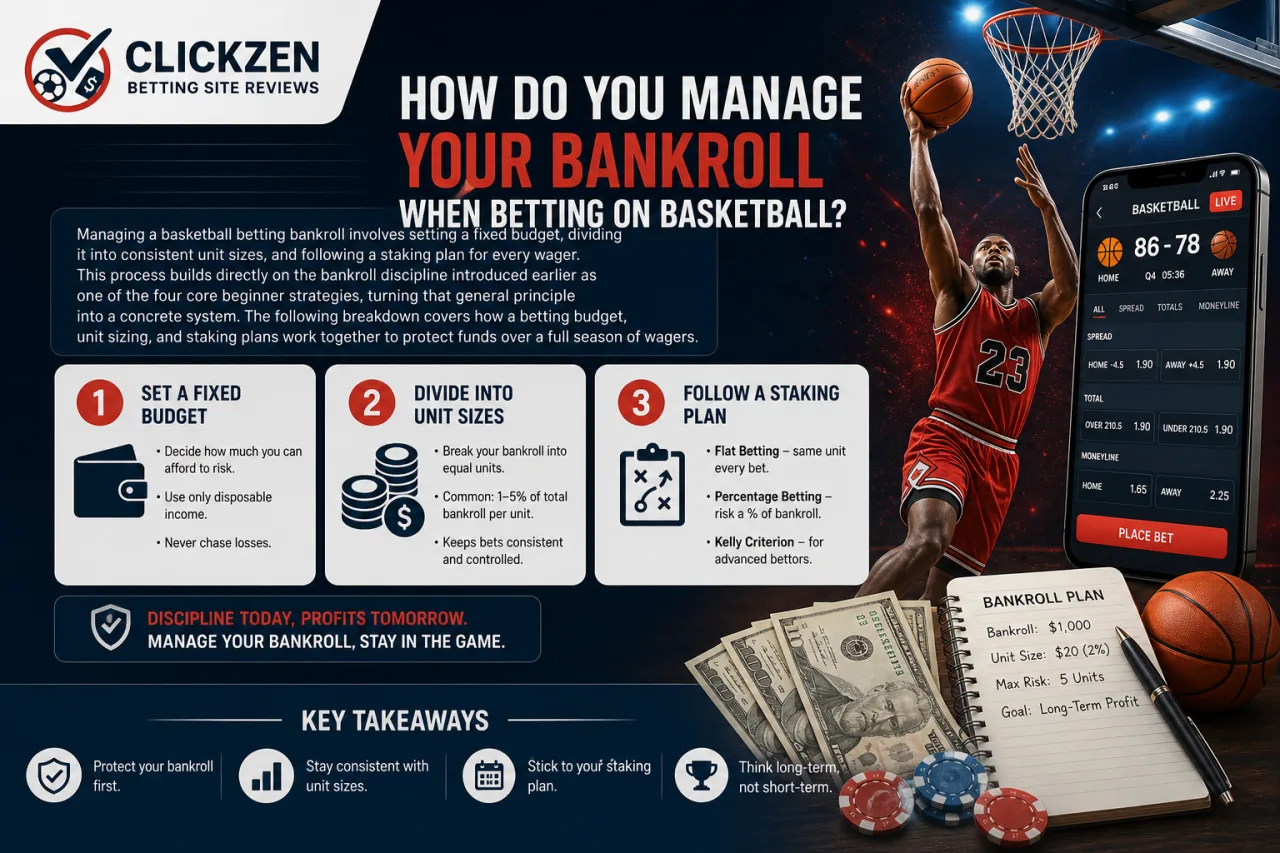
Managing a basketball betting bankroll involves setting a fixed budget, dividing it into consistent unit sizes, and following a staking plan for every wager. This process builds directly on the bankroll discipline introduced earlier as one of the four core beginner strategies, turning that general principle into a concrete system. The following breakdown covers how a betting budget, unit sizing, and staking plans work together to protect funds over a full season of wagers.
How Much of Your Bankroll Should You Bet Per Game?
Beginners are often encouraged to commit only a small, consistent portion of a total bankroll, commonly around 1% to 3%, to a single basketball bet, keeping any one loss from meaningfully damaging the overall betting budget. This figure builds directly on the fixed budget and unit sizing approach introduced above, translating that principle into a specific staking range.
Flat betting applies this same percentage to every wager regardless of how confident a bettor feels about the outcome. A bettor using flat staking on a $1,000 bankroll at 2% per bet places $20 on every wager, whether the pick is a heavy favorite or a close matchup.
Variable staking adjusts the wager size within that 1% to 3% range based on the strength of the research behind a pick, raising the stake slightly on higher-confidence bets and lowering it on more uncertain ones. This method demands more discipline, since inflating a stake too far on a single “sure thing” undermines the entire purpose of a staking plan.
Flat betting suits bettors who want a simple, repeatable system with minimal decision-making, while variable staking suits bettors who track results carefully enough to justify adjusting stakes with evidence rather than instinct. Both approaches connect back to the fixed budget and consistent unit sizing already outlined, keeping the overall bankroll protected across a full season of games.
What Are the Most Common Bankroll Mistakes Beginners Make?
Five bankroll mistakes appear most often among beginners: chasing losses, overbetting favorites, ignoring bankroll limits, betting emotionally, and skipping record-keeping. Each mistake undermines the staking discipline outlined above, turning a structured bankroll plan into a source of avoidable losses.
- Chasing losses drives a bettor to increase stake size after a defeat, hoping to recover money quickly rather than sticking to the fixed unit size already set.
- Overbetting favorites pushes a bettor to place an oversized wager on a heavily favored team, ignoring the smaller payout that favorite already carries relative to the risk.
- Ignoring bankroll limits means placing a wager larger than the agreed percentage per bet, exposing the entire betting budget to a single outcome.
- Betting emotionally means picking a team based on loyalty or a recent highlight rather than the pre-bet research already covered, such as team form or injuries.
- Skipping record-keeping means failing to track wins, losses, and stake sizes, removing the data a bettor needs to spot a mistake pattern before it repeats.
Avoiding these five patterns keeps the flat or variable staking plan described earlier functioning as intended across a full season of basketball bets.
What Advanced Situational Factors Can Give Bettors an Edge in Basketball Betting?
Advanced situational factors that can provide additional betting context include back-to-back fatigue, travel schedules, referee tendencies, and live in-play dynamics, layered on top of the pace and rest-day basics already covered. These angles reward bettors who dig beyond the standard pre-bet checklist, spotting value that beginners scanning only team form or injuries typically miss.
Back-to-back games and heavy travel schedules can affect team performance by compounding the fatigue risk already flagged under rest days, potentially influencing scoring and defensive intensity on the second night. A team playing its second game in two nights, especially after significant travel, may have less recovery time than a well-rested opponent. Bettors experienced in this angle track difficult travel stretches alongside player workload, rotation depth, and other matchup factors rather than treating schedule fatigue as a standalone predictor.
Referee assignments can provide additional context because officiating crews may differ in foul and free-throw patterns over time. A crew with a history of calling more fouls may contribute to more free throws and stoppages, but referee data should be considered alongside team pace, matchup conditions, and other factors rather than used as a standalone predictor of the total.
Live betting means placing wagers after a game has started, with odds updating continuously as the score, pace, and momentum shift in real time. This dynamic extends the moneyline and totals markets already introduced into an in-game format. Bettors watching for a slow start from a strong favorite, or a pace shift after a lineup change, use live odds to find a better number than the pre-game line offered, applying the same odds-reading and bankroll discipline covered earlier to fast-moving in-game decisions.
How Does Live (In-Play) Basketball Betting Differ From Pre-Game Betting?
Live basketball betting wins on real-time reaction to game flow, while pre-game betting wins on preparation time, making the two formats suited to different decision-making speeds. Pre-game odds can move before tip-off, but the odds accepted on a confirmed wager generally remain fixed for that bet, while pre-game betting gives bettors considerably more time to apply the odds-reading, market selection, and bankroll steps already outlined. Live odds shift continuously throughout the game as the score, pace, and momentum change, compressing the same research process into a matter of seconds.
Game state becomes especially important in live betting in a way pre-game analysis cannot fully capture. A slow start from a favored team, a hot shooting stretch, or a sudden run swings live odds well beyond the original pre-game line, creating value for a bettor who reads the shift correctly before the number adjusts. Pre-game betting offers no equivalent, since the line reflects only pre-tip expectations built on team form, injuries, and rest days.
Speed of decision-making separates the two formats most sharply. Pre-game bettors compare odds across sportsbooks and review stats at their own pace, while live bettors evaluate a fast-moving number with the game already in progress, leaving far less room to double-check a pick before it locks in.
Do Referee Assignments and Travel Fatigue Really Affect Basketball Betting Outcomes?
Yes, referee assignments and travel fatigue affect basketball betting outcomes, since both factors shift scoring patterns and team performance beyond what standard pre-bet stats capture. This confirms the situational edges already introduced above, connecting foul-calling tendencies and schedule fatigue directly to betting value on totals and moneyline bets.
Three reasons support this conclusion:
- Foul-heavy officiating crews push more free-throw attempts and stoppages into a game, nudging a total higher than a crew known for letting play flow.
- Back-to-back scheduling compounds the fatigue risk already covered under rest days, often producing slower rotations and softer defensive intensity in the second game.
- Heavy travel across time zones adds physical strain on top of a compressed schedule, further depressing a road team’s output beyond what rest days alone predict.
Bettors factoring in these two variables read situational value that a standard checklist of team form, injuries, and pace alone misses.
Conclusion
Smarter basketball wagering rests on four connected habits: converting odds into implied probability, favoring moneyline and totals bets while building experience, protecting a bankroll through fixed unit sizing, and reviewing team form, injuries, pace, and rest before every pick. Layering in line shopping, referee tendencies, and travel fatigue sharpens that foundation further for bettors ready to look beyond basic stats. A beginner following this structured process, rather than reacting to hunches or recent results, turns each wager into a documented decision and builds betting into a sustainable, long-term skill instead of a guessing game.
Marcus Zeno is the CEO and Lead Betting Analyst at ClickZen. With over eight years of experience in the iGaming industry, he specializes in evaluating global sportsbooks, mobile betting apps, and bonus terms. Marcus is dedicated to cutting through promotional noise to provide bettors with transparent, fact-based insights.

Top Rated Casinos

FanDuel is a regulated North American betting and gaming brand offering Sportsbook, Casino, Fantasy, Racing and prediction markets, with product availability determined by state or provincial regulations.

DraftKings is a regulated North American sportsbook and gaming operator offering sports betting, live wagering, casino games, daily fantasy sports, Pick6 and horse racing in eligible jurisdictions.

Fanatics Sportsbook is a regulated U.S. betting platform available in 23 states plus Washington, D.C., offering major sports markets, live betting, same game parlays and a distinctive FanCash rewards ecosystem.


ClickZen is an independent betting information and review website providing clear, practical insights into sportsbooks, online casinos, betting apps, bonuses, and related services for a global audience.
This website is intended for users aged 18 and over. Gambling can be addictive, so please gamble responsibly. The content on this website is for informational purposes only.
About ClickZen